

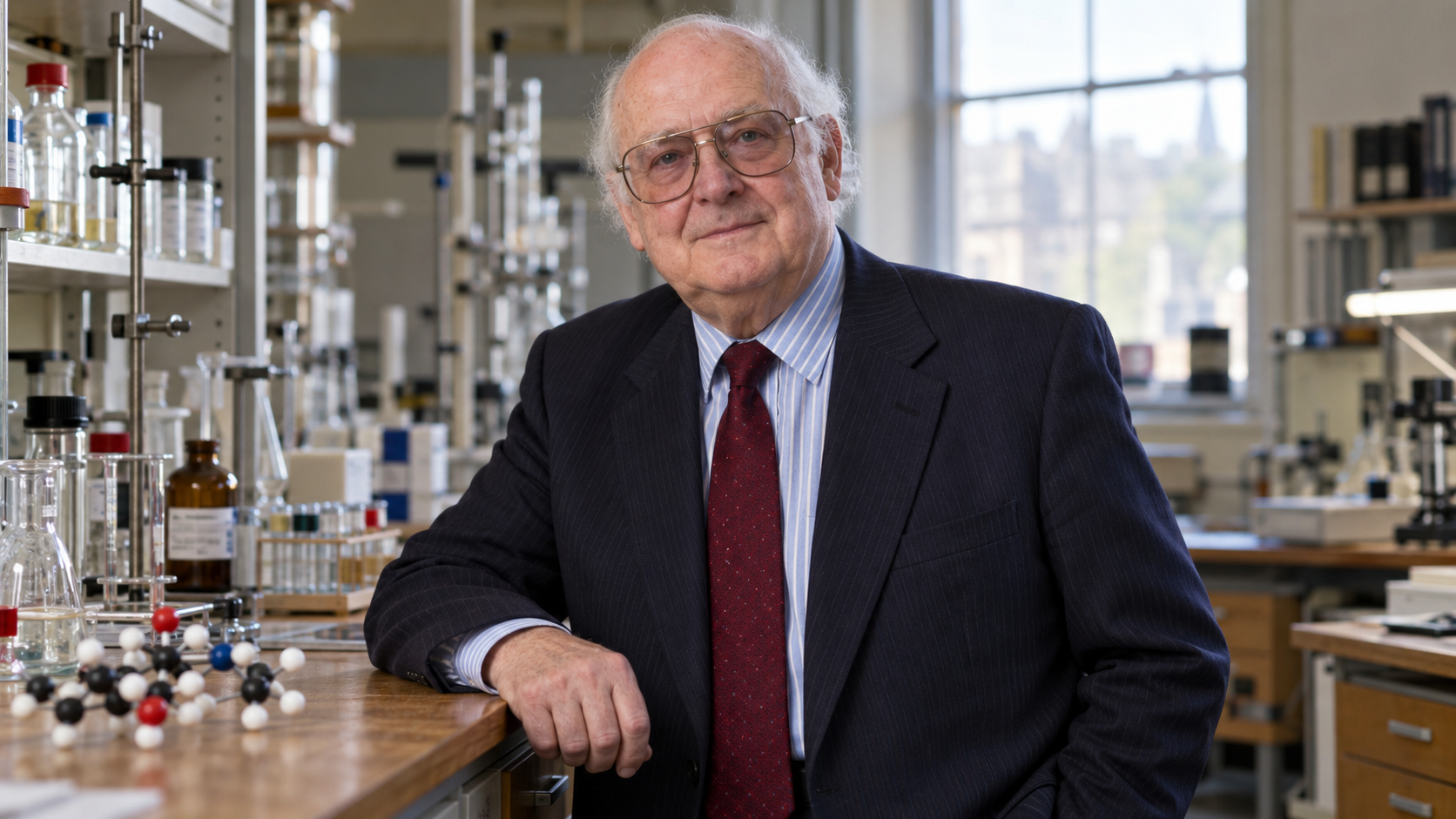
“Analytical pharmacology has got an important and exciting future”
The future of medicine depends partly on how well a promising idea survives contact with a living system. James W. Black closed his Nobel lecture with an optimistic statement about analytical pharmacology, the discipline he used to investigate how drugs act. Delivered in Stockholm on December 8, 1988, the lecture discussed the relationship between chemical messengers, receptors, and experimental methods. Its ending acknowledged both opportunities and dangers. Black’s confidence was therefore rooted in work that still needed doing, rather than a prediction that new instruments would automatically solve difficult biological problems. For this May entry, the final line offers a glimpse of a researcher looking ahead after receiving extraordinary recognition. It also raises a lasting question: what makes enthusiasm about a possible medicine scientifically responsible? An attractive explanation begins a process of inquiry; it cannot complete that process on its own.
The National Museums Scotland account of Black’s career provides the practical background. His work led to propranolol and cimetidine, medicines associated with different clinical problems but developed through attention to the actions of chemical signals. His career crossed universities and industry, with periods of sustained investigation rather than a single sudden revelation. The museum’s collection also records the scientific imagination behind those achievements. Such a history can be read as an invitation to value patient experimental work alongside celebrated breakthroughs. A discovery is often remembered through a name or an award, while the everyday labor disappears from view. Asking a precise question, recognizing an unexpected result, and reconsidering an assumption are less dramatic activities. They remain necessary when a project moves from a persuasive concept toward an understanding that other investigators can examine. Recognition at the end should not obscure that uncertain middle.
Black’s closing discussion gives this optimism a demanding boundary: experimental models must remain adequate to the questions being asked. A simplified view may reveal an important interaction while leaving other relationships unresolved. For readers outside a laboratory, that distinction helps explain why an interesting finding is different from an established clinical option. The appeal of a novel approach should make us curious about the evidence, the conditions under which it was observed, and the questions still open. It should not pressure patients to change medicines or infer that a celebrated scientist’s remark endorses a particular product. The quotation concerns a field of investigation and its possibilities. Its enduring value lies in the combination of aspiration and scrutiny. Health research needs room for imaginative proposals, but it also needs people willing to ask what those proposals actually explain and where they fail.
It is the final line of Black’s 1988 Nobel lecture, immediately before the references. The lecture page confirms December 8 as the delivery date. May 15 is this series’ calendar position.
The preceding discussion identifies the realism of models and the complexity of experimental tests as limiting factors. Those qualifications belong with the hopeful ending.
The museum describes his investigation of chemical signals and how their effects might be blocked. Propranolol and cimetidine addressed different problems, while reflecting a deliberate approach to drug discovery.
This historical connection explains his interest in analytical methods. It does not supply an instruction about using either medicine, whose suitability depends on a separate clinical assessment.
A useful question is what a finding demonstrates under the actual conditions of the study. An exciting concept and a sufficiently tested clinical intervention represent different stages of knowledge.
Black’s example supports curiosity accompanied by critical examination. The post uses that history to explore scientific judgment, without recommending an experimental treatment or forecasting a particular breakthrough.
Explore more "Quotes of The Day"
Discover more notable quotes from influential voices across politics, science, business, technology, sports, and culture. Each quote offers insight into how ideas, beliefs, and decisions shape the world around us.