

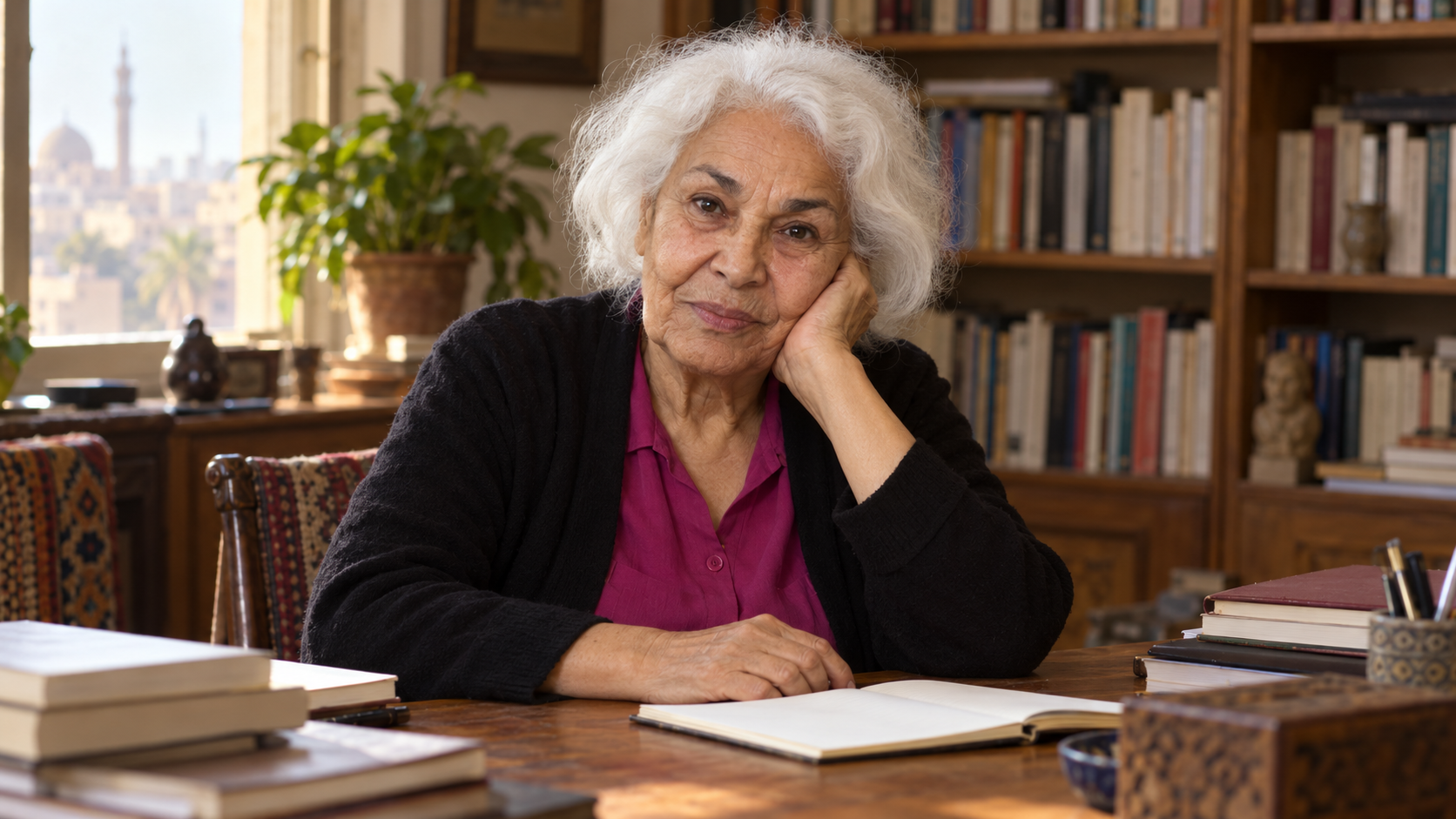
“My principle is to unveil the mind.”
Nawal El Saadawi’s short statement has a sharper context than its simplicity might suggest. In an interview conducted by The Cairo Review on April 8, 2018, the Egyptian physician and writer was discussing women’s freedom, resistance, and the social meanings attached to their bodies. Her answer challenged the idea that liberation could be measured by how a woman appeared. The closing sentence redirected attention to thought. Read in a health series, it invites reflection on who gets to describe a person’s body, whose explanation is accepted, and whether the person most affected has room to question those descriptions. This is a reading of her political and feminist argument, rather than a claim that she offered a technique for managing stress. Her concern was freedom to think within structures that could constrain both bodily experience and public expression.
Her medical background matters to that argument. In the same interview, El Saadawi explains that examining patients contributed material to her writing. In a separate Dialogue Talk conversation, she recalls village practice and the initial resistance she encountered as a woman doctor. Those accounts connect her literary voice to encounters where gender, trust, and illness were present together. They do not make her political views a universal description of every patient’s experience. Instead, they help us understand why a physician might see questions about power as relevant to the body. An explanation of suffering can be incomplete when it treats the person as detached from family expectations, economic dependence, or the conditions under which speaking becomes possible. Critical thought asks whether an accepted explanation has left something important outside the frame.
The quotation is also useful because it resists turning another person’s appearance into proof of what they believe. A reader cannot know someone’s agency simply by looking at clothing, habits, or the way that person speaks in an unfamiliar setting. Understanding requires listening to the person’s own account and recognizing that agreement may have more than one meaning. This interpretation does not settle the debates in El Saadawi’s work, nor does it ask every reader to adopt her entire position. It preserves the challenge contained in the sentence: examine the assumptions that guide judgment before making someone else’s life fit them. For health, that challenge can be expressed through a practical question about attention. Have we made room for the person’s thinking, or have we decided what their body must mean before they can explain it?
The Cairo Review asked El Saadawi about resistance and sexual politics. Her answer questioned measures of liberation based on women's appearance, then ended with the sentence featured here.
The exchange supplies the statement’s particular meaning. They belong to a feminist argument about thought and power, and should not be detached from it to create a generic slogan about mental calm.
El Saadawi told the interviewers that medical study and patient encounters provided material for her fiction and nonfiction. Her writing drew attention to experiences that could cross the boundaries between bodily illness and social life.
Her separate recollection of village practice describes resistance to a woman serving as a doctor. Read beside the quotation, it helps explain her interest in the authority granted to some voices and withheld from others.
One implication of the quotation is that outward appearance cannot give a complete account of another person's freedom. The individual's own understanding matters when we try to interpret choices and constraints.
This is an editorial reflection, not a diagnosis of anyone's beliefs or a summary of all women's experiences. Its value lies in slowing down a judgment long enough to make room for a voice.
Explore more "Quotes of The Day"
Discover more notable quotes from influential voices across politics, science, business, technology, sports, and culture. Each quote offers insight into how ideas, beliefs, and decisions shape the world around us.