

On This Day in Tech: September 12, 1958
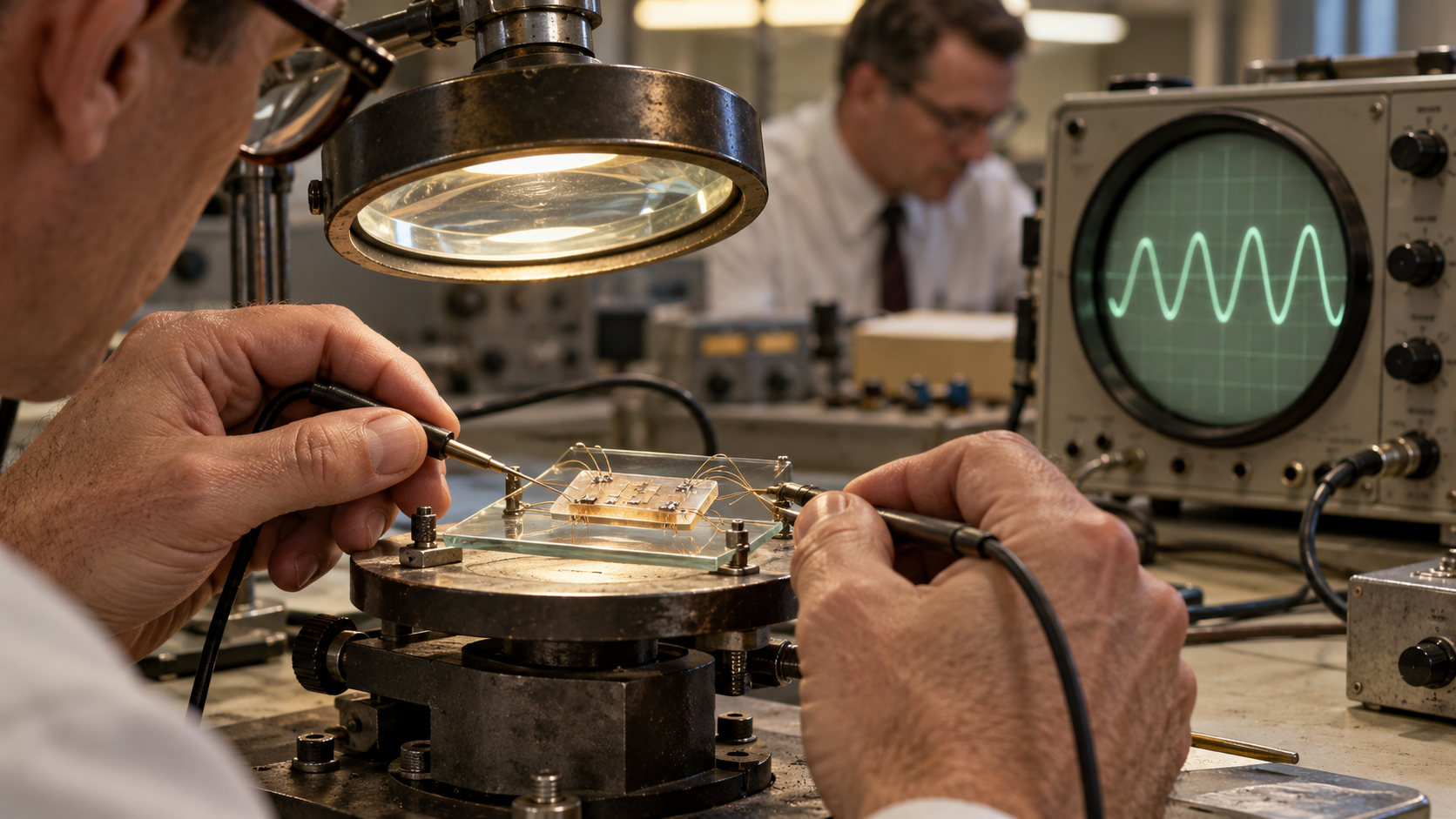
On September 12, 1958, engineer Jack Kilby demonstrated a working integrated circuit in a Texas Instruments laboratory in Dallas. His experimental device was a tiny sliver of germanium that incorporated the active and passive elements of a phase-shift oscillator. Fine gold wires connected the elements so that the circuit produced a waveform on laboratory test equipment. The prototype looked rough, but its successful operation supported Kilby’s central claim: a useful electronic circuit could be formed from a single piece of semiconductor material instead of being assembled from many separately manufactured components.
Electronics manufacturers were then confronting what engineers called the tyranny of numbers. More capable equipment required more transistors, resistors, capacitors, and soldered connections. As component counts rose, circuits became harder to assemble, larger, and more vulnerable to a single failed joint. Texas Instruments hired Kilby in 1958 to work on miniaturization. Because he was new and had not accrued vacation time, he remained in the lab during the company’s summer shutdown. There he developed the idea that different circuit functions could be created in one semiconductor body, reducing the need for numerous discrete parts. Technicians Pat Harbrecht and Tom Yeargan helped Kilby assemble and test the experimental hardware.
The September 12 test was a proof of concept, not a production-ready chip. Kilby’s germanium oscillator combined a transistor, a capacitor, and resistive elements, while its delicate flying wires were attached by hand. He later recorded the successful demonstration in his laboratory notebook and filed a patent application for miniaturized electronic circuits in February 1959. At Fairchild Semiconductor, Robert Noyce independently developed a silicon integrated-circuit approach using the planar process and deposited metal interconnections. That method addressed manufacturing problems left by Kilby’s hand-wired prototype, which is why historians generally recognize Kilby and Noyce as co-inventors of the integrated circuit.
Integrated circuits soon moved from laboratory demonstrations into military, space, industrial, and consumer systems. Manufacturing improvements placed more functions on each chip while lowering size, cost, and power use, making practical everything from digital watches and calculators to computers, medical devices, and communications networks. Kilby’s 1958 circuit contained only a handful of components and did not resemble the densely patterned silicon chips now made by photolithography. Its significance was more fundamental: it showed that integration worked. The demonstration turned miniaturization from a packaging problem into a semiconductor design strategy that became the foundation of modern electronics. Kilby’s later work on electronic calculators illustrated how that strategy could move from specialized systems into everyday products.
By the late 1950s, engineers could make reliable transistors but struggled to connect the growing number of parts required by advanced systems. Every separate component and solder joint added size, labor, and another possible point of failure.
Kilby's proposal was to form the transistor, capacitor, and resistive elements from the same semiconductor material. The idea promised to reduce assembly while allowing complete circuit functions to occupy far less space.
The demonstrated circuit was a phase-shift oscillator built on germanium. When connected to test equipment, it generated a repeating electrical waveform, showing that several functions made in one semiconductor body could operate together.
Its fine gold flying wires and hand-built construction were not suited to economical mass production. The test established feasibility, while later planar silicon methods supplied the more practical route to manufacturing integrated circuits at scale.
Kilby filed his patent application in 1959, and Texas Instruments introduced early solid-circuit products as the industry refined fabrication. Robert Noyce's independent work at Fairchild added a manufacturable interconnection method and helped define the modern chip.
Successive generations placed thousands, then millions and billions, of devices on semiconductor dies. The essential move demonstrated in 1958—building circuit functions together rather than wiring discrete parts one by one—still underlies that progress.
Explore more of "On This Day ..."
Discover more events from the same date across news, politics, technology, sports, and other fields. Each link highlights significant moments that shaped history on different fronts.