

On This Day in Tech: September 11, 1940
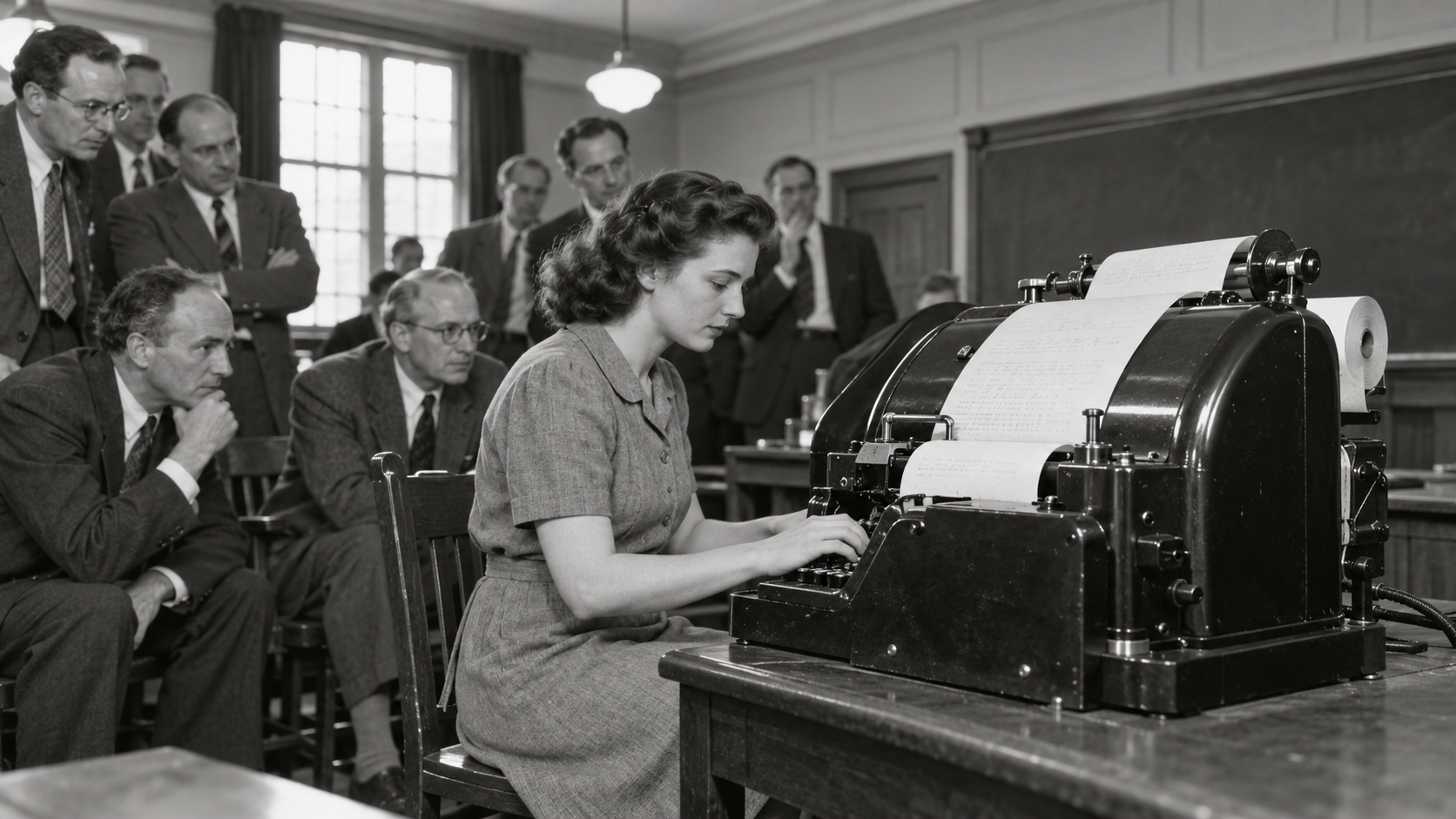
On September 11, 1940, at an American Mathematical Society meeting at Dartmouth College in Hanover, New Hampshire, mathematicians used a teletype terminal to operate a calculator nearly 200 miles away in New York City. The relay-based Complex Number Calculator had been developed at Bell Telephone Laboratories under George Stibitz. During the public demonstration, an operator entered problems proposed by attendees, the terminal sent them over a standard long-distance teletype circuit, and the answers returned to Dartmouth on the same machine. The setup made computation appear at a distance, separating the user from the hardware doing the work.
Stibitz had been exploring the use of telephone relays for arithmetic since the late 1930s. His small kitchen-table Model K proved that relays could add binary digits, and Bell Labs then backed a larger system intended for complex-number calculations needed in communications engineering. The finished machine used roughly 450 relays and could multiply and divide eight-digit complex numbers. It was not a general-purpose computer: its functions were specialized, its logic was electromechanical, and it had neither a stored program nor a screen. Its teletype interface, however, allowed commands and results to travel in coded form over communications equipment that already linked distant offices.
For the Dartmouth demonstration, Bell Labs modified an operator console and connected it to the calculator in New York through a commercial communications line. Meeting participants could submit unfamiliar problems instead of watching a prepared sequence. Results typically came back in less than a minute, slow by later electronic standards but striking for an audience accustomed to desk calculators and hand computation. Bell Labs personnel had tested the connection before the meeting, but September 11 was the public event that showed researchers a working remote service. Historians commonly identify it as the first public demonstration of computer access over a telephone line.
The demonstration did not create a network in the modern sense, and one terminal was not sharing a programmable machine with many simultaneous users. Even so, it established an important architectural idea: the place where a person asks for a calculation does not have to be the place where the computing machinery sits. It also gave an academic audience direct control rather than presenting the calculator as a closed laboratory exhibit. Later time-sharing systems, remote job entry, online terminals, and cloud services would expand that separation with electronic computers and digital networks. The Dartmouth link therefore matters less for its speed than for the relationship it made visible among a remote user, a communications channel, and a centralized computing resource.
The Dartmouth terminal was a teletype, a keyboard-and-printer device already familiar in communications work. Keystrokes were encoded and carried over a long-distance circuit to Bell Labs in New York, where interface equipment passed the instructions to the relay calculator.
After the machine completed a problem, the answer traveled back across the same connection and printed in Hanover. The arrangement reused established telephone infrastructure rather than a purpose-built digital network, which made the demonstration both practical and conceptually revealing.
Bell Labs built the Complex Number Calculator for specialized engineering arithmetic. Its hundreds of electromagnetic relays could handle multiplication and division involving complex numbers, operations that appeared frequently in the analysis of telephone circuits.
The device was impressive but limited. It was not freely programmable, occupied substantial equipment space, and worked at relay speed. The remote session showed access to one specialized service, not the flexible interactive computing that later terminals would provide.
The event placed a usable interface far from the machine itself. That simple separation anticipated later systems in which terminals, personal devices, or web browsers request work from centralized computers located elsewhere.
It also joined two technological traditions that would increasingly converge: automated calculation and telecommunications. The 1940 experiment did not predict every feature of networking, but it offered a clear early example of computing delivered across distance.
Explore more of "On This Day ..."
Discover more events from the same date across news, politics, technology, sports, and other fields. Each link highlights significant moments that shaped history on different fronts.