

On This Day in Tech: September 20, 1954
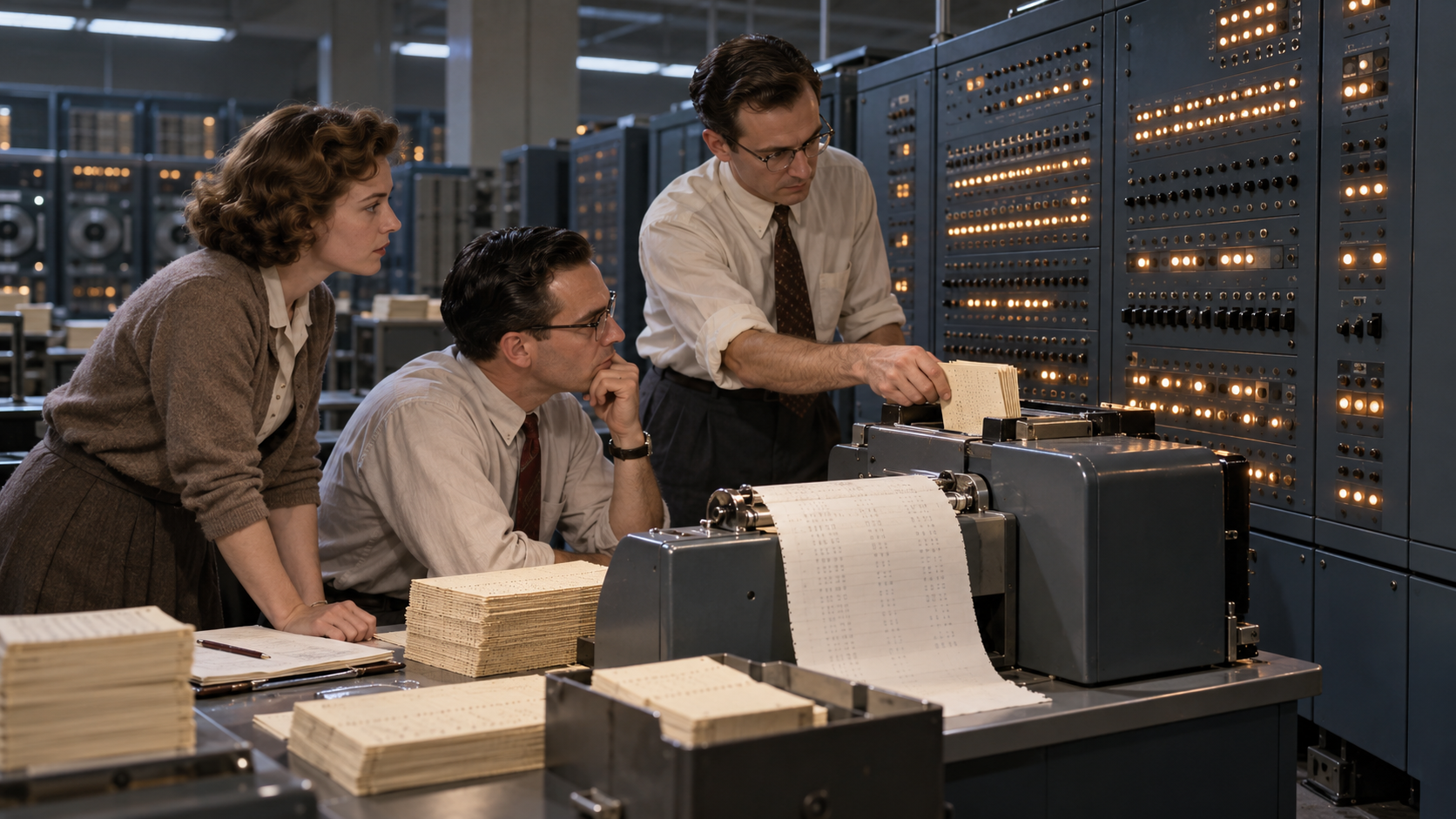
On September 20, 1954, the first successful FORTRAN program ran during IBM’s effort to create a practical high-level language for scientific and engineering work. Mathematician and programmer Harlan Herrick is credited by IBM with running the program, while John Backus led the broader development team. Herrick also helped create the DO loop and GO TO features that became familiar parts of early FORTRAN programming. The milestone came early in a project that would take nearly three years to deliver a production compiler. It nevertheless showed that a programmer could describe a calculation in notation closer to ordinary algebra and have that description translated into instructions a computer could execute.
Programming a mid-1950s computer usually meant writing detailed numerical machine instructions or assembly-like code tied closely to one model’s hardware. The process was slow, expensive, and difficult to debug. Backus, who had already worked on IBM’s Speedcoding system, proposed what became the IBM Mathematical Formula Translating System. FORTRAN, short for formula translation, was aimed at scientists and engineers who wanted to express formulas, loops, and data operations without managing every storage location and processor instruction themselves. IBM assembled a varied team whose members contributed language features, mathematical analysis, and techniques for producing efficient machine code.
The September 20 run did not mean FORTRAN was ready for customers. The team still had to define the language, write documentation, and construct an optimizing compiler for the IBM 704. Optimization was crucial because many programmers doubted automatically generated code could approach the speed of carefully hand-written routines. Team members often tested at night, when they could obtain time on scarce mainframe equipment. IBM published a programmer’s reference manual in 1956 and released the first compiler in 1957. Its output proved fast enough to overcome much of the skepticism, while programs became dramatically shorter and quicker to create.
FORTRAN spread through laboratories, universities, manufacturers, and government agencies, especially where numerical performance mattered. It helped make programming a tool that domain specialists could use directly and made the compiler a central layer between human ideas and computer hardware. The language evolved through standardized versions while retaining a large body of scientific code. Modern weather prediction, engineering simulation, and high-performance computing still include Fortran programs descended from that work. The successful 1954 test was modest compared with the finished system, but it marked an early practical step toward software that could travel above the details of a particular machine and make computing accessible to many more problem solvers. It also set a demanding precedent: higher-level code had to deliver both programmer productivity and credible machine performance.
Early programmers spent much of their time selecting memory locations and writing instructions in forms closely matched to the machine. That work demanded scarce expertise and made even a small change laborious.
FORTRAN let users express numerical relationships in algebra-like statements. A compiler then handled the translation, opening programming to scientists and engineers who understood their problems but did not want to handcraft every machine operation.
The successful 1954 program was an early project milestone. IBM's team still faced years of work before the complete FORTRAN compiler for the IBM 704 became available to customers in 1957.
The largest technical challenge was performance. The compiler had to generate code efficient enough to persuade experienced programmers that convenience would not impose an unacceptable speed penalty on expensive mainframe calculations.
FORTRAN quickly became important in scientific and engineering organizations, and standardization allowed the language to evolve beyond its original IBM implementation. Successive versions added modern structures while preserving numerical strengths.
Decades of validated scientific software give Fortran continuing value in weather, climate, physics, and engineering workloads. Its longevity reflects both the quality of the original compiler effort and the cost of replacing trusted computational models.
Explore more of "On This Day ..."
Discover more events from the same date across news, politics, technology, sports, and other fields. Each link highlights significant moments that shaped history on different fronts.