

On This Day in Tech: September 21, 1942
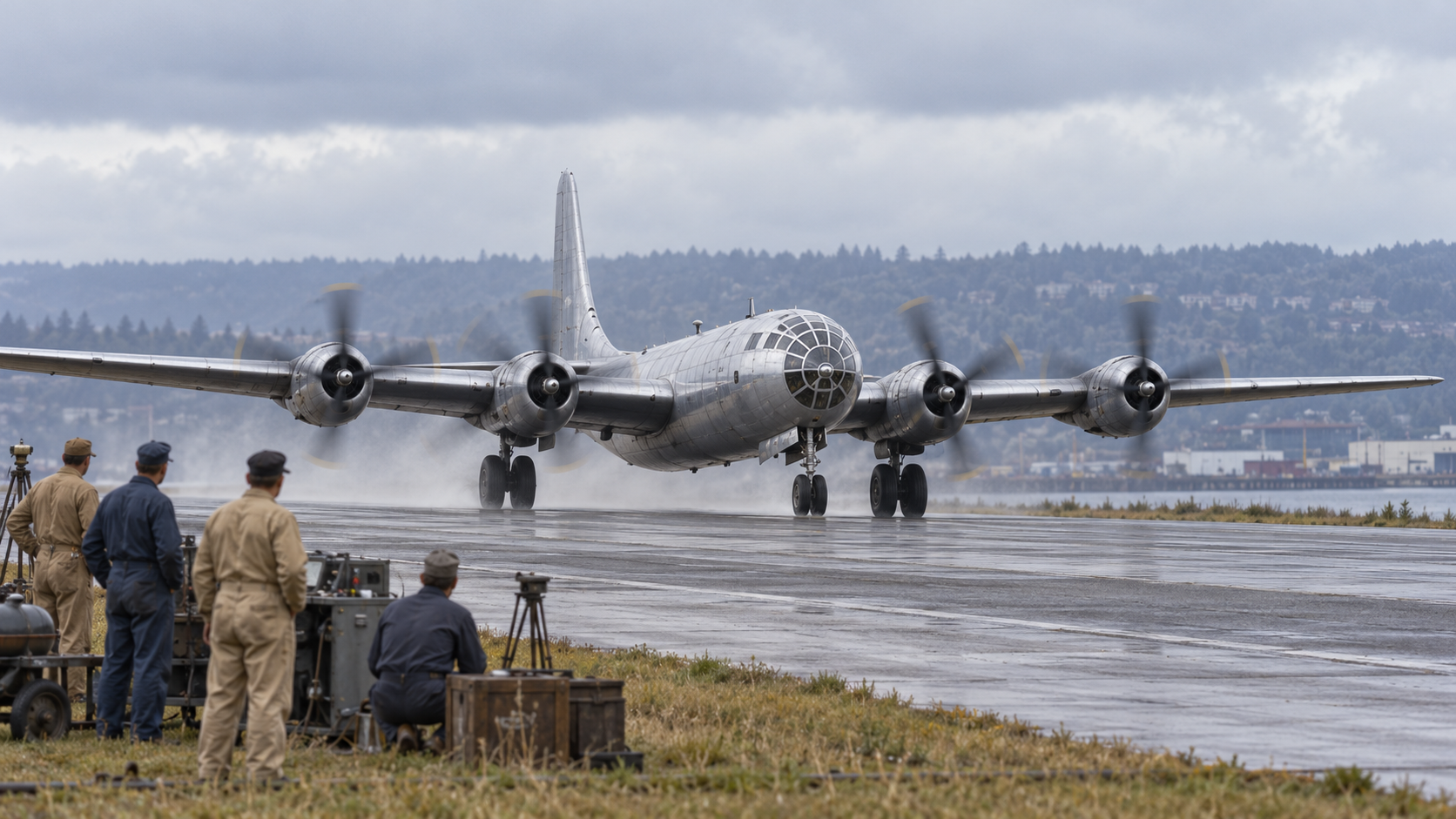
On September 21, 1942, Boeing’s first XB-29 prototype took off from Boeing Field in Seattle, Washington, with company chief test pilot Edmund “Eddie” Allen and a flight-test crew aboard. The flight began the airborne evaluation of an aircraft designed to meet the U.S. Army Air Forces’ demand for a very long-range bomber. Development had started in late 1939, and wartime urgency pushed the program at extraordinary speed. The Army committed to quantity production before the prototype had flown, making the first takeoff not only an engineering trial but a critical checkpoint in an industrial gamble already involving new factories, suppliers, and thousands of workers.
The XB-29 combined size with systems that were unusually advanced for a propeller-driven bomber. Pressurized forward and rear crew compartments were connected by a tunnel over the bomb bays, reducing the need for bulky oxygen equipment during high-altitude flight. Remotely controlled gun turrets relied on centralized sighting and analog computation, while four Wright R-3350 radial engines drove large three-bladed propellers. The production aircraft would also carry extensive radio, navigation, and radar equipment. Its tricycle landing gear and broad glazed nose added further structural and visibility requirements. Bringing those systems together required Boeing and the Army to solve problems in structures, aerodynamics, engines, crew coordination, and mass manufacturing at the same time.
The first flight proved the basic airframe could leave the ground, but it did not validate the entire design. The early R-3350 engines were prone to overheating and fire, and the test program exposed severe reliability problems. In February 1943, the second prototype suffered an engine fire and crashed near Boeing Field, killing Allen, other crew members, and people on the ground. Investigations and engineering changes followed, including improvements to cooling, lubrication, and production quality. The tragedy underscored the human cost of compressing development and manufacturing schedules around an exceptionally complex aircraft.
B-29s entered combat in 1944 and became central to the air war against Japan, including conventional incendiary raids that devastated cities and the atomic bombings of Hiroshima and Nagasaki. Any account of the aircraft’s technical achievement is inseparable from that destructive use. Its engineering legacy nonetheless extended into postwar aviation through pressurization, long-range operations, advanced avionics, and derivatives used for research and transport. Lessons from its engine failures also reinforced the importance of thermal management and quality control in complex aircraft programs. The September 1942 flight marked the beginning of flight testing for one of the era’s most sophisticated aircraft, while the failures and consequences that followed remain essential to understanding what that achievement meant.
The Army sought an aircraft able to carry a heavy load across distances beyond the reach of existing bombers. Boeing answered with a large, high-aspect-ratio airframe powered by four new high-output radial engines.
Pressurized crew spaces, remote defensive systems, and extensive electrical and communications equipment made the design far more integrated than earlier bombers. Each innovation also introduced new failure modes that had to be tested in flight.
The first takeoff confirmed basic flight capability, but the engine installation remained dangerous. Overheating and fires affected the early prototypes, and reliability lagged behind the program's aggressive production commitments.
The fatal 1943 crash of the second prototype forced scrutiny of engine design, cooling, quality control, and test procedures. Subsequent modifications improved the aircraft, but the episode showed the risks of overlapping development with mass production.
The B-29 advanced high-altitude pressurization, centralized fire control, radar-assisted navigation, and long-range mission planning. Its scale also demanded a national manufacturing network and extensive new training systems.
Those achievements served a weapon used in campaigns that caused enormous civilian destruction, including the only atomic bombings in warfare. The aircraft's legacy therefore joins major engineering change with enduring questions about technology and military power.
Explore more of "On This Day ..."
Discover more events from the same date across news, politics, technology, sports, and other fields. Each link highlights significant moments that shaped history on different fronts.