

On This Day in Tech: October 4, 1957
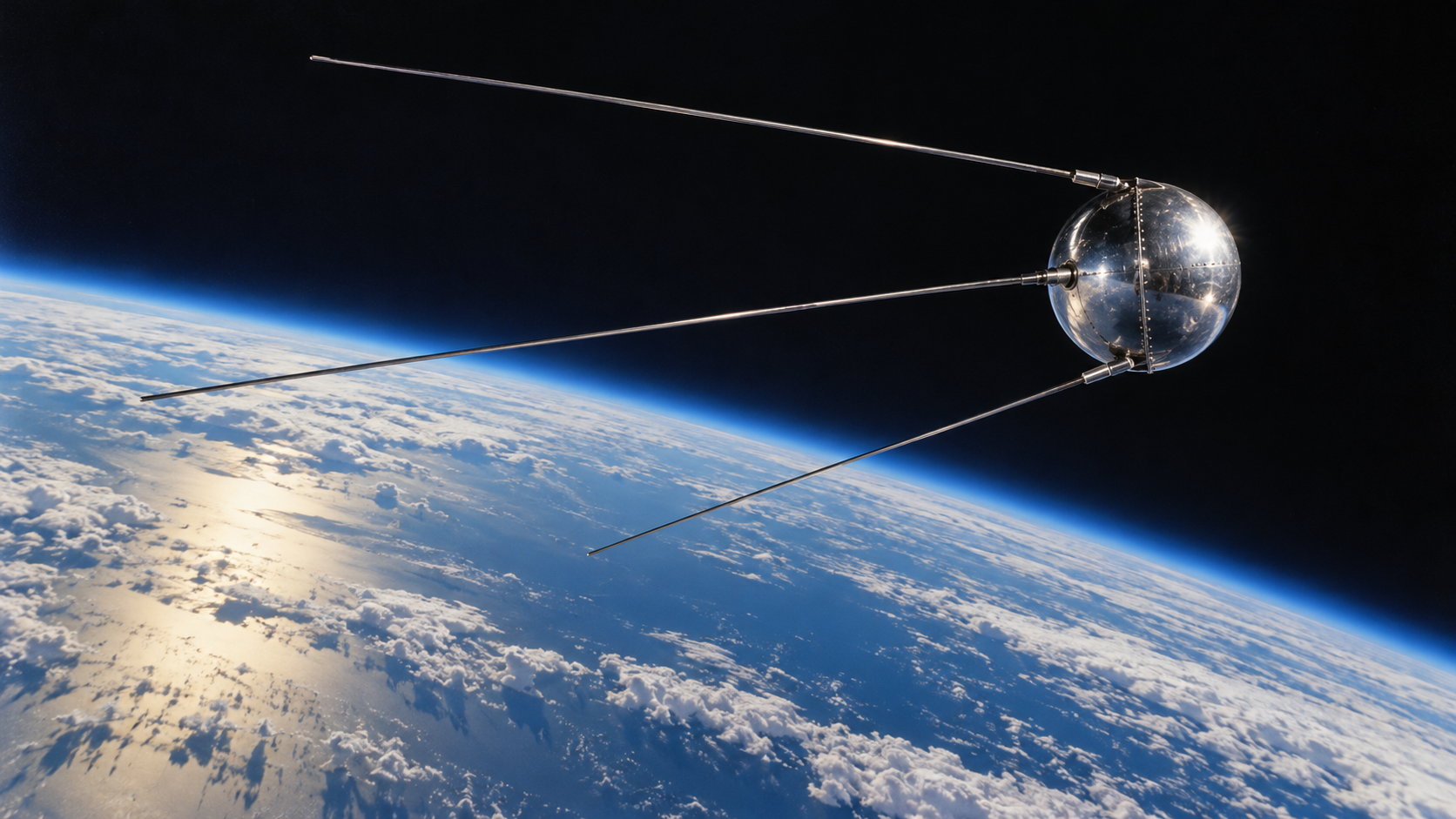
On October 4, 1957, the Soviet Union launched Sputnik 1 from the site now known as Baikonur Cosmodrome in Kazakhstan. The polished metal sphere became the first human-made object successfully placed in orbit around Earth, opening the Space Age. Sputnik measured about fifty-eight centimeters across, weighed roughly eighty-four kilograms, and carried four long whip antennas. An R-7 rocket accelerated it into an elliptical low-Earth orbit. About every ninety-six minutes, the satellite circled the planet while its radio transmitters sent regular pulses that professional stations and amateur operators could receive.
The launch was part of the International Geophysical Year, a multinational scientific program that encouraged both the Soviet Union and the United States to pursue artificial satellites. Soviet engineers initially planned a more complex scientific spacecraft, but development delays led chief designer Sergei Korolev’s team to build a simpler satellite that could fly sooner. Sputnik carried a radio transmitter and systems for monitoring conditions inside its pressurized body, but no imaging equipment. Its engineering was intentionally straightforward: prove that the launch vehicle, satellite structure, power supply, thermal design, and radio system could operate in orbit.
Sputnik’s signal gave the achievement unusual public reach. Listeners around the world could hear its repeated beeps, while observers tracked the satellite and the brighter rocket stage as they crossed the sky. The radio signal ended when the onboard batteries expired on October 26, though the sphere remained in orbit until it reentered the atmosphere on January 4, 1958. In the United States, the launch produced anxiety about Soviet missile capability and the pace of science education. It accelerated satellite and launch-vehicle programs, encouraged new investment in technical training, and contributed to the political momentum that created NASA in 1958.
The first satellite was modest compared with the communications, navigation, weather, Earth-observation, and scientific spacecraft that followed. Yet its success demonstrated that orbital technology had moved from theory to working infrastructure. Sputnik also established practices that remain central to spaceflight: ground tracking, radio telemetry, orbital prediction, and worldwide observation of spacecraft. Within a few years, satellites were relaying communications and monitoring the planet; within twelve years, people had landed on the Moon. October 4 is therefore remembered not only as a Cold War milestone but as the moment an engineered object first began repeatedly falling around Earth, starting a technological system that now supports daily life across the globe. The mission showed that even a simple payload could have enormous strategic consequences.
The Soviet and American satellite programs were contributions to the International Geophysical Year. When a more complex Soviet spacecraft fell behind schedule, engineers prepared a simpler satellite.
On October 4, 1957, an R-7 rocket launched Sputnik 1 from Soviet Kazakhstan and placed the first artificial satellite into low-Earth orbit.
The polished sphere weighed about eighty-four kilograms and carried four long antennas. Its radio transmitters broadcast pulses that could be received and tracked around the world.
The beeps stopped after its batteries expired on October 26, but Sputnik remained in orbit until January 1958. The launch accelerated American space and science programs.
Sputnik proved that launch vehicles, radio systems, power supplies, and spacecraft structures could operate together in orbit. It turned orbital flight into demonstrated technology.
Satellites soon supported communications, navigation, weather forecasting, research, and Earth observation. The first launch also intensified the space race and helped spur NASA's creation.
Explore more of "On This Day ..."
Discover more events from the same date across news, politics, technology, sports, and other fields. Each link highlights significant moments that shaped history on different fronts.