

On This Day in Tech: October 7, 1959
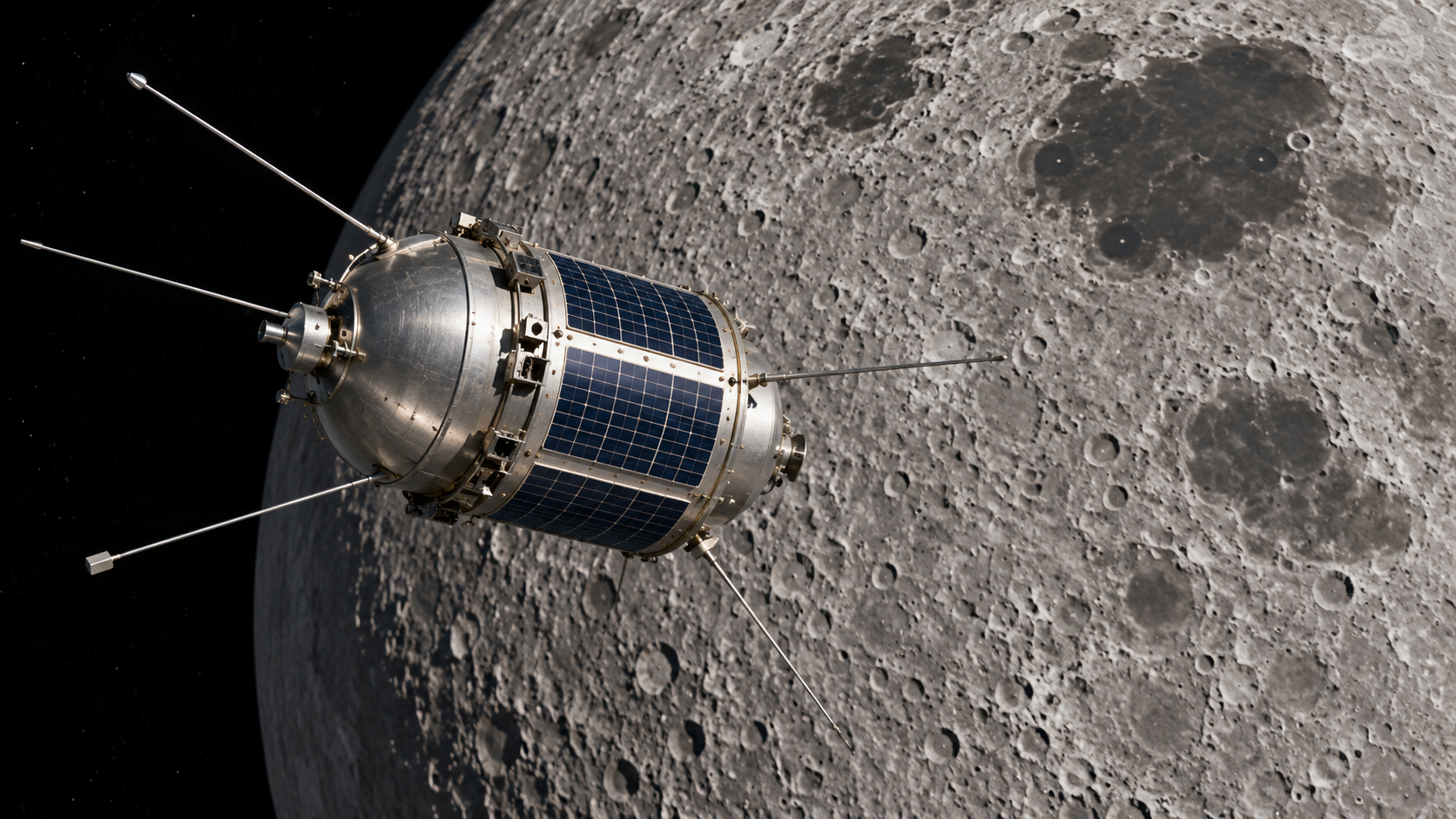
On October 7, 1959, the Soviet spacecraft Luna 3 photographed the far side of the Moon, capturing views of a hemisphere no person had previously seen. Launched from Baikonur three days earlier, the probe had passed the Moon and turned its cameras toward the sunlit terrain behind it. During a session lasting about forty minutes, it exposed twenty-nine photographs covering much of the far side. The images were transmitted to Earth later, after being developed and scanned aboard the spacecraft. Their quality was limited, but the mission transformed an unknown region into a place that could be examined and mapped.
The Moon always keeps approximately the same hemisphere facing Earth because its rotation and orbital periods are synchronized. Ground-based telescopes could therefore reveal only the near side and a little territory around its edges. Reaching another viewpoint required a spacecraft, and returning useful pictures required several technologies to work together far from Earth. Luna 3 needed a suitable trajectory, orientation control, a camera able to operate in space, an automatic photographic laboratory, and a radio link. The mission followed earlier Soviet successes in passing the Moon and striking its surface, but its central achievement was remote imaging.
Unlike modern planetary probes, Luna 3 did not capture digital pictures with an electronic image sensor. It exposed photographic film, processed it internally, and scanned the resulting images so that brightness information could be sent by radio. This arrangement joined mature photographic chemistry with a new space communications system. The returned photographs contained substantial noise and limited detail, yet they clearly indicated that the far side differed from the familiar lunar face. It had fewer of the broad dark plains called maria and extensive heavily cratered terrain. Several large features could be identified despite the imperfections of the transmission.
Later missions produced sharper photographs, complete maps, and detailed measurements of the lunar surface. NASA’s Lunar Reconnaissance Orbiter eventually made it possible to compare modern images with the same general view recorded by Luna 3. Those improvements do not diminish the engineering difficulty of the first attempt. The 1959 mission showed that a robot could gather visual evidence beyond direct human observation, perform complex processing autonomously, and return the results across space. October 7 commemorates the exposures themselves, not the later public release of every image. The achievement helped establish the technological pattern followed by decades of planetary exploration: travel to an otherwise inaccessible viewpoint, measure carefully, and communicate the evidence home.
The Moon's synchronized rotation prevents observers on Earth from seeing most of its far hemisphere. A spacecraft was needed to obtain a different viewpoint.
Luna 3 launched on October 4, 1959, and exposed its far-side photographs on October 7. Transmission and public presentation followed the imaging session.
The probe developed photographic film onboard and scanned it for radio transmission. The system was an automatic laboratory as well as a spacecraft.
The returned pictures were noisy and low in resolution, but they revealed fewer dark maria and allowed major surface features to be recognized.
Subsequent lunar missions replaced the first rough views with detailed mapping. Modern orbital data can reproduce the perspective of the pioneering photographs.
The mission demonstrated autonomous imaging and processing far from Earth, an essential combination for later robotic exploration of the planets.
Explore more of "On This Day ..."
Discover more events from the same date across news, politics, technology, sports, and other fields. Each link highlights significant moments that shaped history on different fronts.