

On This Day in Tech: October 8, 1958
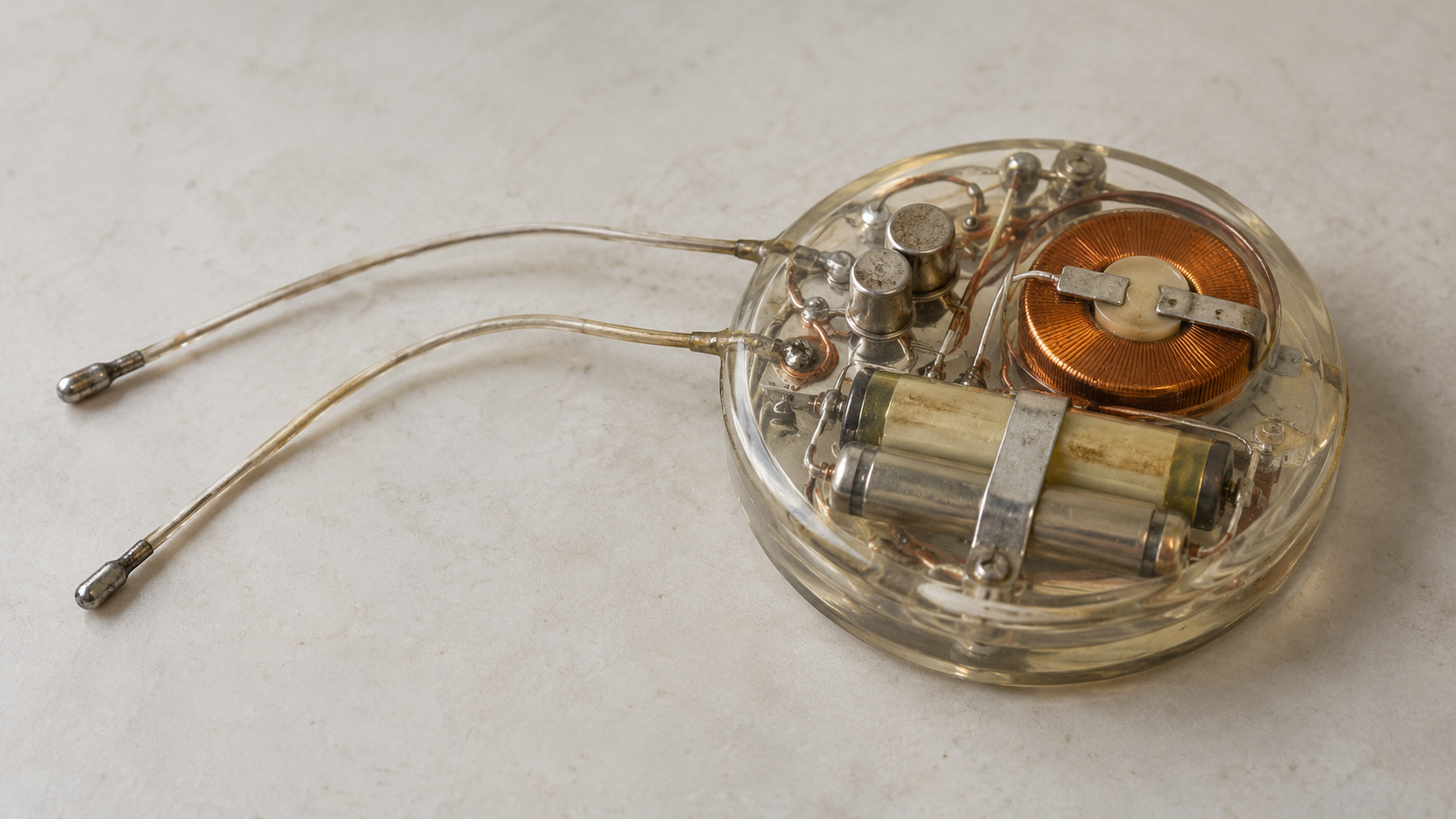
On October 8, 1958, surgeon Åke Senning implanted a fully internal cardiac pacemaker in Arne Larsson at Karolinska Hospital in Stockholm, Sweden. The device had been developed with engineer Rune Elmqvist to deliver electrical impulses directly to the heart through implanted leads. Larsson suffered repeated episodes in which his heartbeat became dangerously slow or stopped, and previous treatments had offered little lasting help. The operation was a landmark in implantable electronics, but the first unit worked for only a few hours. Its rapid failure made the event both a breakthrough and a demonstration of how much engineering remained unfinished.
Earlier pacemakers were external machines, sometimes large enough to require a trolley, while later portable units could be worn outside the body. An implanted system promised to remove the dependence on an external box and the problems created by wires passing through the skin. Achieving that goal required a pulse generator small enough to fit inside a person, a practical power source, reliable electrical connections, and materials that could protect the circuitry. Recent improvements in transistors and batteries made the concept more plausible. Elmqvist assembled the early components and encapsulated them in resin using a small container as a mold.
The first generator’s short life required replacement, and Larsson continued to receive new devices as the technology evolved. Early failures involved more than the pulse-generating circuit: batteries, insulation, leads, and connections all had to survive movement and prolonged contact with the body’s internal environment. Reliable pacing was therefore a system problem rather than simply an exercise in miniaturization. The Stockholm team had shown that an implanted electrical device could sustain a heartbeat, but they had not yet produced the durable, adaptable systems familiar today. The distinction matters because successful implantation and dependable long-term service are separate engineering achievements.
Over the following decades, manufacturers developed better power supplies, hermetic enclosures, improved electrodes, programmable settings, and sensors that could adjust pacing to changing activity. Implantable devices also became easier for clinicians to monitor and tailor to individual needs. Larsson lived until 2001 and received numerous replacement pacemakers during those years, outliving both of the men responsible for the original intervention. The October 1958 operation helped establish the possibility of maintaining an essential bodily function with a compact electronic system. Its lasting importance lies in that union of medicine, materials, power management, and circuit design, followed by sustained efforts to make the complete device reliable enough for everyday life.
External pacing equipment preceded the Stockholm operation. Moving the generator fully inside the body required major reductions in size and new ways to protect the electronics.
Senning and Elmqvist worked together on the implanted system, which was first fitted to Arne Larsson on October 8, 1958.
The initial unit operated for only a few hours. It demonstrated feasibility while exposing the difficulty of making an implant dependable over long periods.
The generator, battery, leads, insulation, and body-compatible enclosure all mattered. A reliable circuit alone could not guarantee reliable treatment.
Later devices gained improved batteries, sealed cases, programmable operation, and sensors. Those changes made pacing more adaptable to patients' activities and clinical needs.
Larsson lived for decades with successive pacemakers. His experience connects the experimental 1958 device with the continuing development of implantable medical electronics.
Explore more of "On This Day ..."
Discover more events from the same date across news, politics, technology, sports, and other fields. Each link highlights significant moments that shaped history on different fronts.