

On This Day in Health: July 8, 1947
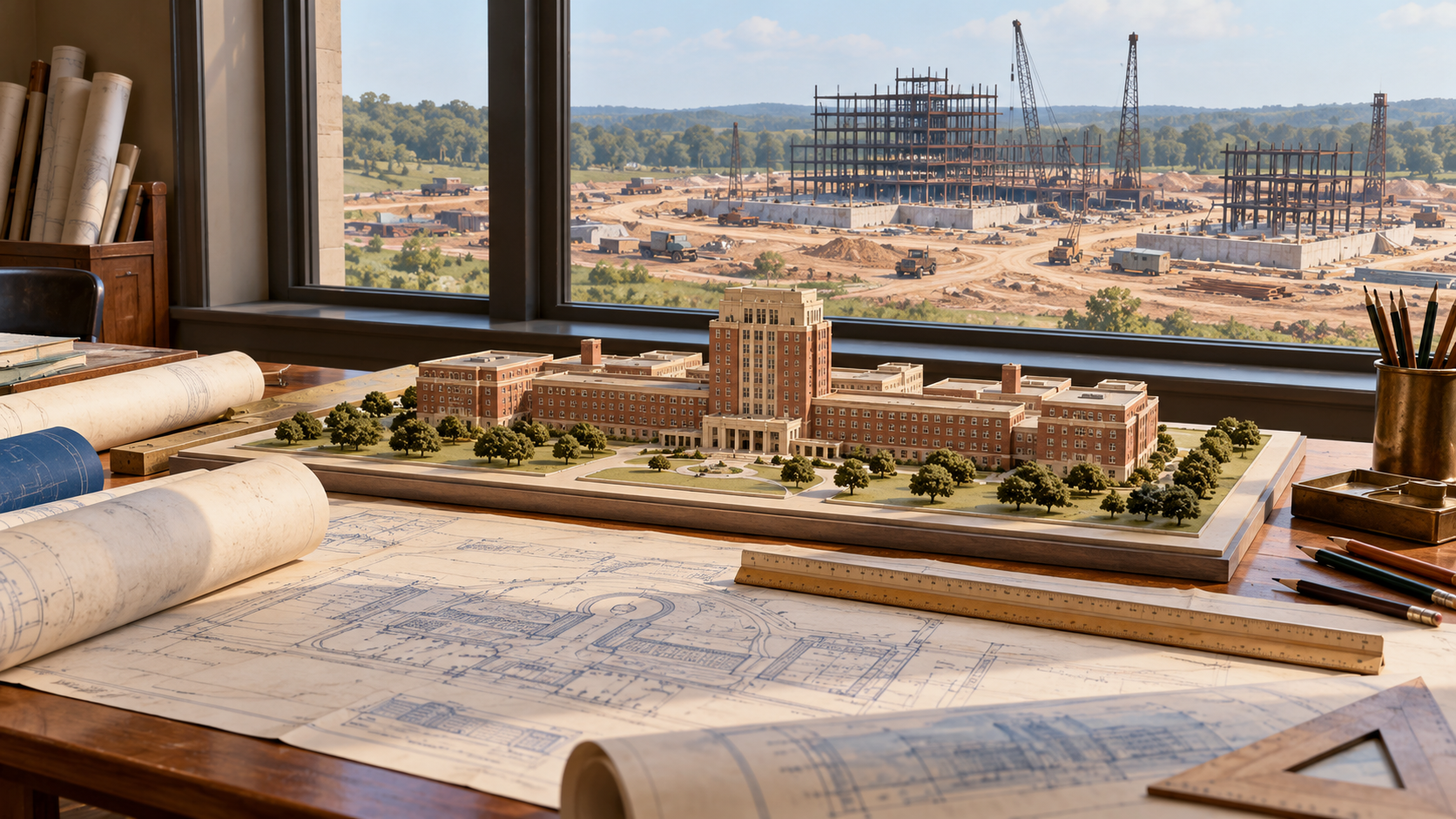
On July 8, 1947, federal appropriations legislation provided money for the National Institute of Health to acquire a site and prepare plans for additional research buildings and a 600-bed clinical research hospital. The provision turned an earlier authorization into a concrete construction program on the NIH campus in Bethesda, Maryland. Officials envisioned a hospital built specifically for studies involving patients, with laboratories and wards close enough for physicians and basic scientists to work together. The eventual facility became Building 10, the NIH Clinical Center. Although the hospital did not admit patients until 1953, the July 8 funding decision supplied the practical foundation for its design and construction.
The need had become clearer during the 1940s. NIH laboratories were expanding their work on cancer, infectious disease, heart conditions, and other major causes of illness, but investigators lacked a dedicated place for carefully controlled clinical studies. The 1944 Public Health Service Act had authorized clinical research, yet authorization alone did not produce a building. The 1947 appropriation supported the site, specifications, drawings, and related facilities needed to move from policy to architecture. Planners sought to combine hospital functions with scientific space, creating an environment where observations from patient care could guide laboratory questions and laboratory findings could inform new diagnostic or treatment studies.
The proposed scale changed before opening. The completed Clinical Center had about 540 beds rather than the original 600-bed description, and units were activated gradually as research programs and staff became ready. The project also raised concerns about the federal government's role in medicine and the protection of people participating in research. NIH emphasized that the center would accept patients through research protocols rather than operate as a general community hospital. In the aftermath of World War II, institutional review and safeguards for participants became central responsibilities, even though the modern system of research regulation would continue to develop over later decades.
President Harry Truman laid the cornerstone in 1951, the building was dedicated on July 2, 1953, and the first patients entered on July 6. The center later supported influential work in chemotherapy, infectious diseases, immunology, genetics, and rare disorders. Those accomplishments can obscure the less visible step that made the institution possible: lawmakers assigned public funds to a new type of hospital devoted to research. July 8 therefore marks a planning and investment milestone rather than a medical discovery. It shows how health advances depend on durable infrastructure, trained teams, ethical oversight, and patients willing to participate, all of which require decisions made years before a study produces a result.
The 1944 Public Health Service Act authorized NIH clinical research. The 1947 appropriation supplied money for a site, plans, specifications, and drawings.
Planners proposed a 600-bed research hospital with related buildings. The completed Clinical Center opened with roughly 540 beds and activated units gradually.
Funding a building did not itself create new treatments. Construction, staffing, protocols, and participant protections still required years of work.
The center was designed for research participants rather than general community admissions. Access depended on eligibility for a scientific protocol.
Bringing wards and laboratories together encouraged clinicians and basic scientists to investigate the same medical problems in close proximity.
The July 8 decision illustrates how public investment in infrastructure can enable discoveries long after the original appropriation is made.
Explore more of "On This Day ..."
Discover more events from the same date across news, politics, technology, sports, and other fields. Each link highlights significant moments that shaped history on different fronts.