

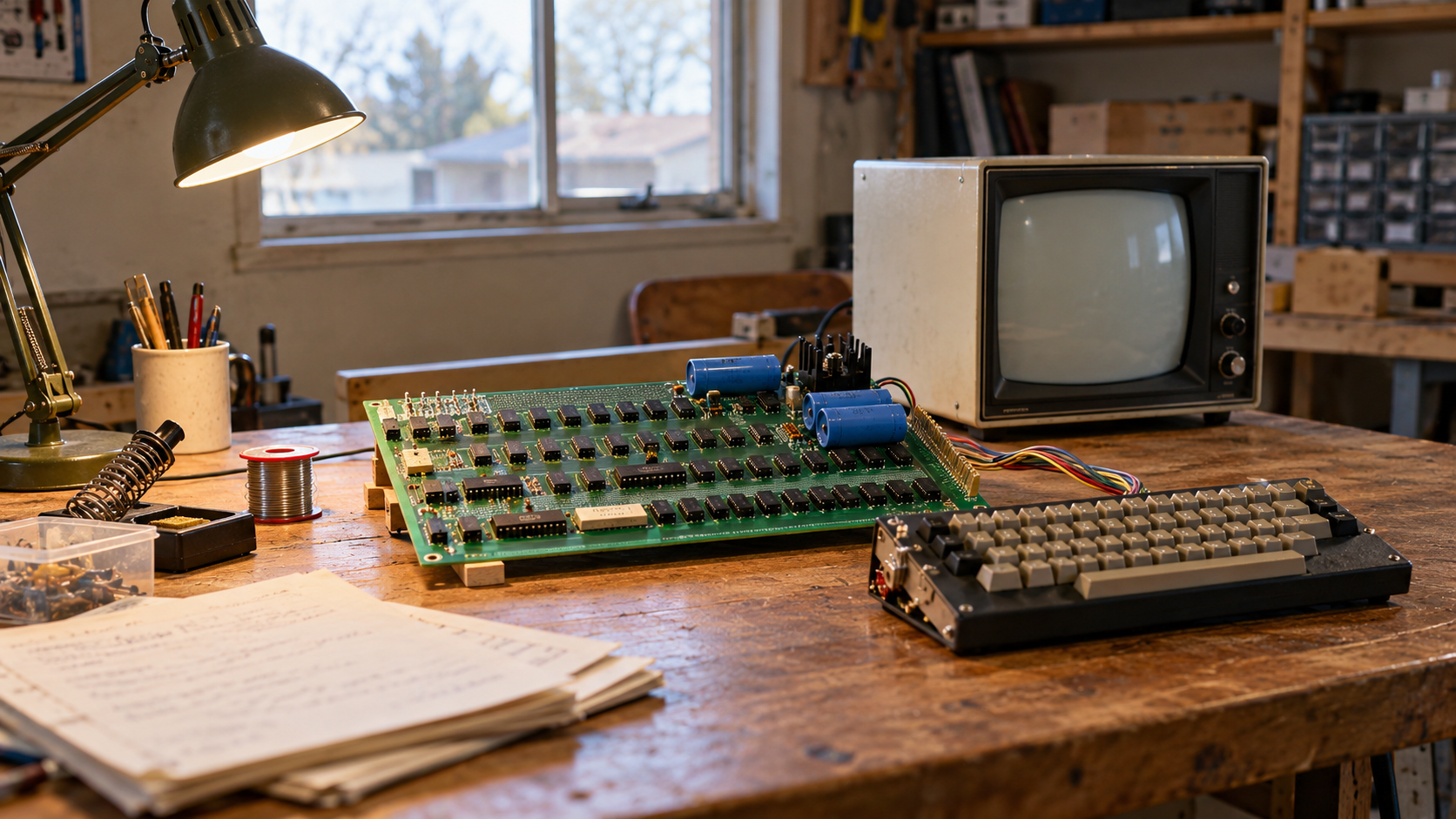
On This Day in Business: January 3, 1977
On January 3, 1977, Apple Computer, Inc. came into existence as a California corporation, giving Steve Jobs and Steve Wozniak a formal company through which to build and sell personal computers. The date is distinct from April 1, 1976, when Jobs, Wozniak and Ronald Wayne had formed an earlier partnership. Wayne soon withdrew, while the remaining founders continued selling Wozniak’s Apple I board. By late 1976, investor and former semiconductor executive Mike Markkula had joined their effort, helped prepare a business plan and supported the financing needed for a more ambitious operation. Incorporation converted a small partnership into a structure that could issue shares, employ staff and pursue larger production commitments.
The young business already had evidence that a market existed. Paul Terrell’s Byte Shop had ordered 50 assembled Apple I boards in 1976, encouraging Jobs and Wozniak to deliver more than a hobbyist design. Even so, the Apple I required buyers to supply essential parts such as a case, keyboard, display and power supply. Apple’s next machine would be sold as a more complete consumer product. Wozniak concentrated on the engineering, Jobs pushed packaging and marketing, and Markkula supplied experienced guidance on planning and distribution. The corporation formed while that Apple II strategy was taking shape, not after the product had already proved itself in the market.
Apple introduced the Apple II at the West Coast Computer Faire in April 1977. Its color graphics, expansion slots, molded case and integrated keyboard made it approachable beyond the small community of people comfortable assembling bare circuit boards. Incorporation did not guarantee the product’s success, but it made scaling possible: the company could raise capital, arrange manufacturing, build a dealer network and establish clearer ownership. Apple’s 1980 public-offering documents treated January 3, 1977, as the corporation’s inception. Those filings show how quickly the business grew, from $773,977 in net sales during its first partial fiscal period to more than $117 million in fiscal 1980.
The longer legacy lies in the transition from inventive partnership to durable enterprise. Apple’s later products and corporate turns were not predetermined on incorporation day, and the company would experience leadership conflicts, competitive setbacks and a major revival decades later. Yet January 3 marks the point when a promising circuit-board venture adopted the legal and financial form needed to compete in an emerging personal-computer industry. It connected Wozniak’s engineering, Jobs’s product ambitions and Markkula’s business organization in a corporation able to take the Apple II to a mass market. That combination helped move personal computing from enthusiast clubs and specialty shops toward homes, schools and ordinary workplaces.
Apple began as a partnership on April 1, 1976. Ronald Wayne soon left, while Steve Jobs and Steve Wozniak continued selling Wozniak’s Apple I single-board computer.
A 50-board order from the Byte Shop showed that customers would buy assembled computers. Mike Markkula later added business planning and financial support as Apple prepared to scale.
The January 3 incorporation created a company that could issue shares, hire employees and make manufacturing and distribution commitments for the Apple II.
The Apple II did not debut until April 1977. Incorporation therefore marked organizational preparation rather than the public launch of the product that drove Apple’s early growth.
Apple’s 1980 offering documents identify January 3, 1977, as the corporation’s inception and report rapid sales growth during the company’s first four fiscal periods.
The date matters because it joined technical invention to a scalable business structure, helping personal computing move beyond hobbyist boards toward a broad consumer market.
Explore more of "On This Day ..."
Discover more events from the same date across news, politics, technology, sports, and other fields. Each link highlights significant moments that shaped history on different fronts.