

On This Day in Lifestyles: January 6, 1907
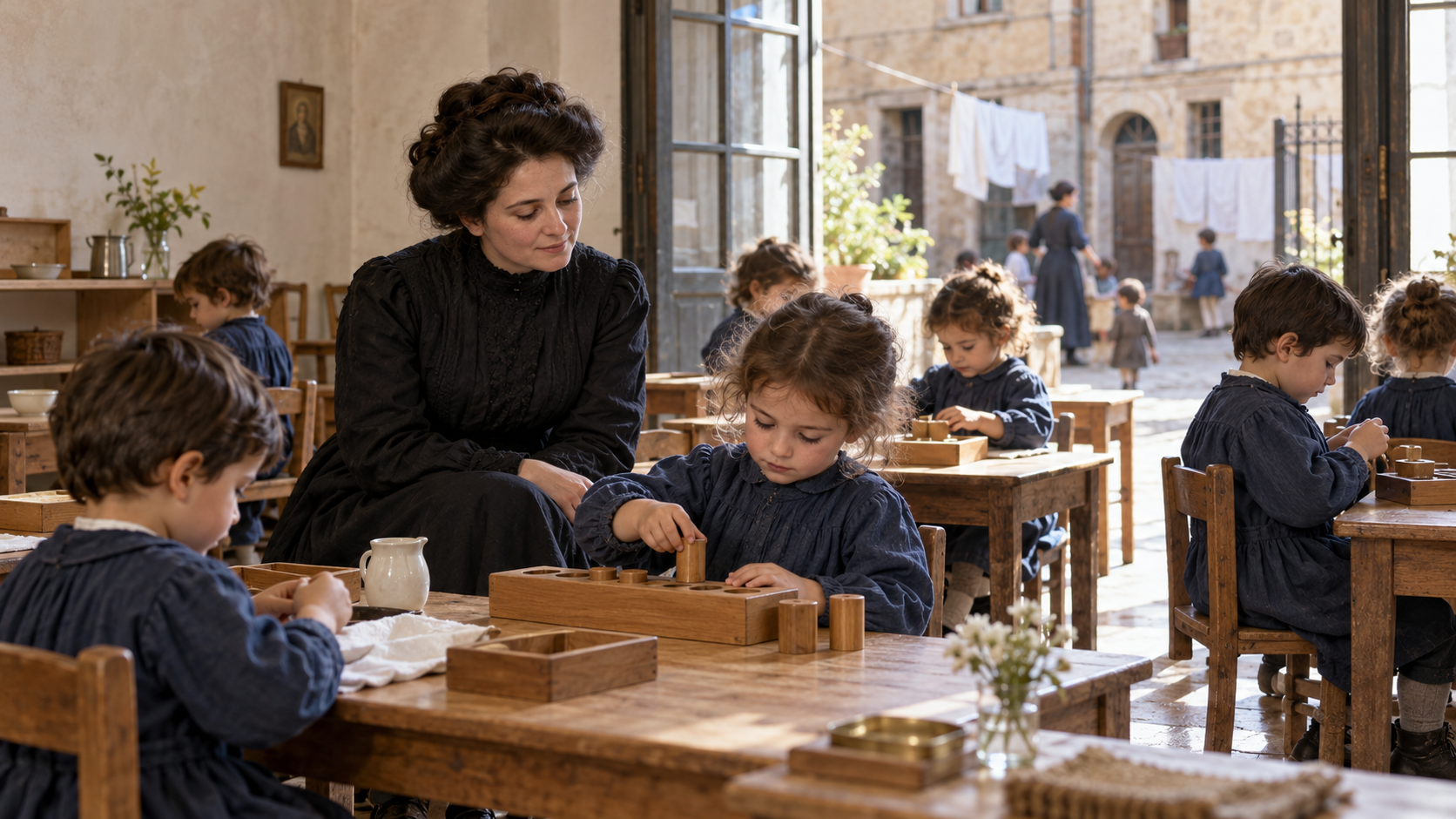
On January 6, 1907, Maria Montessori opened the first Casa dei Bambini, or Children’s House, in Rome’s San Lorenzo district. The school occupied space in a renovated tenement and served about fifty young children whose parents worked outside the home. Montessori, already a physician and educator, was invited to oversee the children rather than leave them unattended in shared corridors. What began as a practical neighborhood arrangement became the setting in which she refined an influential approach to early education. Her earlier work with children in clinical and special-education settings had convinced her that careful observation and thoughtfully designed materials could reveal abilities that conventional classrooms often missed.
The classroom was deliberately organized around the children’s scale and independence. Furniture was light enough to move, shelves placed materials within reach, and daily activities included washing, fastening, sorting, pouring, and caring for the room. Montessori observed which objects held attention and removed activities that encouraged aimless or destructive behavior. Her sensory materials isolated qualities such as size, shape, texture, sound, and weight so children could notice differences through repeated handling. Adults demonstrated tasks carefully, then allowed each child time to practice without constant correction or interruption.
Visitors were struck by the concentration and self-control they saw among children from a poor working-class neighborhood. Montessori concluded that orderly behavior did not require continuous adult command; it could emerge when the environment matched a child’s developmental needs and offered purposeful freedom. That freedom was structured, not unlimited. Children chose among prepared activities, used materials in intended ways, and learned to return them for others. Practical work, movement, language, and sensory exploration formed a connected routine rather than separate lessons delivered to the whole group.
The San Lorenzo experiment attracted public attention, and additional Children’s Houses soon opened. Montessori trained teachers, published her method, and welcomed international observers, helping the approach spread through Europe, the Americas, India, and beyond. Schools later adapted it to different cultures and age groups, producing debates about cost, fidelity, and how much variation the name “Montessori” should permit. The first Casa nevertheless changed assumptions about young children. It treated the room, materials, and adult’s restraint as active parts of education and trusted children to develop capability through meaningful work. More than a century later, child-sized spaces and hands-on learning remain visible far beyond schools that formally use Montessori’s name. The anniversary is therefore not merely the birthday of a school brand; it marks a practical experiment in dignity, attention, and the design of everyday surroundings for children.
On This Day in Life: January 1, 1892
On January 1, 1892, Ellis Island opened as the United States’ first federal immigration station. A steamship carried the day’s first group from ships anchored in New York Harbor to the island’s new wooden processing building. The first immigrant registered there was Annie Moore, a 17-year-old from County Cork, Ireland, who arrived with her younger brothers Anthony and Philip to join their parents in New York. Officials presented her with a gold coin to mark the occasion. Her brief welcome became the human symbol of a much larger federal system that would examine, question, admit, detain, or exclude millions of people arriving at one of the nation’s busiest gateways.
Ellis Island opened during a major shift in American immigration policy. For much of the nineteenth century, states and local authorities handled arriving passengers; New York’s principal station had been Castle Garden in lower Manhattan. Congress took direct federal control in 1890 as immigration increased and national restrictions grew. The island was expanded with landfill, and a station large enough to process shiploads of steerage passengers was constructed. First- and second-class travelers usually received a cursory inspection aboard their ships, while steerage passengers were ferried to Ellis Island. The system reflected both an administrative need to manage volume and a political desire to decide more systematically who could enter.
For most arrivals, inspection was demanding but short. Doctors watched people climb the stairs for signs of physical difficulty, then conducted medical checks; inspectors asked about identity, occupation, money, destination, and family contacts. Shipping manifests supplied the official names against which passengers were checked, undermining the later myth that clerks routinely renamed immigrants at the island. Most passed through within several hours. A minority were held for additional medical or legal review, sometimes for days or weeks, and some were sent back. Families could be separated by illness or adverse decisions, giving the station its reputation as both an island of hope and an island of tears.
The original wooden complex burned in 1897 without loss of life, and a fireproof main building opened in 1900. By the time the station closed in 1954, more than 12 million immigrants had been processed on Ellis Island, with peak years in the early twentieth century. Their settlement reshaped American neighborhoods, workplaces, food, language, religion, and family life, even as nativism and restrictive laws narrowed the gateway after World War I. Restored as part of a national monument, the main building now houses the National Museum of Immigration. The opening day endures because it connects a vast demographic transformation to individual journeys like Annie Moore’s—a teenager stepping ashore with two brothers on a cold New Year’s Day.
Maria Montessori opened the first Casa dei Bambini on January 6, 1907, in a renovated tenement in Rome’s San Lorenzo district.
The Children’s House served roughly fifty children, ages two to six, while their parents worked outside the home.
Child-sized furniture, reachable shelves, sensory materials, and practical tasks were designed to support movement, repetition, concentration, and independence.
Freedom operated inside a prepared structure: children chose purposeful work, used materials carefully, and returned them so others could participate.
Public interest led to new schools, teacher training, publications, and an international movement that reached many cultures and age groups.
The original experiment influenced mainstream ideas about hands-on learning, child-sized classrooms, observation, and the adult’s role in supporting rather than directing every action.
Explore more of “This Day in Lifestyles”
Discover more moments in everyday life, design, education, travel, food, fashion, and culture. Each story connects a calendar date with an event that changed how people lived.