

Home Heat Pump Explainer
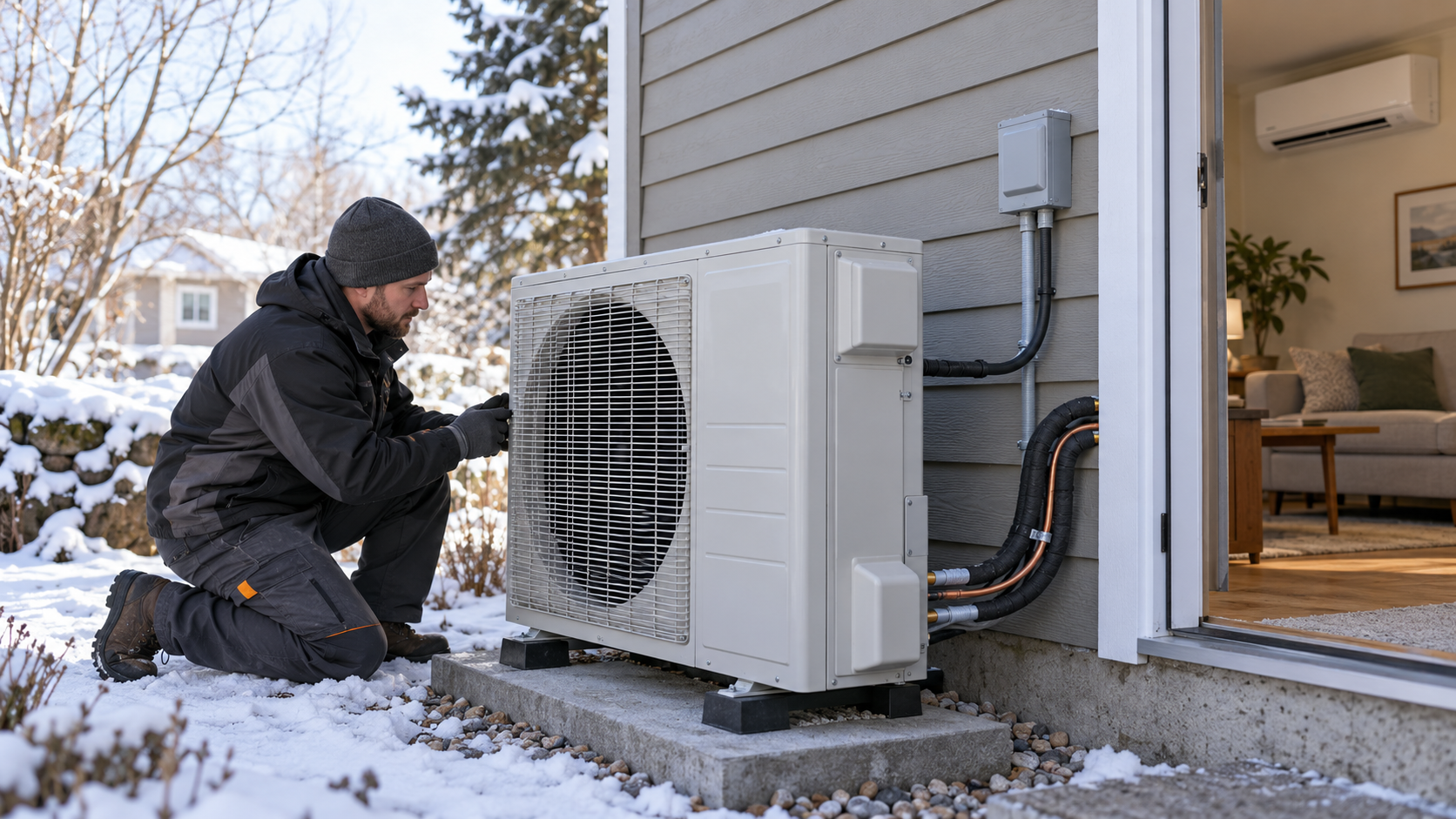
A heat pump heats and cools a home by moving thermal energy rather than producing most of its heat through combustion or electric resistance. In cooling mode it works much like an air conditioner, collecting heat from indoor air and releasing it outdoors. In heating mode a reversing valve changes the direction of the refrigerant circuit, allowing the outdoor unit to collect available heat from cold outside air and deliver it indoors. Cold air still contains thermal energy, so heat transfer can continue at temperatures that feel wintry to people. The equipment uses electricity mainly to run a compressor, fans, pumps, and controls.
The refrigerant is the working fluid that carries energy around the sealed loop. At the indoor and outdoor coils, changes in pressure let it evaporate or condense at useful temperatures. A compressor raises the vapor pressure and temperature; an expansion device lowers them before the next heat-absorbing stage. Fans move household air across the indoor coil and outdoor air across the exterior coil. A thermostat calls for heating or cooling, while sensors and control boards coordinate compressor speed, fans, valves, and safety limits. Ducted systems distribute conditioned air through registers, while ductless mini-splits use one or more indoor heads.
In winter, the outdoor coil can become colder than the surrounding air so heat flows into the refrigerant. Moisture may freeze on that coil, reducing airflow. The system periodically enters a defrost cycle that temporarily sends hot refrigerant outdoors to melt the frost, then returns to heating. Some installations include electric resistance strips or another backup source for extreme cold, defrost, or rapid recovery. Modern cold-climate air-source heat pumps are designed to operate at lower outdoor temperatures than older equipment, but output and efficiency still depend on the model, correct sizing, airflow, building insulation, and local conditions.
Efficiency is commonly described with seasonal ratings rather than one fixed number. The equipment has to work across changing weather, indoor loads, and compressor speeds. Variable-speed systems can run steadily at lower output, which often improves temperature control and reduces repeated starts. A heat pump should not be selected only by the square footage of a house; contractors normally use a load calculation that considers insulation, windows, leakage, orientation, and climate. Oversizing can cause short cycles and uneven comfort, while undersizing without an appropriate plan for design conditions may leave the system relying heavily on backup heat.
Everyday operation differs slightly from a furnace. A heat pump may deliver air that feels warm rather than intensely hot and may run for longer periods. Large thermostat setbacks can trigger expensive auxiliary resistance heat in some systems, so gradual or model-specific control strategies can be more efficient. Filters, outdoor-coil clearance, condensate drainage, and unobstructed registers all affect performance. The refrigerant circuit is not a do-it-yourself service item; leaks, charging, electrical faults, and airflow measurements require trained technicians and must comply with applicable refrigerant and electrical rules.
A heat pump is not automatically the best answer for every building, but it can combine heating and cooling in one system and reduce direct fuel use. Ground-source designs exchange heat with the earth rather than outdoor air and have different installation costs and site requirements. Air-source equipment is more common and easier to add to many homes. The practical decision is a whole-house one: compare climate-rated performance, installed cost, utility prices, electrical capacity, backup strategy, duct condition, and envelope improvements. When those pieces fit together, the reversible refrigeration cycle can provide comfortable heating and cooling with one coordinated machine.
A heat pump uses a compressor, refrigerant, coils, fans, and a reversing valve to move heat into or out of a home. Key terms include refrigerant cycle, compressor, evaporator, condenser, expansion device, reversing valve, defrost, and auxiliary heat.
Outdoor air above absolute zero contains thermal energy. By lowering the refrigerant pressure, the outdoor coil becomes colder than the air, so heat flows into the refrigerant before the compressor raises its temperature.
Not necessarily. Many modern models operate well below freezing, but capacity and efficiency change with temperature. The selected model, design conditions, backup plan, building load, and maintenance determine cold-weather performance.
Explore more "Explainers"
Discover additional explainers across politics, science, business, technology, and other fields. Each explainer breaks down a complex idea into clear, everyday language—helping you better understand how major concepts, systems, and debates shape the world around us.