

Freezing Food Safely Explainer
Freezing keeps food safe longer because the low temperature prevents microorganisms from multiplying while the food remains frozen. It does not sterilize the food. Bacteria, yeasts, and molds may become inactive at freezer temperatures and become active again after thawing. The U.S. Department of Agriculture states that food held continuously at 0 degrees Fahrenheit remains safe indefinitely, although its quality declines over time. That distinction explains why freezer-storage charts usually describe the period for best flavor and texture rather than a sudden safety deadline.
The physical process begins as water in the food turns into ice. With less liquid water available and molecules moving more slowly, microbial growth and many chemical reactions are greatly reduced. Freezing speed affects what happens to the food’s structure. Rapid freezing forms smaller ice crystals, while slow freezing permits larger crystals that can damage cell walls and cause more moisture to escape during thawing. A home freezer cannot prevent every texture change, but food frozen promptly in reasonably thin portions usually retains quality better than a large, warm mass that takes many hours to freeze.
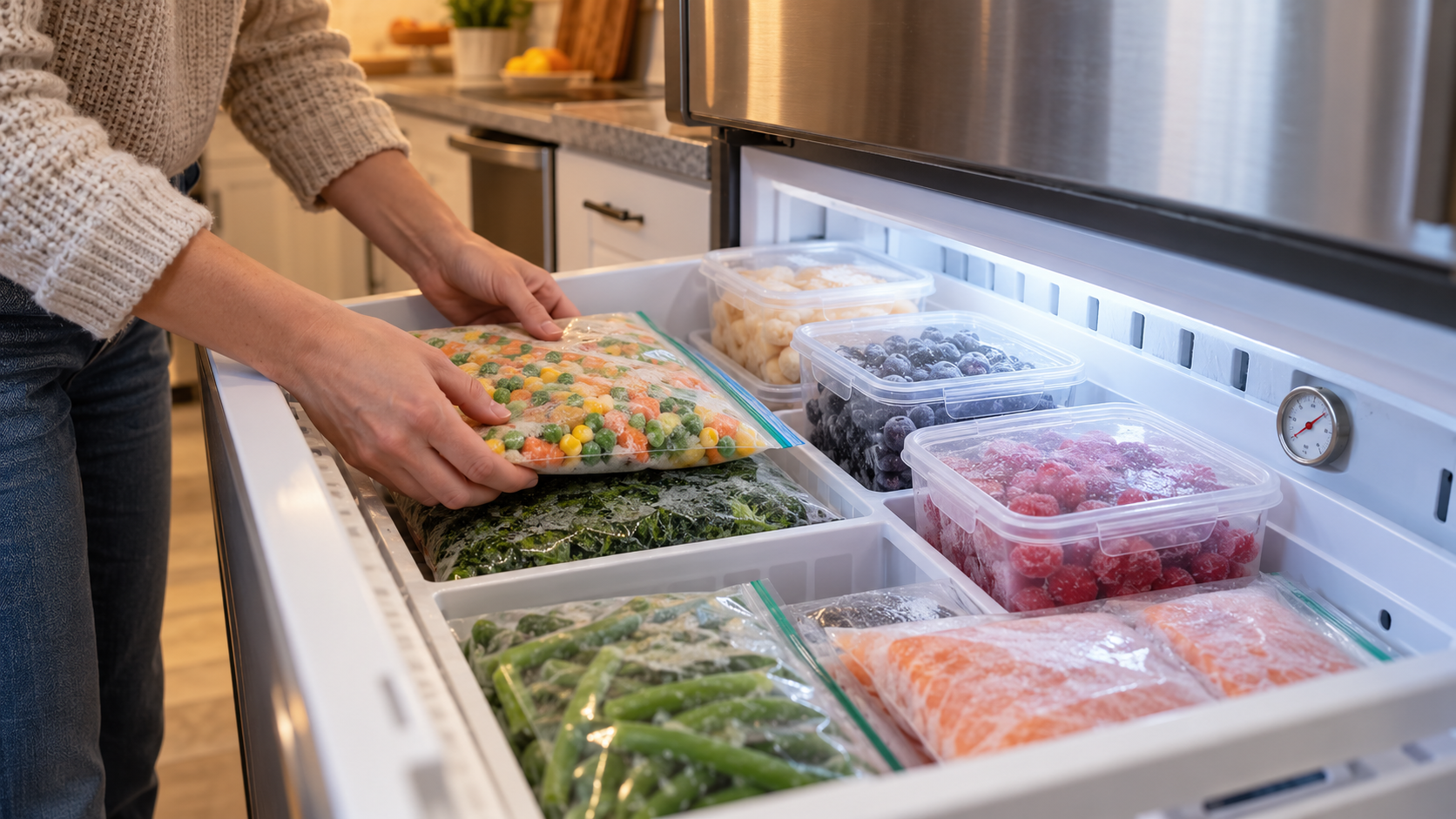
Packaging protects quality by limiting contact with air and preventing moisture loss. Freezer burn is dehydration at the surface; it can create dry, discolored patches without making the food unsafe. Airtight freezer bags, rigid freezer-safe containers, or suitable wraps reduce that damage when they are closed with as little trapped air as practical. Packages should be meal-sized, cooled appropriately before freezing, and arranged with space for cold air until solid. Once frozen, they can be stacked more closely. Dating and identifying packages—even with a simple home label—supports first-in, first-out use and keeps older items from disappearing beneath newer ones.
Different foods respond differently. Meat, many cooked dishes, fruit, and properly prepared vegetables can freeze well, while lettuce, mayonnaise-based sauces, and some emulsions may separate or become watery. Enzymes can continue to affect the color, flavor, and texture of vegetables even though microbes are not growing. Briefly blanching many vegetables before freezing slows those enzymes and improves quality. Freezing food at its best does not improve it; it preserves much of the quality present at the start. Food already stale, bruised, or near spoilage will not emerge better after months in the freezer.
Safe thawing matters because surviving microorganisms can multiply as the surface warms. The USDA recommends thawing perishable food in the refrigerator, in cold water with controlled handling, or in the microwave followed by immediate cooking. A countertop, warm garage, or outdoor porch can leave part of the food in a temperature range that supports rapid growth while the center is still frozen. Food thawed in the refrigerator may generally be refrozen if it was handled safely, although another freeze-thaw cycle can reduce quality. Frozen raw products that look browned or partially cooked must still be cooked according to their instructions and verified safe temperatures.
A thermometer makes the freezer more useful during normal storage and power interruptions. A closed, full freezer holds cold longer than a partly filled one, but time alone cannot establish the condition of every item. Food that still contains ice crystals or remains at refrigerator temperature may often be used or refrozen under USDA guidance; food that has warmed beyond safe limits must be evaluated conservatively. Smell and appearance cannot detect every hazard, and tasting is not a safe test. The practical system is straightforward: keep the freezer at 0 degrees Fahrenheit or below, freeze food promptly in protective portions, rotate for quality, thaw safely, and remember that cold pauses microbial growth rather than erasing the need for good food handling.
Freezing stops microbial growth while food remains frozen but does not sterilize it. Key terms include 0 degrees Fahrenheit, ice crystal, freezer burn, airtight packaging, blanching, thawing, refreezing, and first-in-first-out rotation.
Fast freezing forms smaller ice crystals that do less damage to food cells. Thin, spaced packages freeze more quickly than one large warm mass, reducing moisture loss and texture damage after thawing.
No. Many microbes become inactive rather than die and can resume growing after thawing. Thawed food must be handled like other perishable food and cooked or stored using appropriate safety guidance.
Explore more "Explainers"
Discover additional explainers across politics, science, business, technology, and other fields. Each explainer breaks down a complex idea into clear, everyday language—helping you better understand how major concepts, systems, and debates shape the world around us.