

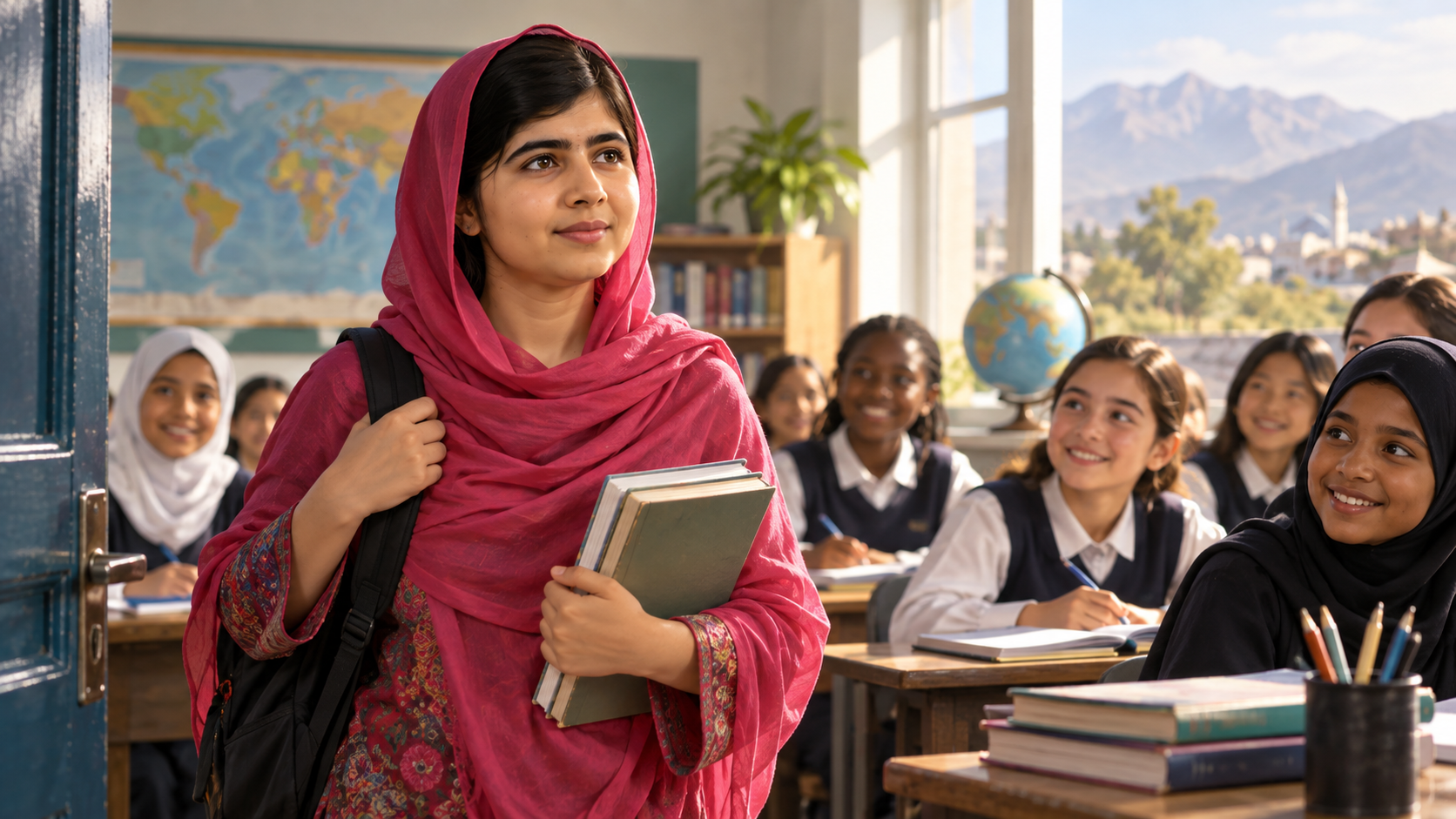
“One child, one teacher, one book and one pen can change the world.”
Malala Yousafzai spoke these words at the United Nations in July 2013, on her sixteenth birthday and less than a year after a Taliban gunman attacked her for advocating girls’ education in Pakistan’s Swat Valley. She framed education as a right rather than a privilege and rejected revenge against her attackers. The familiar sentence condensed a broader appeal to governments for free, compulsory schooling and to communities for an end to prejudice. Its power comes from joining individual tools—a child, teacher, book, and pen—to institutional change.
The quotation is inspiring, but it should not be reduced to a claim that individual effort alone overcomes structural barriers. Schools require safety, public funding, trained teachers, accessible materials, and policies that allow excluded children to attend. Families may confront poverty, displacement, discriminatory rules, or armed groups. Reporting on education should therefore connect personal stories with enrollment data, budgets, law, and local conditions. A heroic narrative can attract attention while hiding the many students and educators whose work is collective and less visible.
Education remains a major news issue during conflict, migration, technological change, and disputes over curriculum. Journalists can examine who is out of school, whose language and history appear in materials, and whether announced reforms reach classrooms. Malala’s line remains useful because it names human relationships at the center of large systems. A pen becomes powerful when learners gain the opportunity to use it and when institutions protect that opportunity. Accurate coverage can show both student agency and government responsibility.
Yousafzai’s list of child, teacher, book, and pen identifies education as a relationship supported by tools, not a miracle produced by a single object. News coverage can flatten that idea when it treats an individual student as an inspirational symbol while ignoring school safety, teacher pay, language policy, disability access, displacement, or restrictions imposed by authorities. A stronger story connects personal testimony to those structures and follows what happens after international attention moves elsewhere. It should also avoid portraying communities only as recipients of outside rescue; students, families, and local educators often define the priorities and sustain the work. The quotation remains relevant because access to education affects whose knowledge enters public life and who can challenge official accounts. Journalism can support that right by documenting barriers precisely, measuring whether promised resources arrive, and giving young people room to speak beyond rehearsed narratives of victimhood or triumph. That wider frame turns inspiration into accountable public-interest reporting.
Malala addressed young delegates at the UN after surviving an assassination attempt linked to her advocacy for girls’ schooling. Her speech called for education, peace, and equal treatment rather than retaliation.
The line celebrates individual agency without eliminating structural responsibility. Books and teachers need safe schools, funding, legal protection, and access for children excluded by conflict, poverty, or discrimination.
Education reporting connects personal achievement to budgets, enrollment, safety, and policy implementation, showing whether the right described in speeches exists in practice.
Explore more "Quotes of The Day"
Discover more notable quotes from influential voices across politics, science, business, technology, sports, and culture. Each quote offers insight into how ideas, beliefs, and decisions shape the world around us.