

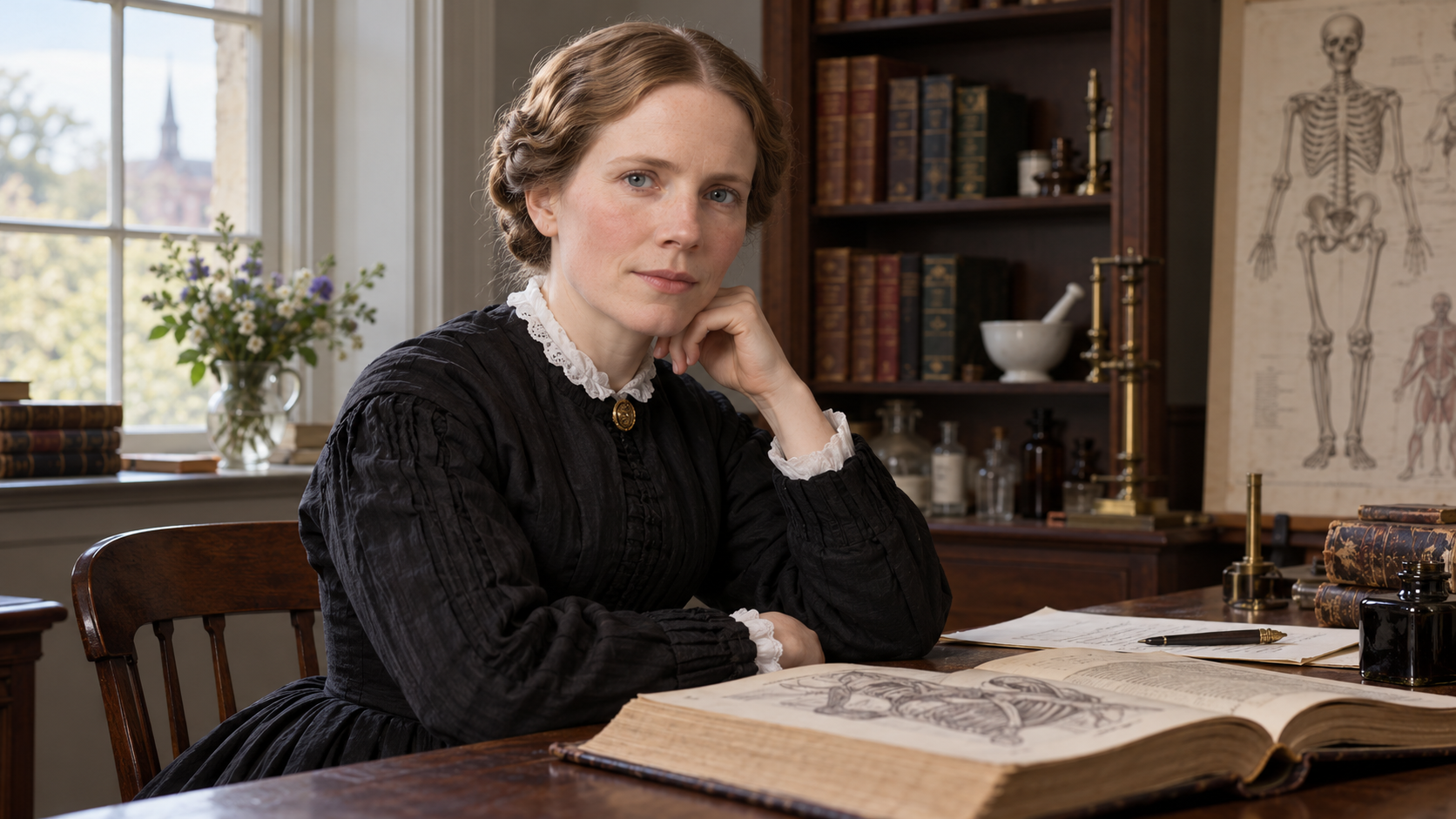
“If the present arrangements of society will not admit of woman’s free development, then society must be remodeled, and adapted to the great wants of all humanity.”
Elizabeth Blackwell wrote these words in an August 12, 1848 letter to abolitionist and women’s-rights organizer Emily Collins, while Blackwell was still pursuing the medical education that would make her the first woman in the United States to receive a medical degree. The letter, later printed in History of Woman Suffrage, does more than defend an individual ambition. Its full sentence begins with the “present arrangements of society” and ends with the “great wants of all humanity,” moving from a barrier placed before women to a wider judgment about institutions. Blackwell’s point was structural: if prevailing customs could not accommodate women’s development, those customs had failed a human need and should be rebuilt. The quotation is slightly longer than the series’ preferred limit because cutting it would weaken that complete movement from exclusion to reconstruction. The letter predates Blackwell’s 1849 graduation and shows that the institutional argument was already present while the outcome of her own training remained uncertain.
The sentence refuses to treat admission as a favor granted by an unchanged system. Blackwell asks whether the system itself deserves to remain intact when it wastes ability and narrows service. Her later career gave that argument a practical form through medical work, education, and institution building, yet the quote should not be polished into an uncomplicated triumph story. She faced hostility, limited clinical opportunities, and the burden of being treated as an exception. Access for one pioneer also did not erase barriers based on race, class, or disability. The useful lesson is therefore larger than individual persistence. Talent can survive exclusion, but a society pays a cost when people must spend their energy overcoming rules that should never have blocked them. Her wording also widens the constituency for reform: the beneficiary is not only the excluded applicant but a society that needs all available intelligence and care.
In health care, Blackwell’s challenge remains a way to examine who is able to learn, practice, conduct research, and shape policy. Representation matters partly because institutions make better decisions when more experience reaches the table, but head counts alone do not complete the work. Training pathways, evaluation standards, mentoring, pay, and the design of workplaces can still reward a narrow idea of who belongs. Blackwell’s wording directs attention to those arrangements rather than asking excluded people to adapt endlessly. Remodeling can mean changing a policy, widening access to education, or listening to communities whose needs have been treated as peripheral. The measure is not whether an institution can point to an exceptional entrant. It is whether capable people can develop freely and use their knowledge for the health of the public. That standard invites outcome measures beyond enrollment, including retention, authority, working conditions, and whether patients encounter a profession able to understand a broader range of lives.
Blackwell wrote the sentence to Emily Collins in 1848 while seeking a place in medicine.
Its structure connects women’s development with society’s obligation to serve humanity.
The quote questions the arrangements that create exclusion, rather than celebrating one exceptional person who gets through.
Lasting change reaches training, evaluation, work conditions, authority, and opportunity.
Health systems can ask whose knowledge is welcomed and whose experience remains outside decision making.
Remodeling succeeds when capable people can contribute without first carrying an avoidable burden of exclusion.
Explore more "Quotes of The Day"
Discover more notable quotes from influential voices across politics, science, business, technology, sports, and culture. Each quote offers insight into how ideas, beliefs, and decisions shape the world around us.