

On This Day in Business: January 10, 1901
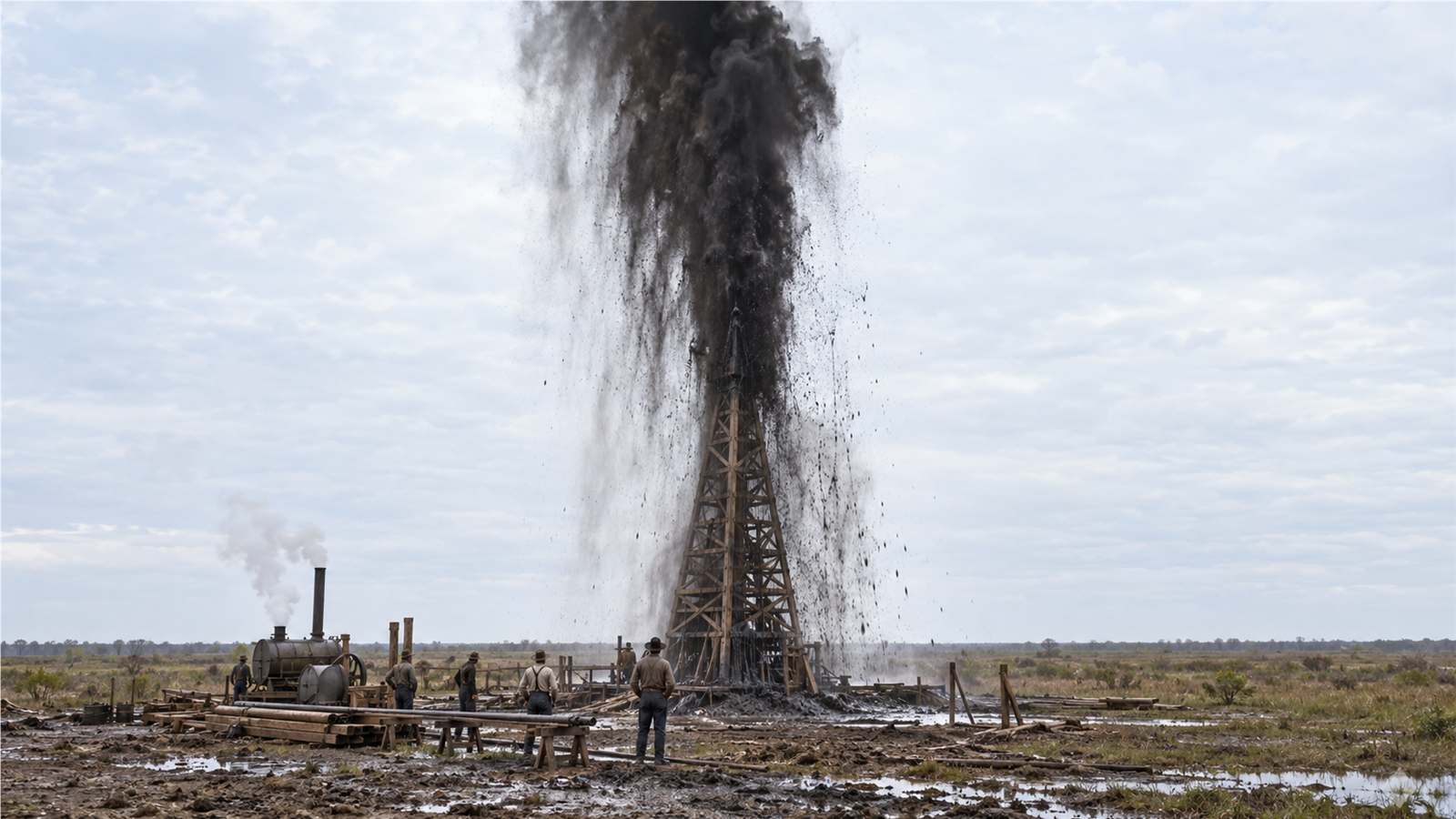
On January 10, 1901, the Lucas well at Spindletop, a salt-dome hill south of Beaumont, Texas, erupted in a towering stream of oil. Mining engineer Anthony F. Lucas had pursued the site after earlier drilling attempts failed, while Pennsylvania investors John Galey and James Guffey supplied crucial financing and brought in the Hamill brothers as drillers. At a depth of roughly 1,139 feet, pressure forced drilling mud and pipe from the hole before crude oil surged above the wooden derrick. The well was not the first oil discovery in Texas, but its extraordinary flow demonstrated that the Gulf Coast could support production on a scale far beyond the modest wells then operating in the state.
The gusher ran uncontrolled for nine days before crews capped it. Estimates vary, but Texas historical sources commonly place its flow near 100,000 barrels a day, greater than the combined output of many existing American wells. That abundance changed the economics of petroleum. Oil prices in the local market collapsed while entrepreneurs rushed to lease land, organize companies and drill nearby. Beaumont’s population multiplied within months, and a forest of derricks covered the small field. Speculation created winners and failures, while fires, spills, crowded claims and inadequate storage exposed the costs of producing much more crude than the region could immediately handle.
Spindletop also created demand for an entire industrial system. New pipelines, rail tank cars, ships, refineries, storage facilities and port improvements were needed to move and process the oil. Companies that became associated with Texaco, Gulf, Mobil and Exxon trace important origins or early growth to the boom. Cheaper fuel encouraged factories, railroads and ships to shift from coal toward petroleum, while the emerging automobile market later increased demand for gasoline. The discovery did not single-handedly create those changes, but it supplied capital and volume at a moment when engineers and businesses were finding more uses for refined products.
Production at the original field soon declined from its spectacular beginning, showing the boom-and-bust risk of concentrated drilling. Yet the commercial response spread exploration across Texas and helped establish the Gulf Coast as a major refining and transportation center. Government agencies also faced new questions about waste, pollution, ownership and regulation as wells multiplied. January 10 matters because the Lucas gusher converted a disputed geological idea into visible proof and triggered investment far beyond one lease. Spindletop became a symbol of the modern petroleum industry: dramatic discovery followed by rapid company formation, infrastructure building, price volatility and long-term dependence on a fuel whose economic benefits were accompanied by serious environmental and safety consequences.
Pattillo Higgins had promoted drilling on the Spindletop salt dome, and Anthony Lucas later pursued the prospect with financing and technical help from experienced Pennsylvania oilmen.
The Hamill brothers used rotary drilling techniques to work through difficult Gulf Coast formations before the Lucas well reached the oil-bearing layer at about 1,139 feet.
The well blew in on January 10, sending oil far above its wooden derrick and flowing at an estimated 100,000 barrels per day until crews capped it nine days later.
The sudden supply overwhelmed local storage and transport, pushed prices down and produced spills, fires, speculation and intense drilling on a small area of land.
Investors built pipelines, refineries, tank cars, ships and port facilities, while companies linked to Texaco, Gulf, Mobil and Exxon emerged or expanded through the boom.
Spindletop made Texas a major oil region and accelerated petroleum use in industry and transportation, while also exposing the volatility and environmental costs of rapid extraction.
Explore more of "On This Day ..."
Discover more events from the same date across news, politics, technology, sports, and other fields. Each link highlights significant moments that shaped history on different fronts.