

On This Day in Business: January 9, 2007
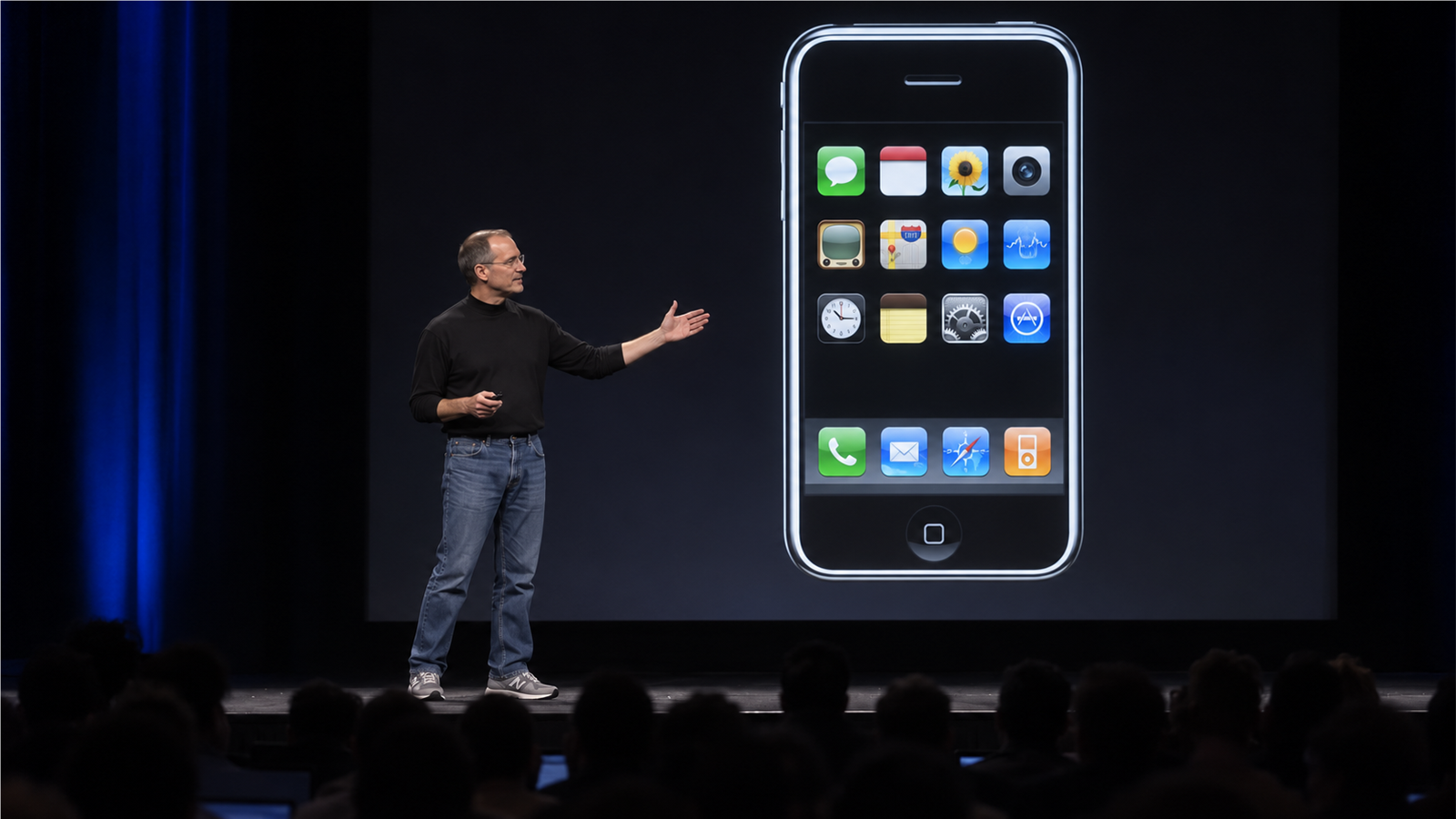
On January 9, 2007, Apple chief executive Steve Jobs unveiled the original iPhone during the Macworld conference in San Francisco. He presented it as three products in one: a mobile phone, a widescreen iPod with touch controls and an internet communications device. Instead of the physical keyboards common on many advanced phones, the device relied on a 3.5-inch multi-touch display and software controls that changed with the task. The announcement moved Apple into a large market dominated by established handset makers and wireless carriers. It also extended the company’s strategy of combining hardware, software, content synchronization and retail support in a tightly managed product experience.
The demonstration emphasized direct manipulation. Users could scroll with a finger, pinch photographs, browse full web pages and select voicemail messages from a list. Apple also described sensors that rotated the display, reduced brightness according to ambient light and turned off the screen when the phone approached a user’s face. The first model operated on Cingular’s EDGE network and included Wi-Fi, Bluetooth, a two-megapixel camera and either four or eight gigabytes of storage. Those specifications were not the most powerful available in every category. The commercial proposition was that familiar communication and media functions could be made coherent through a responsive interface and desktop-class software.
Jobs announced an exclusive United States partnership with Cingular, which was owned by AT&T. The arrangement gave Apple a distribution and network partner while requiring buyers to accept a carrier relationship. Apple said the four-gigabyte model would cost $499 and the eight-gigabyte model $599 with a two-year contract. The phone was not available on announcement day; United States sales began June 29. It also lacked features later considered standard, including third-party native applications at launch and a faster 3G radio. The distinction between unveiling and shipping matters: January 9 introduced the product and its business model, while months of engineering, carrier preparation and retail execution remained.
Market adoption turned the announcement into a platform shift. Apple reported selling its millionth iPhone 74 days after the June release. The company later opened an App Store, expanded to more carriers and countries, and built services and accessories around the device. Competitors accelerated their own touchscreen strategies, while software developers and media companies gained a new route to mobile customers. None of those outcomes was assured during the keynote, and the original phone had meaningful limitations. January 9 nevertheless established the core proposition: a pocket computer organized around touch, software and internet access rather than a fixed keypad. That proposition changed Apple’s revenue mix and helped reshape the economics of handsets, wireless data, applications and digital services.
Apple entered the phone market after building successful businesses around Macintosh computers, the iPod and the iTunes ecosystem, but it had no history as a handset maker.
The original design replaced most physical controls with a 3.5-inch multi-touch display, allowing software to present different keyboards, lists and controls for different tasks.
Steve Jobs introduced the iPhone at Macworld on January 9 as a phone, widescreen iPod and internet communicator combined in one handheld device.
The demonstration was not a retail launch. The first United States units went on sale June 29, and early models used EDGE service and did not yet support native third-party apps.
An exclusive Cingular partnership tied the product to a carrier network, while Apple controlled the hardware, operating software, synchronization and much of the customer experience.
Rapid sales and the later App Store turned the handset into a broader platform, reshaping competition in phones, mobile software, media distribution and digital services.
Explore more of "On This Day ..."
Discover more events from the same date across news, politics, technology, sports, and other fields. Each link highlights significant moments that shaped history on different fronts.