

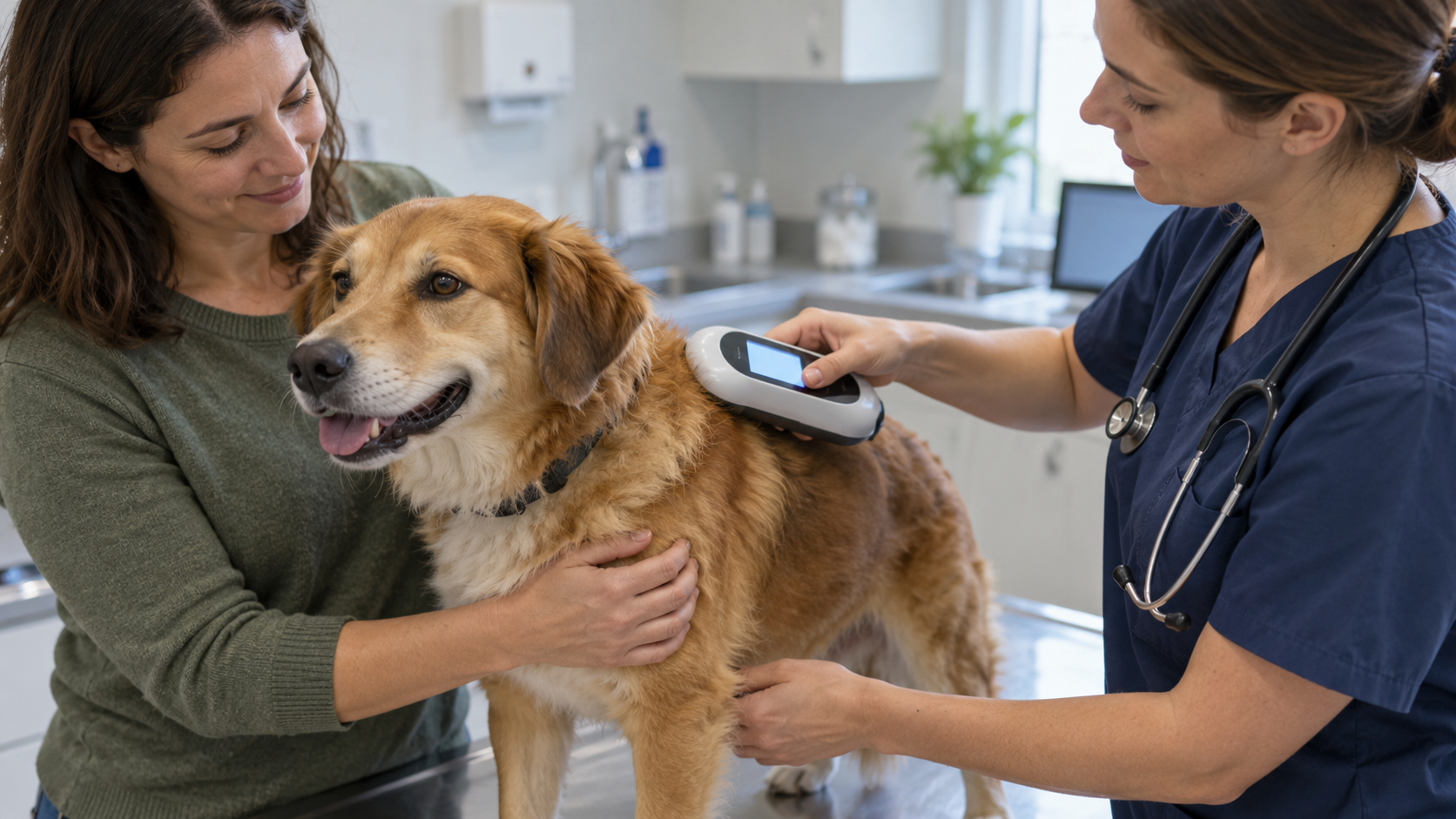
Pet Microchip Explainer
A pet microchip is a tiny passive identification device implanted under the animal’s skin, commonly between the shoulder blades in dogs and cats. It contains a unique number and an antenna sealed in biocompatible material. The chip has no battery and does not continuously transmit. When a compatible scanner passes nearby, the scanner’s radio-frequency field briefly powers the chip, which returns its number. A shelter, veterinary clinic, or animal-control agency can then use that number to identify a registry and request the owner contact information stored there.
The chip itself usually contains only the identification number, not the owner’s address, medical history, or live location. The useful information resides in one or more registry databases. Implantation and registration are separate steps: a perfectly readable chip cannot reunite anyone if its number was never registered or the listed phone and email are obsolete. Owners should verify the number, registry, alternate contact, and address after implantation, whenever they move or change numbers, and during routine veterinary visits.
Scanning technique matters because chips can migrate a short distance and different technologies have been used. Staff typically scan the animal’s whole body slowly with a universal scanner, holding it close and changing orientation. A failed first pass does not prove that no chip is present. Metal collars, scanner batteries, animal movement, chip position, and equipment compatibility can affect the read. If a number appears, a lookup service can point staff toward a participating registry; privacy controls mean the public may not see the owner’s details directly.
Implantation is performed with a sterile needle and feels similar to a vaccination, although the needle is larger. Sedation is not usually required, but a veterinarian or trained professional should assess the animal and follow local rules. The chip should be scanned before and after placement to confirm the number and function. Adverse reactions are uncommon, yet swelling, pain, discharge, or a persistent lump warrants veterinary attention. A chip does not replace an identification tag, because a visible phone number lets a neighbor return a pet without finding a scanner.
Microchips are not GPS trackers. They cannot show the pet on a map, announce that an animal has left a yard, or communicate over cellular networks. GPS collars contain their own power and radio systems and have different cost, charging, coverage, and privacy considerations. A microchip’s advantage is durability: it remains with the animal when a collar slips off and can be read years later. Its limitation is dependence on someone finding the pet, scanning thoroughly, locating the correct registry, and reaching a current contact.
Reunion therefore depends on a chain of ordinary actions. The pet receives a standards-compatible chip, the owner registers it, contact details stay current, finders bring the animal to a scanning organization, staff scan the entire body, and the registry relays information. Owners can strengthen the chain with a collar tag, clear photographs, license, veterinary records, and prompt lost-pet reports. The chip is not a surveillance device or proof of ownership by itself, but it is a durable identifier that helps turn an unknown animal into a reachable household.
A passive pet microchip returns a unique number when energized by a nearby scanner; a registry links that number to owner contacts. Key terms include passive RFID, scanner, identification number, registry, universal scan, registration, migration, and alternate contact.
Usually only a unique identification number. Owner contact details are held by a registry, so registration and updates are essential after implantation, moving, or changing a phone number.
No. A microchip has no battery, GPS, or cellular connection. It must be scanned at close range after the animal is found; a collar tag and active GPS device serve different purposes.
Explore more "Explainers"
Discover additional explainers across politics, science, business, technology, and other fields. Each explainer breaks down a complex idea into clear, everyday language—helping you better understand how major concepts, systems, and debates shape the world around us.