

On This Day in Tech: November 30, 1956
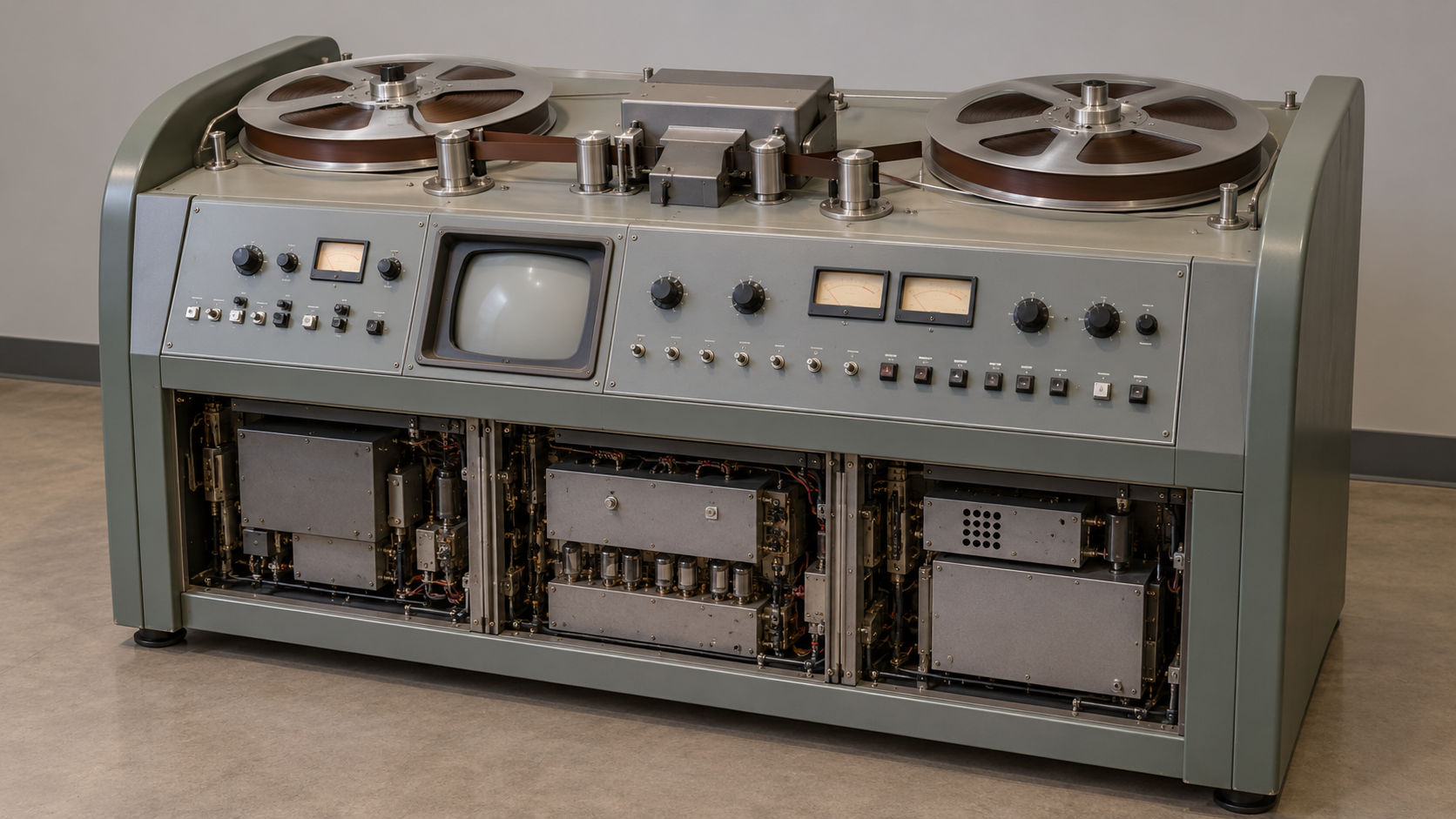
On November 30, 1956, CBS used an Ampex videotape recorder at Television City in Hollywood to rebroadcast Douglas Edwards and the News for West Coast viewers. The program had originated in New York and was shown later to accommodate the difference in time zones. This was a practical on-air use of the new recording system, not its first laboratory experiment or public demonstration. Ampex had already shown the technology earlier that year. The broadcast mattered because it put magnetic video recording into a routine network task: preserving a television program well enough to transmit it again at the intended local hour.
Before practical videotape, a broadcaster could record a television image on motion-picture film using a kinescope process. That approach required filming a screen, developing the film, and preparing it for transmission. It could preserve performances, but it added processing work and compromised picture quality. Magnetic recording offered the prospect of replay without waiting for film development. Recording television was much more difficult than recording sound, however, because the video signal required substantially more information to be captured. Simply running ordinary audio tape past a stationary head faster was not a satisfactory solution for an economical, reliable broadcast system.
The Ampex team, led by Charles Ginsburg, developed a system using rotating recording heads that scanned across two-inch-wide tape. Charles Anderson, Ray Dolby, Alex Maxey, Shelby Henderson, and Fred Pfost contributed to the work. Mechanical precision, signal electronics, tape handling, and stable playback had to function together; producing an image once in a laboratory was not enough. The large early console was professional equipment, with open reels, extensive electronics, and maintenance requirements. It was not a compact cassette recorder for households. On November 30, CBS demonstrated the operational value of that combined engineering effort by using a recorded program in its broadcast schedule.
Videotape subsequently changed how television programs could be produced, delayed, repeated, and edited, although those practices developed over time. The first systems did not provide the instant random access or effortless digital editing familiar today. Nor did the ability to reuse tape guarantee preservation: a recording could be erased, discarded, or left without serviceable playback equipment. Film continued to have important uses alongside magnetic video. The anniversary therefore marks a change in broadcast capability, not the immediate disappearance of an older medium. By separating a program’s performance time from its later transmission without a film-processing cycle, the CBS rebroadcast helped demonstrate a new working relationship between television production, storage, and scheduling.
CBS recorded the New York news program and replayed it for West Coast viewers on November 30, 1956. The delay served a real scheduling need.
Ampex had demonstrated the recorder earlier in 1956. The November anniversary concerns broadcast use rather than the first experiment.
Rotating heads made it possible to record a video signal across wide tape. Precision mechanics and signal processing were both necessary.
The early machine was a large professional console. It should not be mistaken for a later home cassette recorder or an audio-only reel machine.
Videotape enabled new production and scheduling practices, but early editing and operation still required specialized work.
A reusable medium is not automatically an archive. Long-term preservation depends on retaining recordings and maintaining a way to play them back.
Explore more of "On This Day ..."
Discover more events from the same date across news, politics, technology, sports, and other fields. Each link highlights significant moments that shaped history on different fronts.