

On This Day in Health: July 26, 1990
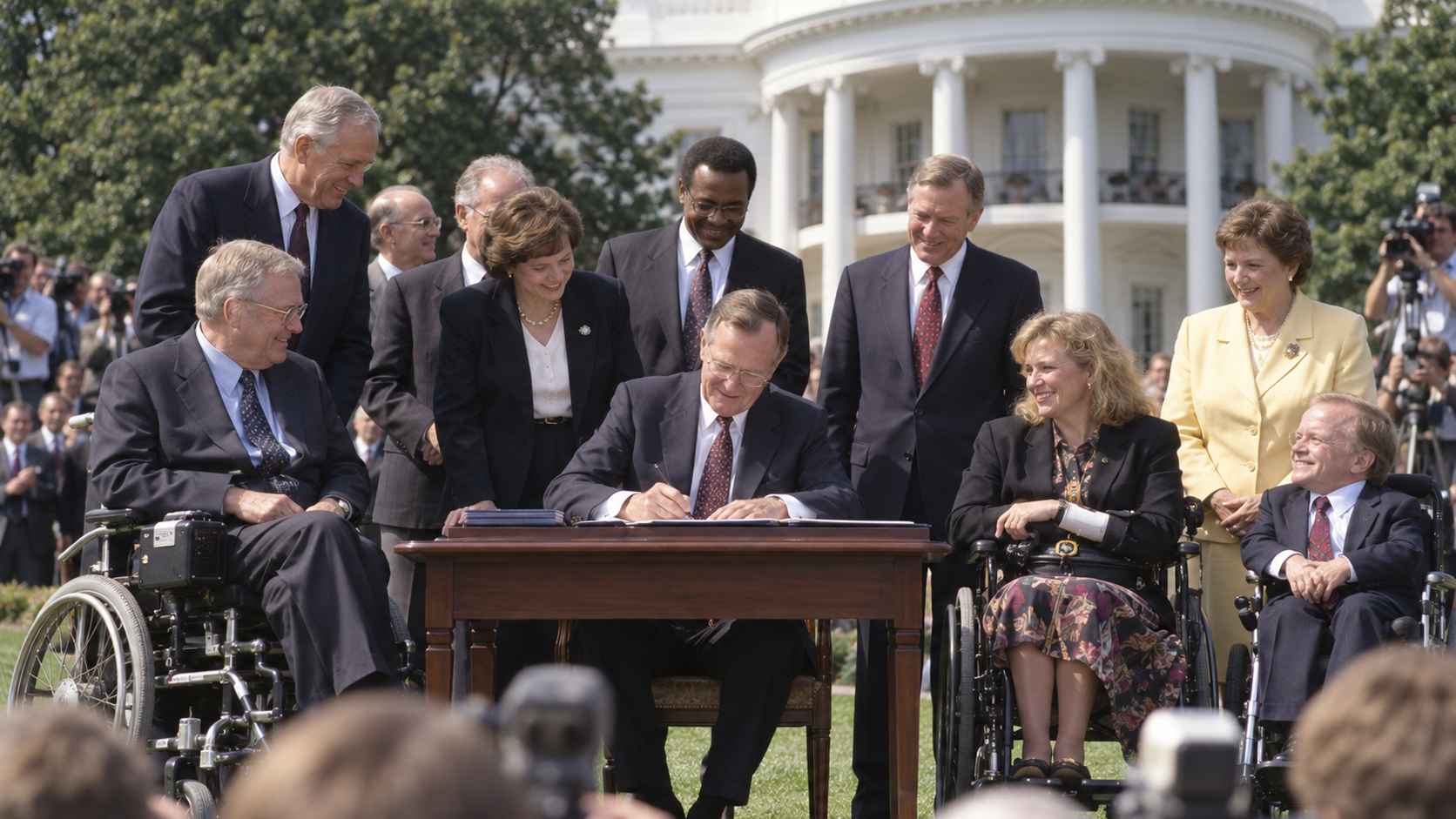
On July 26, 1990, President George H. W. Bush signed the Americans with Disabilities Act on the White House South Lawn. Hundreds of advocates, officials, and guests witnessed the ceremony, including disability rights leaders who had spent years pressing Congress for comprehensive protection. Public Law 101-336 treated exclusion based on disability as a civil rights issue. Its passage established a national commitment to equal opportunity, independent living, and participation in public life for people with physical, sensory, intellectual, and psychiatric disabilities. The law built on the Rehabilitation Act of 1973 while extending protections far beyond federally funded programs.
The ADA addressed barriers through several titles. Title I prohibited covered employers from discriminating against qualified workers and required reasonable accommodations when they did not cause undue hardship. Title II applied to state and local government services and public transportation. Title III covered private businesses open to the public, including stores, hotels, restaurants, theaters, and doctors' offices. Title IV required telecommunications relay services for people with hearing or speech disabilities. These rules joined physical access with communication access, employment opportunity, and fair treatment, recognizing that disability exclusion can be created by policies and environments as well as by stairs or narrow doorways.
The law had direct health consequences even though it was not a health insurance program. Medical offices, hospitals, pharmacies, and public health agencies had to examine whether their spaces, equipment, information, and procedures excluded patients with disabilities. Effective communication could require interpreters or accessible formats, while reasonable modifications could prevent routine rules from blocking care. Employment protections also mattered because work often determines income and access to insurance. Implementation took regulations, technical standards, litigation, and continuing advocacy. The statute did not instantly remove inaccessible buildings, unequal treatment, or gaps in clinical knowledge, but it supplied enforceable tools for challenging those barriers.
Congress later passed the ADA Amendments Act of 2008 after court decisions had narrowed who qualified for protection. The amendments directed that disability be interpreted broadly and shifted attention toward whether discrimination occurred. Across subsequent decades, the ADA influenced building design, transportation, workplace practices, digital services, emergency planning, and health care delivery. Its anniversary is also a reminder that accessibility remains unfinished work. People with disabilities still report delayed care, inaccessible diagnostic equipment, communication failures, and bias. The July 26 signing nevertheless changed the legal foundation: access was no longer framed mainly as charity or preference, but as a civil right backed by public responsibility.
The ADA emerged from decades of organizing by disabled people and from earlier federal measures, especially Section 504 of the Rehabilitation Act of 1973.
President Bush signed the bipartisan measure on July 26, 1990, before a large South Lawn audience that included prominent disability rights advocates.
The law prohibited disability discrimination in employment, government services, public accommodations, transportation, and telecommunications, with different provisions taking effect on separate schedules.
Covered organizations had to make reasonable changes and remove certain barriers, but duties were shaped by standards such as undue hardship, fundamental alteration, and ready achievability.
The ADA helped normalize accessible design and strengthened legal routes for challenging exclusion from medical care, work, education, transit, and civic life.
The 2008 amendments broadened statutory coverage, while continuing enforcement and advocacy address persistent physical, communication, technological, and attitudinal barriers.
Explore more of "On This Day ..."
Discover more events from the same date across news, politics, technology, sports, and other fields. Each link highlights significant moments that shaped history on different fronts.