

On This Day in Health: August 2, 1820
John Tyndall was born in Leighlinbridge, County Carlow, Ireland, on August 2, 1820. He began as a surveyor, studied science in Germany, and joined London’s Royal Institution in 1853. Tyndall became known for precise experiments on heat, gases, light, glaciers, and the atmosphere. His work was not confined to one discipline, and some of its strongest effects on health came from applying physics to a medical question: could apparently clean air carry the living particles associated with decay and disease? At a time when germ theory still faced resistance, he created memorable demonstrations that made invisible contamination visible.
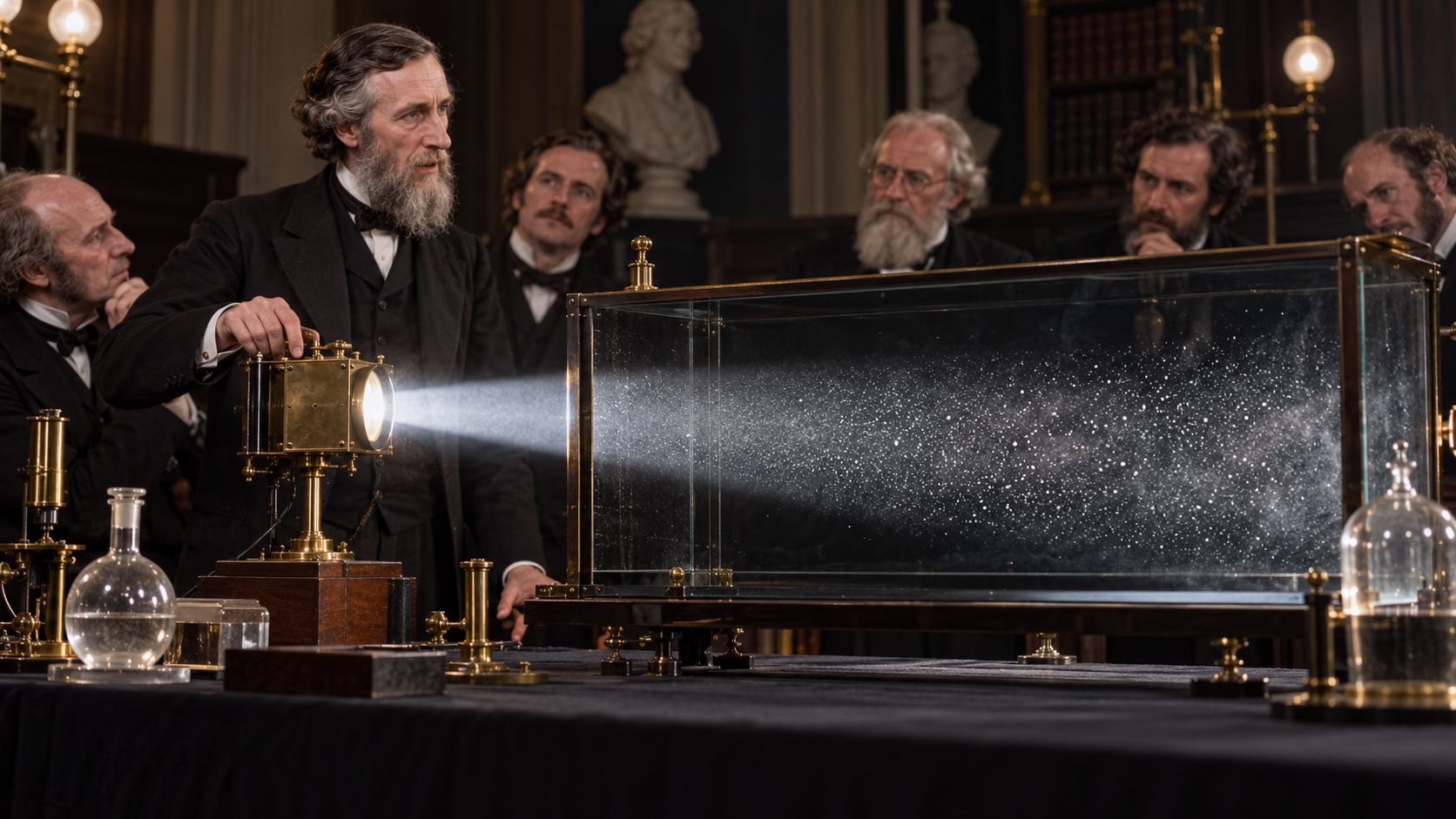
Tyndall sent a concentrated beam of light through enclosed air. Dust suspended in ordinary air scattered the beam and revealed a bright path, while carefully cleared air appeared optically empty. He then used dust-free chambers and nutrient infusions to test claims that life could arise spontaneously. Properly prepared infusions remained sterile when protected from airborne particles but developed growth after exposure. His experiments supported Louis Pasteur’s conclusion that microorganisms came from existing life rather than appearing from lifeless matter. Tyndall became an influential English-language advocate for germ theory, explaining why controlling dust, instruments, and air could matter in laboratories and medical settings.
The research also exposed a puzzle. Some infusions survived ordinary boiling and later produced growth. Tyndall recognized that certain organisms could persist in unusually resistant states. He developed a method of intermittent heating: heat the material, allow surviving spores to germinate, then heat it again. Repeating the cycle could destroy organisms that a single treatment missed. The procedure became known as tyndallization. Modern sterilization generally relies on more dependable methods such as pressurized steam, filtration, radiation, or validated chemical processes, but Tyndall’s experiments helped establish that sterilization must account for both active microbes and resistant forms.
Tyndall also designed cotton-wool respirators to filter particles from inhaled air and discussed their possible use against dust, smoke, and contagion. His devices were not modern medical respirators, and nineteenth-century ideas about infection were still developing, yet the underlying principle of filtration is familiar. His broader career included research showing that gases such as water vapor and carbon dioxide absorb radiant heat, work central to later climate science. The health significance of his birthday lies in his experimental habits: isolate variables, remove contamination, repeat the test, and make unseen hazards measurable. Those habits strengthened germ theory and helped shape the laboratory logic behind infection control.
Tyndall was born in County Carlow on August 2, 1820, trained in Germany, and joined the Royal Institution, where he became a prominent experimental physicist and lecturer.
By passing intense light through air, he showed how suspended particles scatter a beam and created a vivid way to distinguish dusty air from optically clean air.
Protected nutrient infusions stayed sterile while exposed ones developed growth, strengthening the case that microorganisms arrived from existing airborne material.
When simple boiling failed, Tyndall connected later growth with resistant forms and developed repeated heating cycles that became known as tyndallization.
His cotton-wool respirators applied filtration to dust, smoke, and possible contagion, anticipating a principle that remains central to respiratory protection.
Modern microbiology has refined his conclusions and uses stronger sterilization methods, but his controlled experiments helped make contamination a measurable scientific problem.
Explore more of "On This Day ..."
Discover more events from the same date across news, politics, technology, sports, and other fields. Each link highlights significant moments that shaped history on different fronts.