

On This Day in Health: August 3, 1956
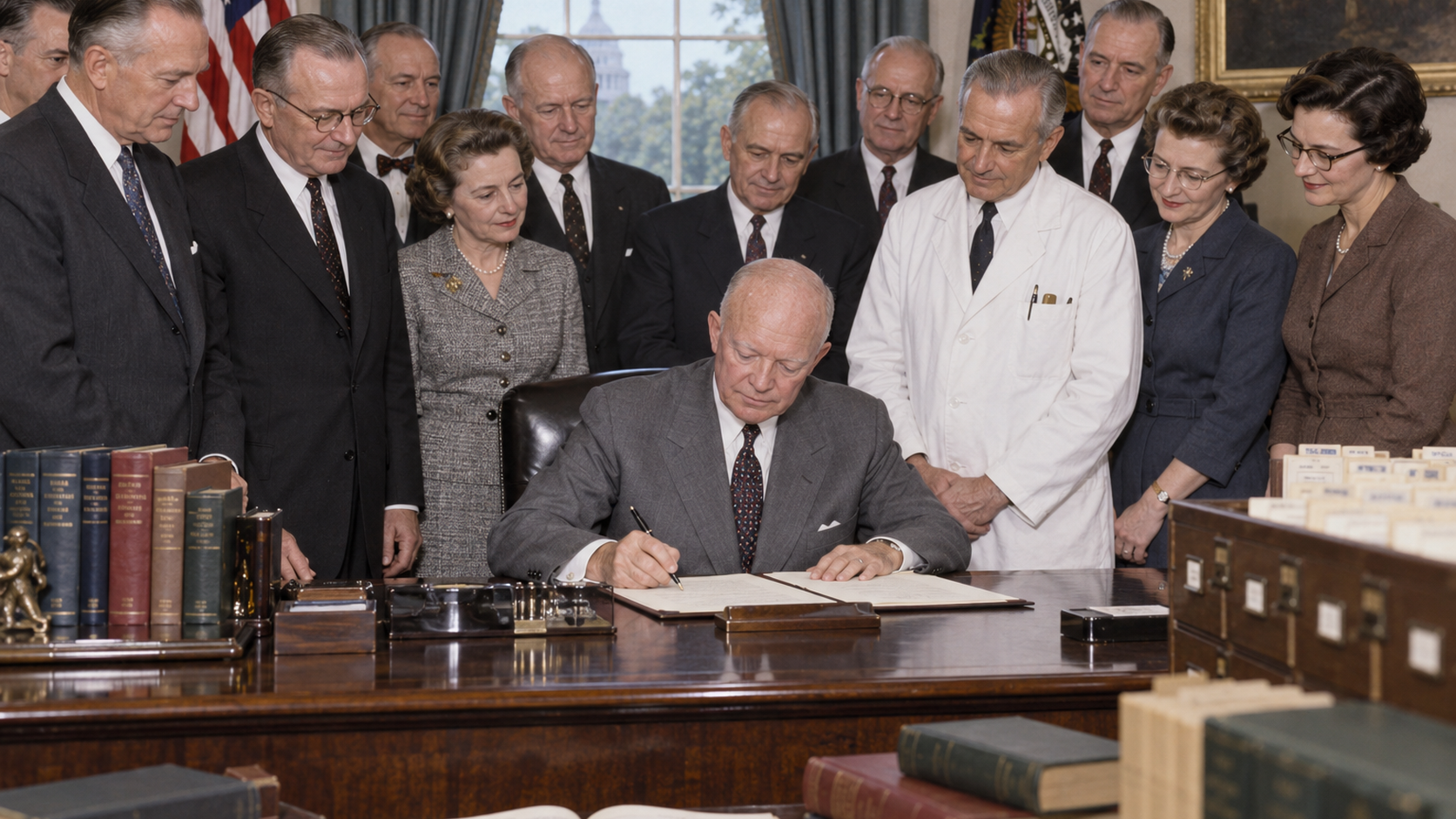
On August 3, 1956, President Dwight D. Eisenhower signed the National Library of Medicine Act. The law transferred the Armed Forces Medical Library to the U.S. Public Health Service and established it as the National Library of Medicine. The change gave a venerable collection a national civilian mission at a moment when medical research and publication were expanding rapidly. The statute directed the library to acquire and preserve medical materials, organize them through cataloging and indexing, publish bibliographies, lend or copy materials, and provide reference and research assistance. It also created a Board of Regents to advise federal health leaders on policy.
The institution’s roots reached back to 1836, when the Office of the Surgeon General of the Army began assembling medical books. Under John Shaw Billings in the nineteenth century, the library became internationally important and produced the Index-Catalogue and Index Medicus, tools that helped physicians find scattered medical literature. By the mid-twentieth century, however, the collection occupied an aging building on the National Mall, and its military placement limited the broader role advocates imagined. Surgeon Michael DeBakey, medical librarians, federal officials, and legislators pushed for stable authority, modern facilities, and a mission that matched the library’s value to research and public health.
Senators Lister Hill and John F. Kennedy introduced the legislation, and the act authorized both the new institution and suitable buildings. The transfer became effective later in 1956. A purpose-built library opened on the NIH campus in Bethesda in 1962, placing the collection near a growing center of biomedical research. Director Frank Bradway Rogers guided the transition and pursued machine-assisted indexing. That effort led to MEDLARS, an early computerized system for storing and retrieving medical citations, followed by MEDLINE and online search. The library’s later programs would include PubMed, ClinicalTrials.gov, GenBank, and the National Center for Biotechnology Information.
The August 3 law mattered because access to evidence is part of health infrastructure. Research cannot inform care if clinicians and scientists cannot locate, evaluate, and share it. A national library could preserve the record, create common vocabularies, connect regional institutions, and use new technology to move knowledge faster. Today’s instant searches can obscure how much organization lies behind them: indexing standards, curated databases, preservation work, networks, and public systems built over decades. The National Library of Medicine Act turned a historic military collection into a national biomedical information service. It helped make medical knowledge more discoverable and established a foundation for the digital tools used by researchers, health professionals, patients, and families around the world.
The collection began in 1836 in the Office of the Surgeon General of the Army and grew into a major international resource for medical books, journals, and indexes.
President Eisenhower signed the National Library of Medicine Act on August 3, 1956, transferring the Armed Forces Medical Library to the Public Health Service.
The law required preservation, cataloging, indexing, publication, lending, copying, and reference assistance while creating a Board of Regents to advise the institution.
Advocates including surgeon Michael DeBakey and Senators Lister Hill and John F. Kennedy helped secure a civilian mission and authority for a modern building.
The Bethesda facility opened in 1962, and subsequent computerized systems led from MEDLARS and MEDLINE to widely used online biomedical resources.
NLM’s evolution shows that organized, accessible evidence is essential infrastructure for research, clinical decisions, public health, and informed patients.
Explore more of "On This Day ..."
Discover more events from the same date across news, politics, technology, sports, and other fields. Each link highlights significant moments that shaped history on different fronts.