

On This Day in Tech: December 7, 1972
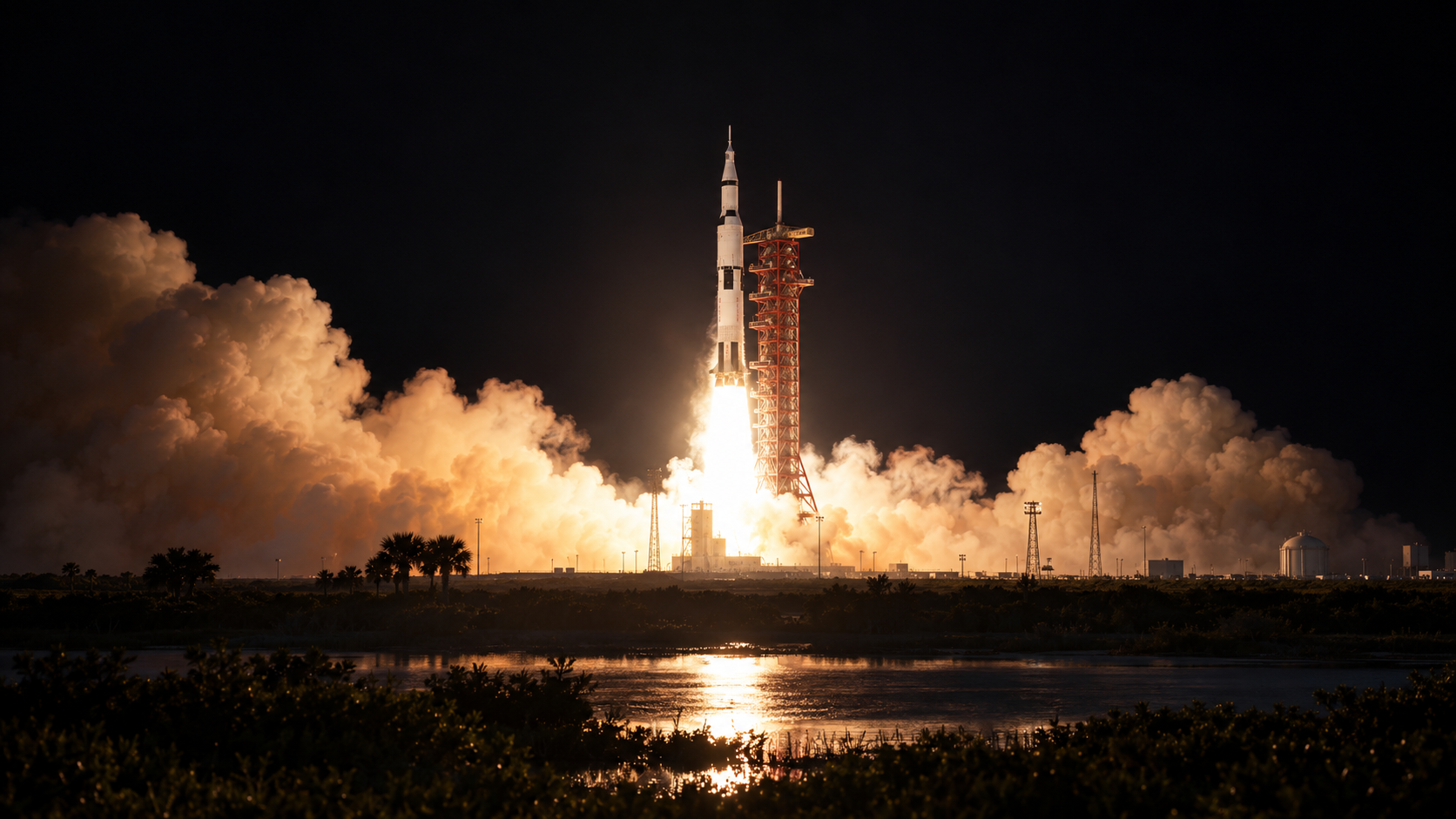
On December 7, 1972, NASA launched Apollo 17 from Kennedy Space Center’s Launch Pad 39A in Florida, sending Eugene Cernan, Ronald Evans, and Harrison Schmitt toward the Moon. The Saturn V lifted off at 12:33 a.m. Eastern Standard Time, illuminating the nighttime landscape. It was the first night launch in the American human spaceflight program and the beginning of Apollo’s final lunar landing mission. The date marks the departure from Earth, not the landing at Taurus-Littrow. Cernan and Schmitt would reach the lunar surface on December 11, while Evans operated the command and service modules in lunar orbit.
The launch followed a late countdown interruption that demonstrated the importance of ground computers as well as rocket engines. A sequencing problem prevented an expected automatic command from being sent to pressurize the third stage’s liquid-oxygen tank. An engineer supplied the command, but the automatic system still registered the missing signal and halted the count. Controllers investigated, recycled the sequence, and resumed preparations. The delay shifted liftoff from the evening of December 6 into the following morning. Thus the launch date reflects a real operational sequence, not merely a convenient anniversary selected after the mission.
Apollo 17 depended on several connected spacecraft and maneuvers. The Saturn V’s lower stages accelerated the vehicle upward and toward orbit; its third stage first established a parking orbit around Earth and later fired again to begin the journey to the Moon. The crew’s command and service modules then separated, turned around, and docked with the lunar module before extracting it from the rocket stage. These steps transformed a stacked launch vehicle into a spacecraft arrangement suitable for the lunar voyage. Each transition required working guidance, propulsion, separation mechanisms, communications, and crew procedures rather than a single uninterrupted rocket burn from Florida to the lunar surface.
The expedition extended Apollo’s scientific work through geological exploration, experiments, photography, and observations from orbit. Schmitt, a trained geologist, brought professional field-science experience to the surface investigations. A lunar rover helped Cernan and Schmitt reach sites beyond walking distance, while Evans conducted a separate program overhead. Their successful return on December 19 completed the mission, but it was not an outcome already guaranteed at liftoff. December 7 remains an anniversary of launch-system integration and carefully managed operations. Its technological significance includes both the spectacular Saturn V departure and the less visible work of people and computers that identified an anomaly, restored a safe countdown, and began a complex sequence of flights and transfers.
Apollo 17 carried a commander, command module pilot, and lunar module pilot. Their responsibilities divided between the spacecraft that stayed in orbit and the vehicle that descended.
Harrison Schmitt was a trained geologist. His participation connected the engineering objective of reaching the Moon with the scientific task of interpreting rocks and terrain.
The original countdown targeted the evening of December 6. A hold lasting two hours and forty minutes moved the actual launch into December 7.
The rocket's brightness should not obscure the role of the ground sequence. A missing automatic command could halt the launch even after an engineer had supplied the needed action.
The mission used a lunar rover and a package of surface experiments, building on equipment and procedures developed during earlier Apollo flights.
Apollo 17 was the final lunar landing expedition of the Apollo program. That program-specific description avoids making a changing claim about every later spaceflight effort.
Explore more of "On This Day ..."
Discover more events from the same date across news, politics, technology, sports, and other fields. Each link highlights significant moments that shaped history on different fronts.