

On This Day in Tech: December 15, 1970
On December 15, 1970, the Soviet Union’s Venera 7 descent capsule reached the surface of Venus and transmitted information back to Earth. Developed by the Lavochkin organization, the mission achieved the first return of spacecraft data from the surface of another planet. Its landing followed an interplanetary journey begun with launch from Baikonur in August. The accomplishment was not an ordinary spacecraft arrival in a familiar environment: Venus’s dense atmosphere, high pressure, and extreme heat had defeated earlier attempts to obtain a sustained surface record. Venera 7 survived long enough to demonstrate that a specially engineered capsule could operate there.
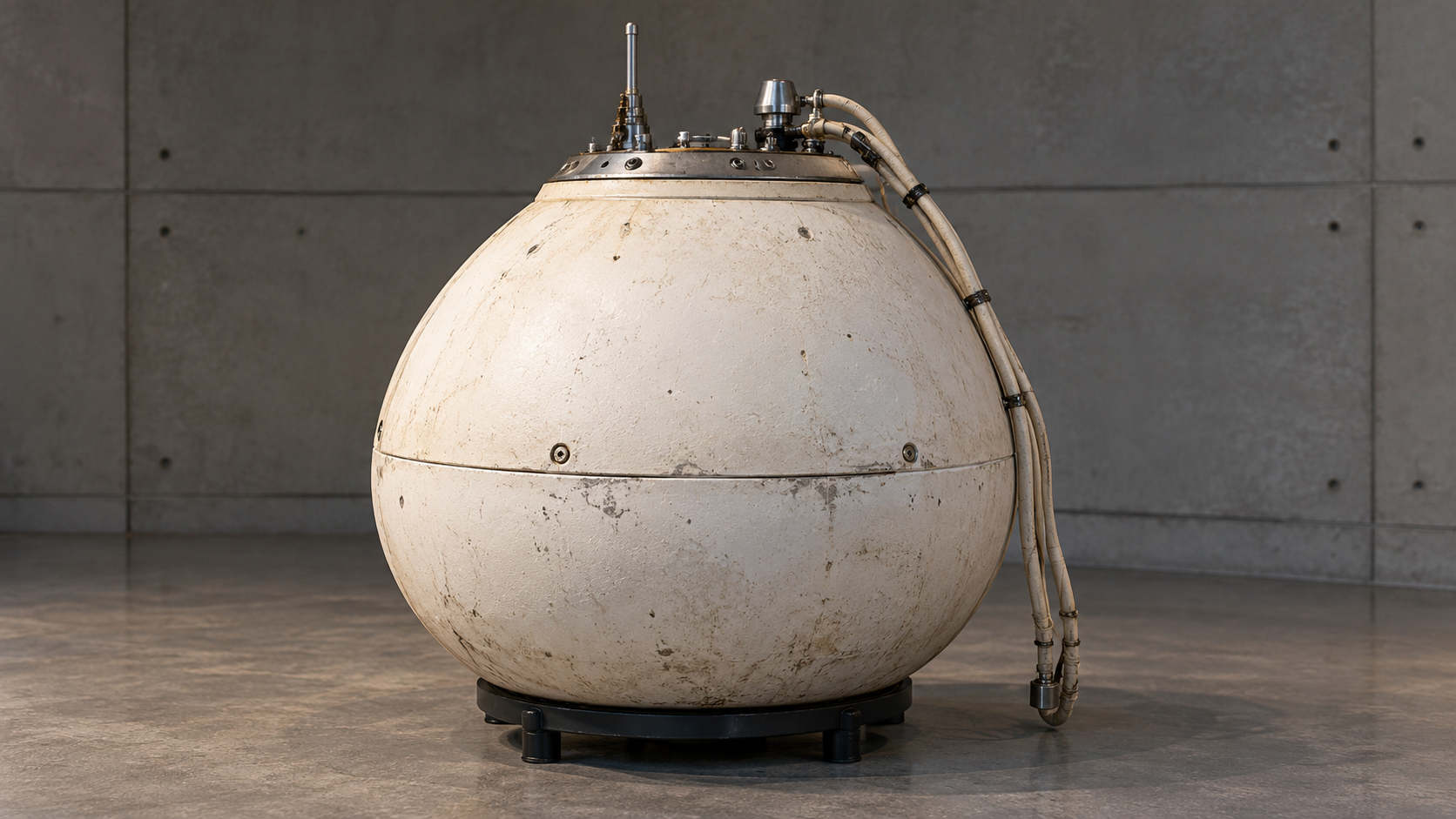
The design incorporated lessons from earlier Venera atmospheric probes. Measurements had shown that the surface environment was much harsher than some early expectations, requiring a stronger pressure vessel and careful thermal protection. The descent capsule used a robust titanium inner shell, insulation, and a protective outer structure. Its carrier spacecraft supplied the systems needed during the cruise and prepared the capsule for the final encounter, including cooling it before release. The lander’s task was deliberately limited. It did not carry a rover, produce panoramic surface photographs, or promise months of operation. Protecting a small instrument package for a short interval was already a demanding engineering objective.
During the December 15 descent, atmospheric drag slowed the capsule and a parachute reduced its speed further. Parachute trouble made the final part of the descent more severe than intended. The radio signal became difficult to recognize around the time of impact, and the outcome was not immediately obvious from a simple clear transmission. Subsequent processing of the recorded signal revealed roughly twenty-three minutes of information from the surface. The spacecraft had continued transmitting even though its final orientation weakened reception. Temperature measurements established conditions of roughly 475 degrees Celsius, with uncertainty that matters when interpreting a pioneering instrument record.
The mission’s success therefore required more than a vessel reaching the ground. It depended on pressure-resistant construction, thermal management, descent equipment, radio transmission, ground recording, and careful analysis after the event. Its limited data should not be inflated into a complete survey of Venus or confused with photographs from later Venera landers. Subsequent missions improved the equipment and expanded the scientific return, but they built on the proof that a capsule could survive the surface at all. December 15 marks that practical achievement: engineers had crossed the boundary between studying a planet from afar and obtaining information from functioning equipment on its ground, while confronting conditions that left very little time for the experiment.
Venera 7 followed earlier atmospheric probes that refined knowledge of Venus's pressure and temperature. Those results changed the engineering requirements for a survivable lander.
The pressure shell and thermal protection addressed different hazards. Strong construction alone would not keep instruments cool, while insulation alone could not resist the surrounding atmosphere.
The landing was harder than planned after parachute problems. Calling the mission successful does not mean that the descent proceeded without faults.
Recorded signals required processing before the surface transmission was recognized. The scientific outcome emerged through analysis, not an immediately obvious public picture.
The mission returned a brief physical measurement record, not surface photography. Later Venus landers supplied capabilities that Venera 7 did not carry.
The reconstructed capsule image is grounded in an engineering-model photograph and a technical diagram. It does not claim to show an authentic scene on Venus.
Explore more of "On This Day ..."
Discover more events from the same date across news, politics, technology, sports, and other fields. Each link highlights significant moments that shaped history on different fronts.