

On This Day in Tech: December 16, 1965
On December 16, 1965, NASA launched Pioneer 6 from Cape Canaveral, Florida, beginning a mission to measure the environment between the planets. A Delta rocket sent the small, uncrewed spacecraft into an orbit around the Sun, inside Earth’s path. Managed by NASA’s Ames Research Center, the mission carried instruments for studying charged particles, magnetic fields, cosmic rays, and radio propagation. It was not a landing mission or a probe dispatched to photograph the surface of the Sun. Its purpose was to sample conditions where the spacecraft traveled and help scientists understand how solar activity affected a much wider region of space.
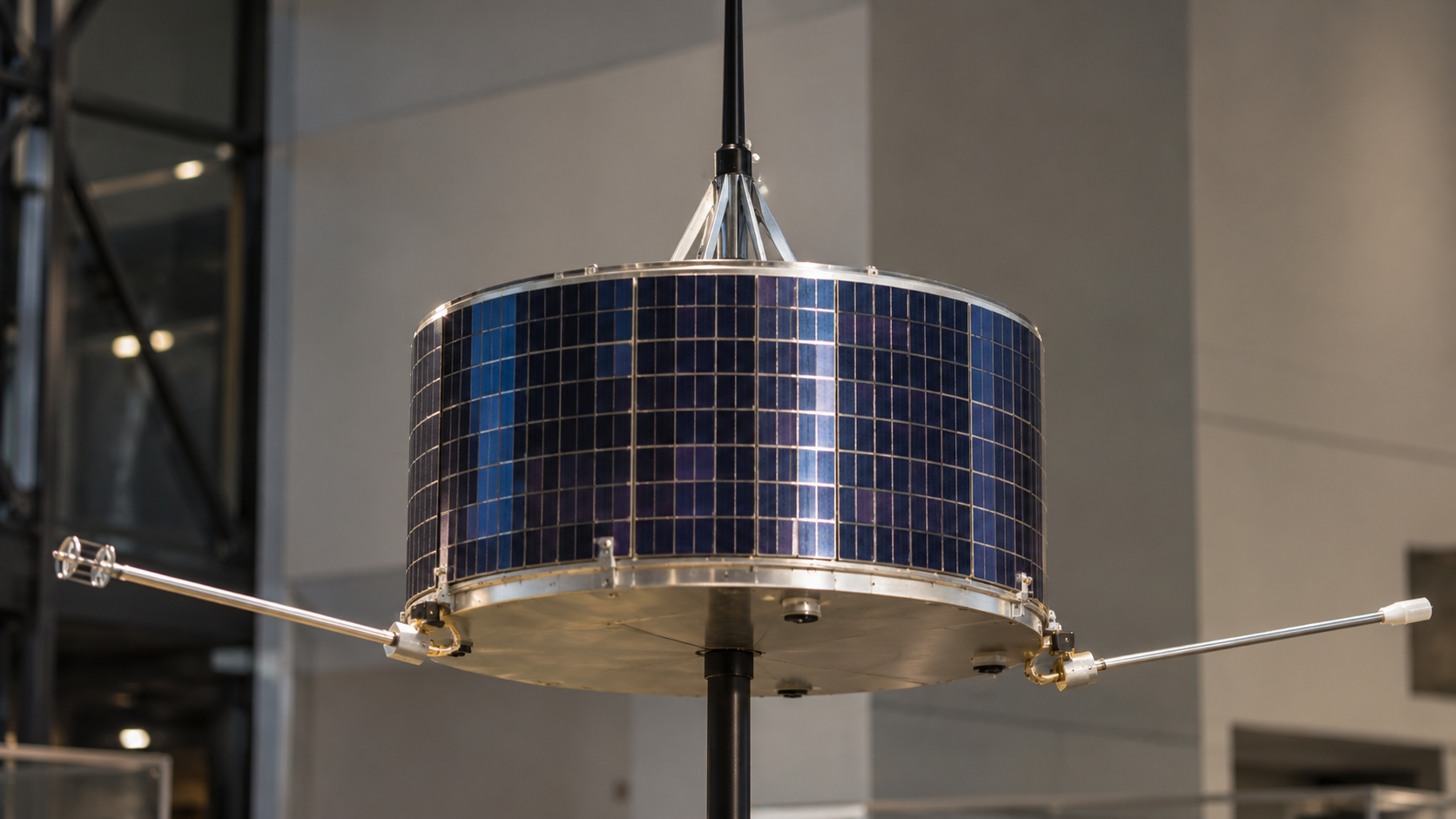
Pioneer 6 was the first of a new group of solar-orbiting Pioneers that would take measurements from widely separated locations. Observing from Earth alone could not reveal whether a change was limited to one region or moving through interplanetary space. Multiple spacecraft offered a way to compare conditions over time and distance. The compact design used a cylindrical body with solar cells, antennas, and instruments, while rotation helped maintain a workable orientation. The mission placed particular value on dependable measurements and communications rather than a large photographic payload. Information about the spacecraft’s own health was needed alongside the scientific observations.
Solar wind consists of charged particles flowing outward from the Sun, accompanied by a magnetic environment that changes with solar activity. Pioneer 6 could investigate these conditions directly rather than infer everything from distant telescopes. Its measurements became more informative as other Pioneers joined the network. Radio tracking also offered a different kind of experiment: when the spacecraft passed behind the Sun from Earth’s perspective in 1968, its signal helped researchers examine the solar corona. That later observation was not performed on launch day. It depended on a useful alignment, working equipment, and the ability to maintain a difficult communications link.
The spacecraft greatly exceeded its original six-month design lifetime, and NASA made its last contact with Pioneer 6 in December 2000. That longevity did not mean that every instrument remained unchanged or that every period provided uninterrupted coverage. Components aged, power availability changed, and useful operations depended on the condition of the remaining systems. The broader achievement was the demonstration that a modest spacecraft could provide valuable observations over a long interval when supported by reliable engineering and ground operations. December 16 marks the beginning of that record. Pioneer 6 helped turn the space between planets from an almost empty-looking background into an environment that could be measured repeatedly, compared across locations, and considered when planning other technological activities.
The mission's orbit was centered on the Sun, not Earth. Its path allowed measurements from a different location than instruments attached to an Earth-orbiting satellite.
The Smithsonian reference is a quarter-scale model, and the second visual reference is a later exhibit replica. Neither is presented as an archival photograph of Pioneer 6 in flight.
Measurements from separated probes helped distinguish local conditions from changes spreading through a wider region. The value came from coordination as well as individual instruments.
The 1968 solar occultation used a radio signal passing near the Sun from Earth's perspective. It was a later experiment, not a camera observation made during the 1965 launch.
Pioneer 6 survived far longer than its initial design interval. Longevity should not be confused with a claim that all components operated continuously for its entire history.
Space-weather research links solar physics with practical concerns such as communications and other spacecraft operations. Pioneer measurements helped develop that wider observing approach.
Explore more of "On This Day ..."
Discover more events from the same date across news, politics, technology, sports, and other fields. Each link highlights significant moments that shaped history on different fronts.