

Flash Memory Data Storage Explainer
Flash memory stores information by changing the electrical state of microscopic transistors and retaining that state when power is removed. In a floating-gate or charge-trap cell, electrons are placed behind an insulating barrier. The trapped charge changes the voltage required to make the cell conduct. During a read, circuits apply controlled voltages and sense whether current flows. That threshold corresponds to a stored value. No mechanical part moves, and the charge remains for years under specified conditions, although retention is not permanent.
A cell can represent more than one bit by using several threshold-voltage ranges. Single-level cells use two states for one bit. Multi-level, triple-level, and quad-level designs distinguish four, eight, or sixteen states. Packing more bits into a cell increases capacity, but the voltage windows become narrower. Programming and reading require finer control, error correction becomes more important, and endurance usually falls. Manufacturers choose cell mode and spare capacity according to performance, price, and expected workload.
Programming uses a strong electric field to move electrons through the insulating material into the storage region. A controller applies carefully shaped voltage pulses and verifies the resulting threshold after each step. Cells sharing word lines and bit lines are programmed together in pages, commonly holding several kilobytes plus error-correction information. Data cannot normally be overwritten in place because removing charge is organized differently. Before reused cells are programmed, an entire larger erase block must be returned to an erased state.
That page-and-block geometry gives NAND flash its characteristic behavior. Reading and programming operate on pages, while erasing operates on blocks containing many pages. Updating a small file may require writing new pages, marking old data invalid, copying still-valid pages elsewhere, and erasing the old block later. A storage controller hides these operations behind ordinary logical addresses. NOR flash uses a different array organization that permits convenient random reads and is often chosen for code storage, while NAND favors dense mass storage.
Each program and erase cycle stresses the insulator. Over time, charge can leak, traps accumulate, and threshold distributions spread. Temperature and long retention intervals worsen some effects. Error-correcting codes recover a limited number of incorrect bits, and controllers track blocks, refresh data, and avoid repeatedly wearing the same area. Bad blocks exist even in new high-density devices and are mapped out. Published endurance describes an operating expectation with specified management, not an exact moment when every cell fails.
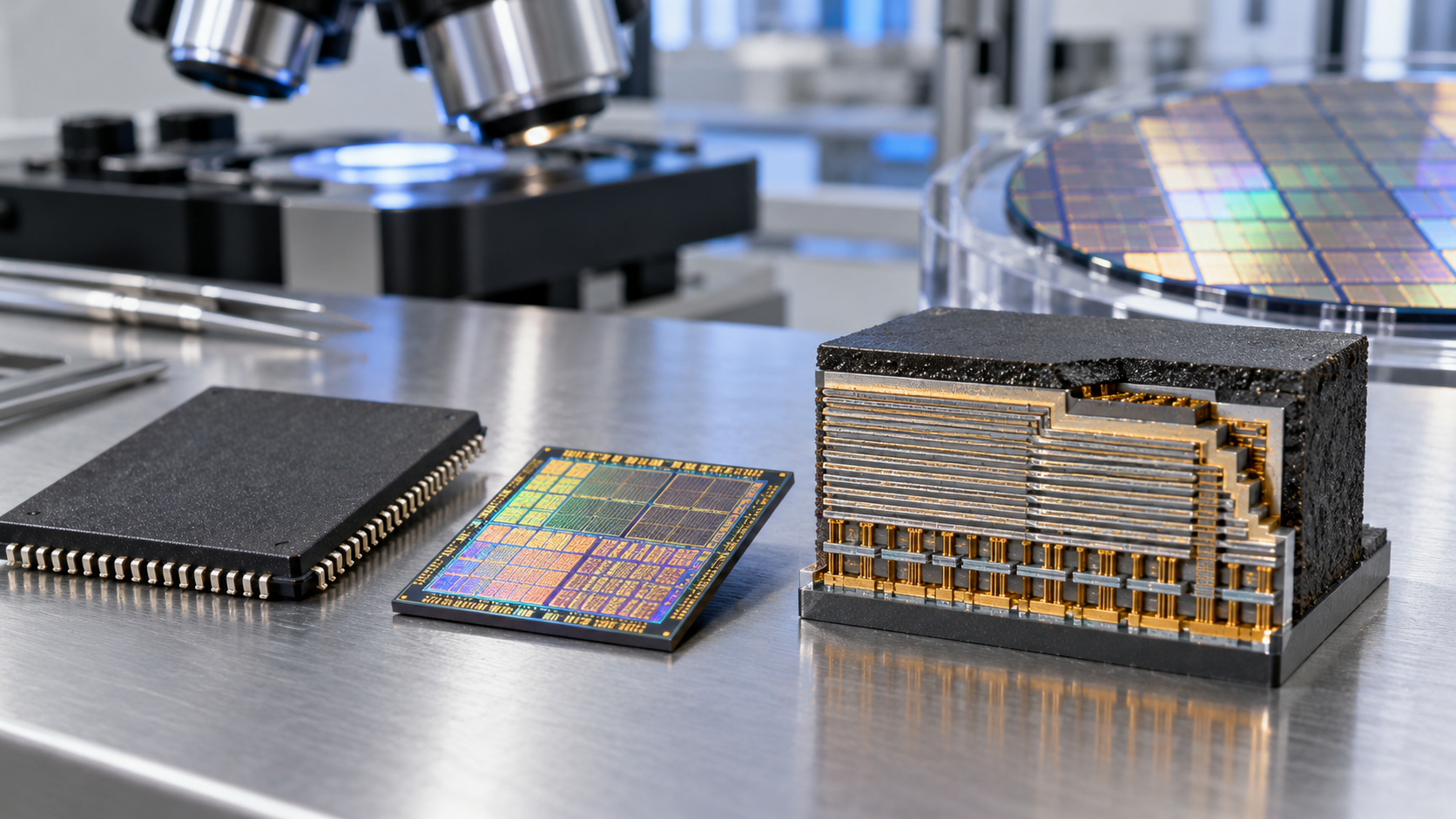
Three-dimensional NAND stacks cells vertically to increase density without shrinking every feature in the horizontal plane. Strings of transistors pass through many deposited layers, and newer generations add more tiers. Vertical construction improves capacity but makes manufacturing, channel uniformity, and layer alignment demanding. Some products temporarily operate a portion of higher-density NAND in a faster one-bit mode as a write cache, then fold that data into denser storage later. Performance can drop when that cache is exhausted.
Flash memory therefore stores data as carefully separated threshold states, but a usable drive depends on far more than the cells. Page buffers, high-voltage circuits, sense amplifiers, error correction, address mapping, bad-block handling, wear management, and refresh preserve the illusion of simple writable storage. The nonvolatile charge is the physical memory; the controller is what turns imperfect, block-erased arrays into dependable files, applications, and removable cards.
An SSD controller is the processor inside a solid-state drive that organizes data across NAND flash memory. It translates the computer’s requests into the operations the flash chips can perform safely.
It maps logical addresses to physical locations, schedules reads and writes, corrects errors, and moves data when blocks need to be erased. It also uses cache and parallel channels to improve responsiveness.
Flash cannot overwrite a small piece of data directly; it often must erase a larger block first. Extra free capacity gives the controller room to rearrange data and maintain speed as the drive fills.
Explore more "Explainers"
Discover additional explainers across politics, science, business, technology, and other fields. Each explainer breaks down a complex idea into clear, everyday language—helping you better understand how major concepts, systems, and debates shape the world around us.