

MEMS Microphone Explainer
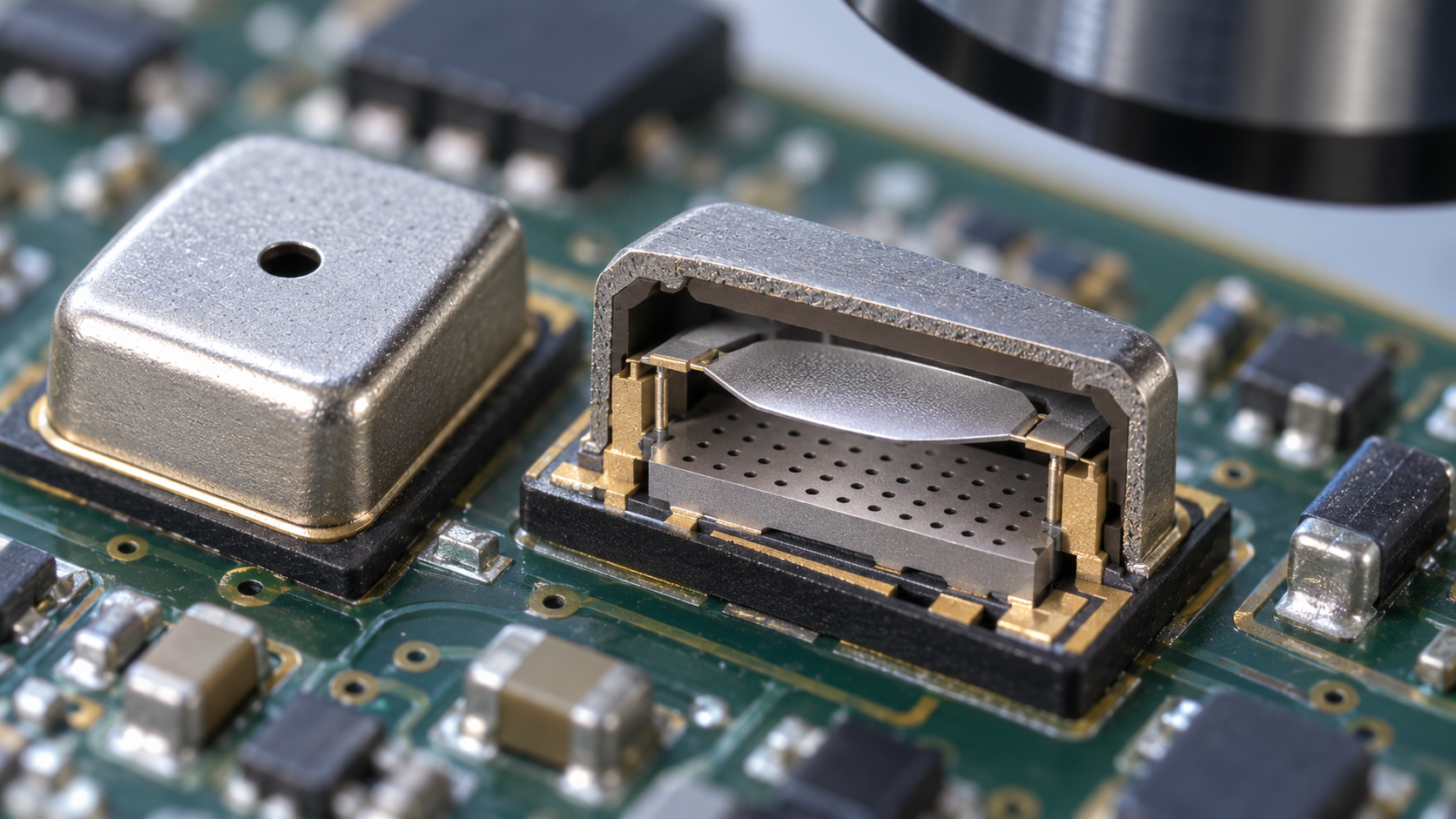
A microelectromechanical systems microphone, or MEMS microphone, senses sound with a structure etched into silicon. Air pressure enters through a small port and moves an extremely thin diaphragm. A fixed perforated backplate sits close to that diaphragm, and together they form a capacitor. As sound pushes the diaphragm, the gap changes by a microscopic amount, changing capacitance. Integrated electronics apply bias, detect that change, amplify it, and produce an analog voltage or a digital bitstream that the host device can record and process.
The acoustic path begins at the package opening. A top-port microphone admits sound through its lid, while a bottom-port device uses a hole in the circuit board. The cavity, port, protective mesh, and any gasket affect frequency response and noise. The backplate contains openings so air can move with limited damping while remaining electrically fixed. Tiny vents equalize slow atmospheric pressure changes; otherwise weather or altitude could hold the diaphragm away from its intended resting position.
Capacitance is very small, so the sensing circuit must sit close to the mechanical element. A preamplifier converts the capacitance variation into a usable signal while adding as little noise as possible. Analog MEMS microphones output a voltage that an external audio converter samples. Digital models include conversion and transmit pulse-density modulation or another serial format. Integration makes devices consistent, compact, and resistant to electrical interference along the board, which suits phones, earbuds, laptops, cars, and voice-controlled equipment.
Sensitivity describes output for a known pressure, while signal-to-noise ratio compares a reference sound with the microphone’s own noise. Acoustic overload point indicates how loud a signal can become before distortion exceeds a defined limit. Frequency response shows how evenly the microphone handles bass through treble. These specifications interact. A tiny low-power design may sacrifice noise performance or maximum level, and a protective waterproof membrane can alter response even when the microphone chip itself is unchanged.
Modern products use arrays rather than one microphone. Differences in arrival time and level allow beamforming toward a talker and suppression of other directions. Multiple microphones also support echo cancellation, wind detection, and active noise control. Array performance depends on precise spacing, synchronized sampling, calibration, enclosure acoustics, and algorithms. A high-quality sensor placed behind a poor port can perform worse than a modest sensor with a well-designed acoustic path.
Fabrication produces many mechanical structures on a wafer using semiconductor processes. The MEMS die may be packaged with a separate application-specific circuit or integrated more closely. Sealing must protect fragile structures from particles, moisture, solder flux, and handling while leaving an acoustic route open. Mechanical shocks can make the diaphragm strike a stop, and ultrasound or strong radio interference can create unexpected signals. Product designers add filtering, shields, meshes, and software checks for the intended environment.
The microphone’s achievement is turning air motion into a repeatable electrical measurement at millimeter scale. Pressure bends a silicon diaphragm, geometry changes capacitance, and nearby electronics recover the signal before noise overwhelms it. Packaging then determines how real sound reaches that sensor. The digital audio used by an application is therefore the product of a mechanical resonator, an analog front end, a converter, clocking, enclosure design, and signal processing—not simply a hole in a device.
NAT Traversal Explainer
NAT traversal is the set of techniques that helps two devices communicate when one or both sit behind a network address translator. A home or office router commonly gives local devices private addresses and creates temporary public address-and-port mappings for outbound traffic. That conserves public addresses and hides internal addressing, but it also means a remote device cannot simply send a new packet to the private address. Real-time applications such as voice calls, video meetings, and peer-to-peer data transfer must discover usable paths through those mappings or fall back to a relay.
Interactive Connectivity Establishment, or ICE, organizes this process. Each endpoint gathers candidate addresses that might receive traffic. Host candidates represent local interfaces. Server-reflexive candidates describe public mappings learned through a STUN server. Relayed candidates come from a TURN server that is prepared to forward traffic. The endpoints exchange candidate information through the application’s signaling channel, form candidate pairs, and run authenticated connectivity checks. A successful pair proves that packets can travel over that route under the current network conditions.
STUN supplies the public view. An endpoint sends a binding request to a STUN server on the Internet, and the response reports the source address and port that the server observed. That server-reflexive address reflects the router’s current mapping, not a permanent identity or a tunnel. STUN by itself does not guarantee that another endpoint can use the mapping, because translators and firewalls differ in how they create, filter, and expire state. ICE therefore treats STUN as one tool and verifies each proposed path rather than assuming a discovered address will work.
Connectivity checks also coordinate which path the two endpoints should select. Both sides send STUN-based checks over candidate pairs, follow ICE priorities and roles, and nominate a working pair. The traffic used for checking helps create or refresh the necessary NAT state. When a direct path works, media or data can flow between endpoints without passing through an application relay. The connection must still keep mappings alive as needed and react if the network changes—for example, when a phone moves from Wi-Fi to cellular service or a router replaces its mapping.
Some networks will not permit a dependable direct path. A symmetric mapping policy, restrictive firewall, incompatible address family, or blocked UDP can defeat otherwise valid candidates. TURN handles that case by allocating an address on a reachable relay server. Each endpoint communicates with the relay, which forwards packets between them. Relaying adds bandwidth cost, latency, and an additional service dependency, but it provides a predictable route when direct traversal fails. Well-designed applications gather relay candidates early enough that failure of direct checks does not cause a long, confusing pause.
NAT traversal is not a way to ignore security policy. ICE checks must be authenticated as specified so an attacker cannot casually redirect traffic, and the application still needs encryption, identity checks, consent, rate limits, and abuse protection. Candidate exchange usually travels through a separately authenticated signaling service, but that service does not carry the media simply because it introduced the endpoints. Privacy settings may limit which local addresses are exposed, so implementations balance path discovery with unnecessary network disclosure. Mappings can expire, enterprise networks can require proxies, and IPv6 may reduce address translation without eliminating firewalls or path discovery. Implementations also protect STUN and TURN infrastructure against amplification, credential theft, and relay abuse. Applications monitor the selected path and can restart ICE when connectivity is lost or the network interface changes. The enduring lesson is that endpoints cannot infer reachability from an address alone. ICE combines candidate discovery, verified connectivity checks, prioritized path selection, and a relay fallback to turn uncertain network boundaries into a connection that applications can actually use.
Explore more "Explainers"
Discover additional explainers across politics, science, business, technology, and other fields. Each explainer breaks down a complex idea into clear, everyday language—helping you better understand how major concepts, systems, and debates shape the world around us.