

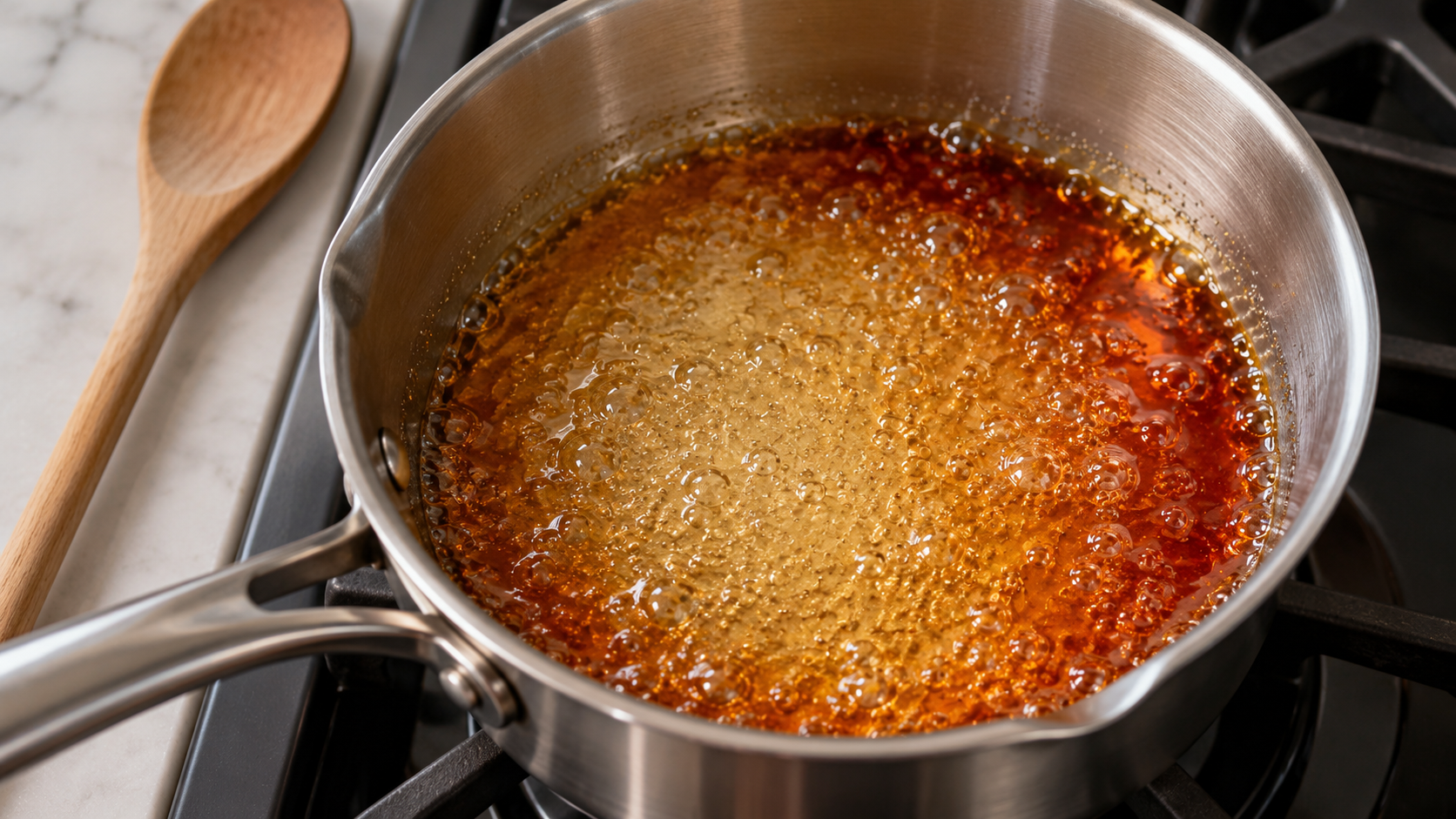
Sugar Caramelization Explainer
Caramelization browns sugar through a complex family of heat-driven reactions. As sugar becomes hot enough, its molecules begin to rearrange, lose water, split into smaller fragments, and combine into larger colored compounds. Volatile products create aromas described as buttery, nutty, fruity, toasted, or bitter. The process does not require proteins or amino acids, which distinguishes it from the Maillard reaction responsible for much of the browning in bread crust and seared meat. A pan of nearly pure sugar can caramelize because the sugar itself supplies the reacting material.
The sequence begins differently depending on the method. In dry caramel, granulated sugar is heated directly and first melts in localized areas. In wet caramel, sugar dissolves in water; boiling then removes that water before the syrup climbs into the caramelization range. Water helps distribute dissolved sugar evenly but does not lower the final temperature needed for browning. Because evaporation holds a wet syrup near its boiling point at first, visible color may seem to arrive suddenly after most free water is gone and temperature begins rising rapidly.
Sucrose can break into glucose and fructose in a reaction called inversion, especially in the presence of acid and water. Continued heating promotes dehydration and fragmentation into reactive compounds such as furans, aldehydes, and other aroma precursors. Condensation and polymerization create larger molecules associated with yellow, amber, and brown color. Scientists use names such as caramelan, caramelen, and caramelin for broad colored fractions, but cooking caramel is not one single chemical. Its exact mixture changes continuously with sugar type, temperature, time, moisture, acidity, and impurities.
Temperature control determines the balance between sweetness, aroma, and bitterness. Pale caramel retains more simple sweetness and delicate aromas. Deeper amber develops stronger toasted and bitter notes, while further heating produces acrid flavors and eventually carbonized material. Residual heat in a heavy pan continues cooking after the burner is turned off. Cooks therefore judge both color and temperature, remove the pan before the desired endpoint, or carefully stop the reaction with an added liquid. Adding liquid to very hot caramel can cause violent boiling and steam, so the method requires heat-resistant equipment and distance from splashes.
Crystallization is a physical problem separate from browning. Undissolved crystals on a pan wall can seed an orderly sucrose lattice, turning a smooth syrup grainy. Clean pans, complete dissolution, limited agitation after boiling, washing down the sides, and small amounts of interfering sugars or acid can reduce that risk. Crystallized sugar can still brown, but uneven solid masses make heat control harder. A dark patch can burn while neighboring crystals remain pale. Gentle swirling distributes heat more safely than splashing syrup up the sides with vigorous stirring.
Caramelization changes when sugar is mixed with other food. Milk or cream introduces proteins, so caramelization and Maillard chemistry can occur together. Butter adds fat, water, and milk solids. Fruit supplies acids, minerals, and several sugars that react at different rates. Color alone cannot reveal which pathway dominates. For consistent caramel, use an even pan, moderate controlled heat, clear visual cues, and a safe stopping method. The brown color is evidence that familiar sugar molecules have become a diverse population of new substances—not that the sugar has merely been toasted on its surface.
Caramelization is the heat-driven breakdown and recombination of sugars into volatile flavors and colored compounds. Key terms include sucrose, inversion, dehydration, fragmentation, condensation, polymerization, furan, crystallization, residual heat, and Maillard reaction.
No. Caramelization can occur with sugar alone. The Maillard reaction involves reducing sugars reacting with amino compounds, so both pathways may occur in foods containing protein.
Boiling water initially limits the syrup temperature. After most water evaporates, the temperature rises quickly into the caramelization range and color develops rapidly.
Explore more "Explainers"
Discover additional explainers across politics, science, business, technology, and other fields. Each explainer breaks down a complex idea into clear, everyday language—helping you better understand how major concepts, systems, and debates shape the world around us.