

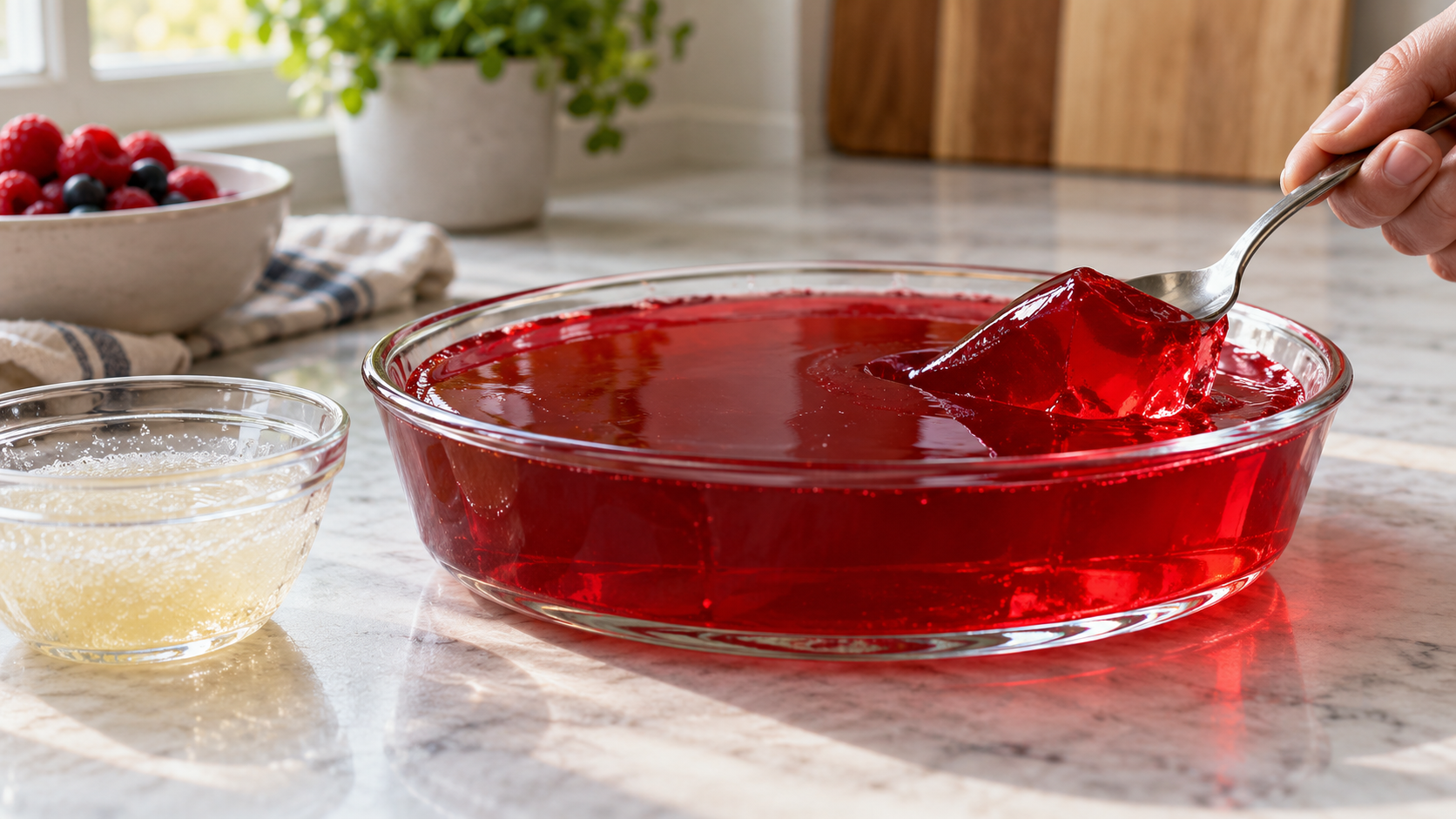
Gelatin Gelation Explainer
Gelatin turns a flavored liquid into a soft solid by building a microscopic network that holds a large amount of water. Gelatin is produced by partially breaking down collagen, the structural protein found in animal connective tissue. Its molecules are long protein chains that disperse when properly hydrated and heated. As the solution cools, portions of neighboring chains line up and form small ordered junctions resembling parts of collagen’s original structure. Those junctions connect the chains into a three-dimensional mesh, while water remains mobile inside the spaces of the mesh.
Preparation usually begins with blooming. Dry gelatin granules or sheets are placed in cool liquid so water can penetrate and separate the particles without immediately clumping their outsides into a gummy barrier. Once hydrated, gentle heat lets the swollen material dissolve throughout the liquid. Boiling for an extended time is unnecessary and can weaken the protein chains, especially in acidic mixtures. The goal is a uniform molecular dispersion, not merely invisible lumps. Stirring and adequate liquid help distribute the chains before cooling starts.
Cooling changes the balance of molecular motion and bonding. At high temperature, the flexible chains move freely and water interactions keep them apart. As thermal motion decreases, selected segments form hydrogen-bonded, helix-like junction zones. A single chain can connect several zones, and each zone can include parts of multiple chains. Once enough connections span the container, the mixture reaches a gel point: it resists flow and springs back after small deformation. The network is physical rather than permanently covalent, which makes ordinary gelatin gel thermoreversible.
Thermoreversibility explains why gelatin melts in a warm mouth and can often be melted and reset. Heating disrupts the weak junction zones and returns the system toward a liquid sol; cooling allows connections to form again. Formation takes time because chains must diffuse, align, and organize. Refrigeration speeds cooling, but colder is not always better if freezing creates large ice crystals that damage texture. Gel strength rises with gelatin concentration and suitable maturation time, while sugar, salts, alcohol, fat, dairy proteins, and acidity can alter hydration and network behavior.
Fresh pineapple, papaya, kiwi, figs, and some other fruits contain protease enzymes that cut protein chains. Enough active enzyme can shorten gelatin molecules so they no longer bridge a strong network. Heating the fruit can inactivate the enzyme, which is why canned or cooked versions may gel when fresh versions do not. Very acidic conditions or prolonged high heat can also hydrolyze protein. These effects are not evidence that gelatin needs less water at random; the formulation must balance gelatin amount, total liquid, other ingredients, temperature, and processing time.
A gelatin gel is mostly water, so it can lose quality through evaporation or syneresis, in which liquid separates from the network. Covering the container limits drying and odor absorption. Mechanical stirring after setting breaks the connected structure into pieces, and repeated melting can change texture if heat exposure is excessive. Gelatin is derived from animal collagen and is not suitable for all dietary or religious requirements; agar, pectin, and starch form gels through different mechanisms and are not direct one-for-one replacements. The familiar wobble comes from a sparse protein scaffold flexible enough to deform yet connected enough to hold water.
Gelatin is a collagen-derived protein that hydrates, dissolves with gentle heat, and forms reversible junction zones as it cools. Key terms include collagen, protein chain, bloom, dispersion, hydrogen bond, junction zone, gel point, thermoreversible, protease, and syneresis.
Fresh pineapple contains a protease that cuts gelatin proteins. Cooking or canning can inactivate the enzyme, but the recipe still needs the correct gelatin, liquid, acidity, and timing.
Its network is held mainly by weak physical junctions. Warmth disrupts those connections, returning the gel toward a flowing liquid without requiring a permanent chemical reaction.
Explore more "Explainers"
Discover additional explainers across politics, science, business, technology, and other fields. Each explainer breaks down a complex idea into clear, everyday language—helping you better understand how major concepts, systems, and debates shape the world around us.