

On This Day in Business: January 25, 1915
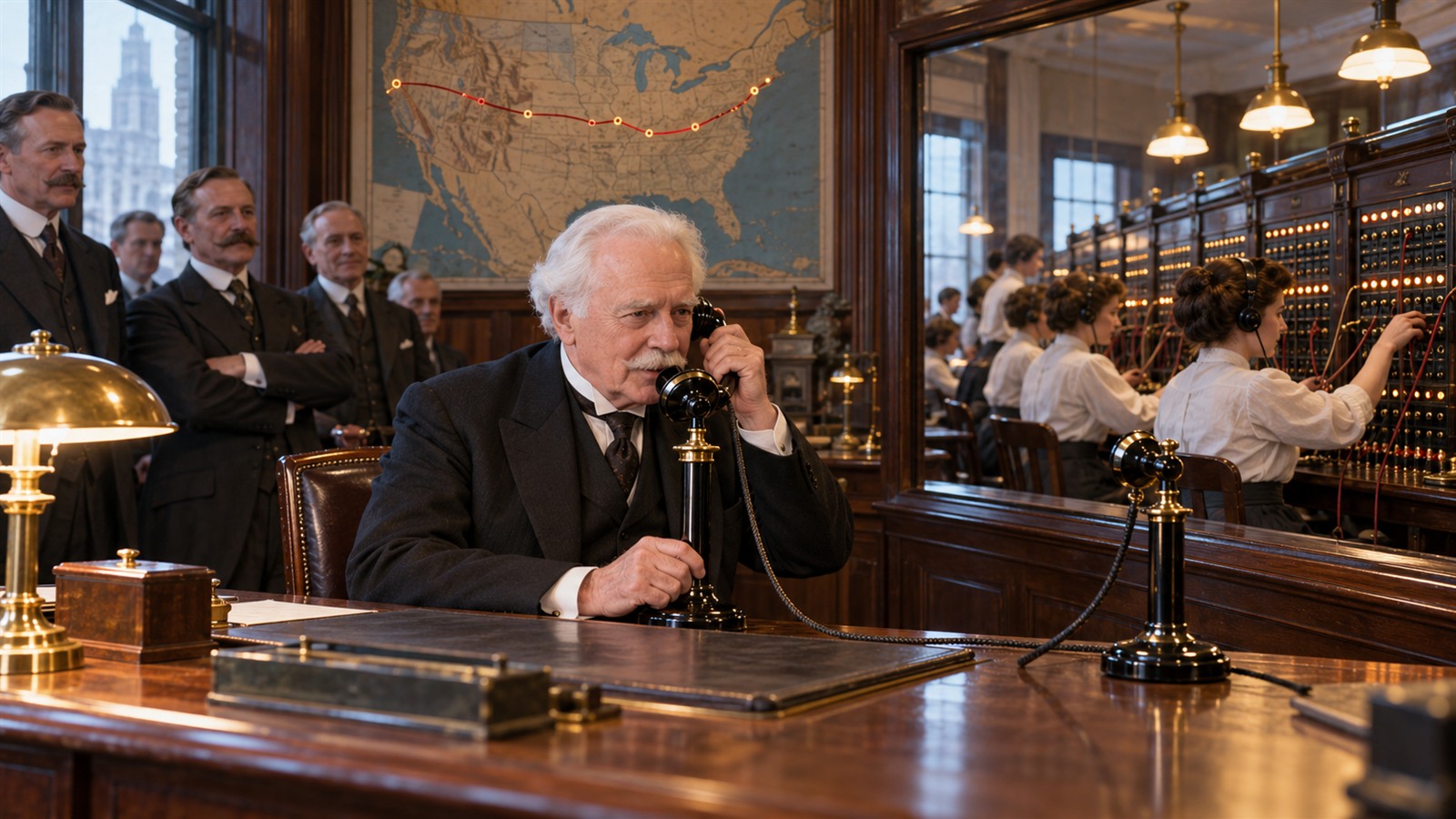
On January 25, 1915, American Telephone and Telegraph ceremonially opened transcontinental telephone service. Alexander Graham Bell sat in New York and repeated the famous request from his first experimental call: 'Mr. Watson, come here, I want you.' Thomas Watson, Bell's former assistant, answered from San Francisco that reaching him would now take a week. President Woodrow Wilson joined from Washington, while AT&T president Theodore Vail participated from Jekyll Island, Georgia. The carefully staged conversation demonstrated that a human voice could travel across the continent through one coordinated network, just weeks before San Francisco's Panama-Pacific International Exposition drew national attention westward.
The engineering achievement had been completed and tested before the ceremony. AT&T crews joined the final wires in Utah in June 1914, and the line was successfully tested the following month. Long-distance speech still required major improvements in loading coils, vacuum-tube repeaters, switching and line construction. The completed circuit stretched roughly 3,400 miles and used thousands of poles. A call could not be dialed directly; operators assembled the route and monitored connections across multiple cities. The January event therefore marked the public and commercial opening of a system whose reliability depended on both advanced equipment and a disciplined national operating organization.
Initial service was exclusive. A three-minute daytime call between New York and San Francisco cost $20.70, a substantial sum in 1915, and additional time raised the bill. AT&T was not trying to replace local conversation overnight. It was selling immediacy to customers for whom days saved could justify a premium—businesses, government offices, newspapers and wealthy individuals. The line also strengthened the company's claim that a unified network created value through reach. Every additional exchange, operator and long-distance circuit made more connections possible, illustrating the network effects that would shape telecommunications industries for the next century.
The ceremonial call compressed a continent into a single conversation and supplied AT&T with a powerful public narrative. Bell and Watson linked the new service to the telephone's origin, while Wilson's participation gave it national importance. Over time, amplifiers, automated switching and lower prices made coast-to-coast calling ordinary rather than spectacular. January 25 matters because it joined engineering, operations and marketing at the moment infrastructure became a sellable service. The episode reminds modern businesses that networks are not built by invention alone. They require standards, capital, maintenance, trained people and enough coverage to make a connection valuable—and they often enter the market first as costly premium products before scale turns them into everyday utilities.
AT&T spent years extending copper circuits westward while developing loading coils and vacuum-tube repeaters that kept speech intelligible over great distances.
The physical line was completed in Utah in June 1914 and tested in July, months before the carefully planned public opening ceremony.
On January 25, 1915, Bell spoke from New York to Watson in San Francisco, with President Wilson and AT&T president Theodore Vail joining remotely.
Operators assembled the roughly 3,400-mile connection through multiple exchanges; direct customer dialing across the continent did not yet exist.
A three-minute New York-to-San Francisco call cost $20.70, positioning speed as a premium service for business, government and affluent customers.
Falling costs and improved switching later made long-distance calling routine, validating the commercial power of a unified network with expanding reach.
Explore more of "On This Day ..."
Discover more events from the same date across news, politics, technology, sports, and other fields. Each link highlights significant moments that shaped history on different fronts.