

On This Day in Business: January 26, 1926
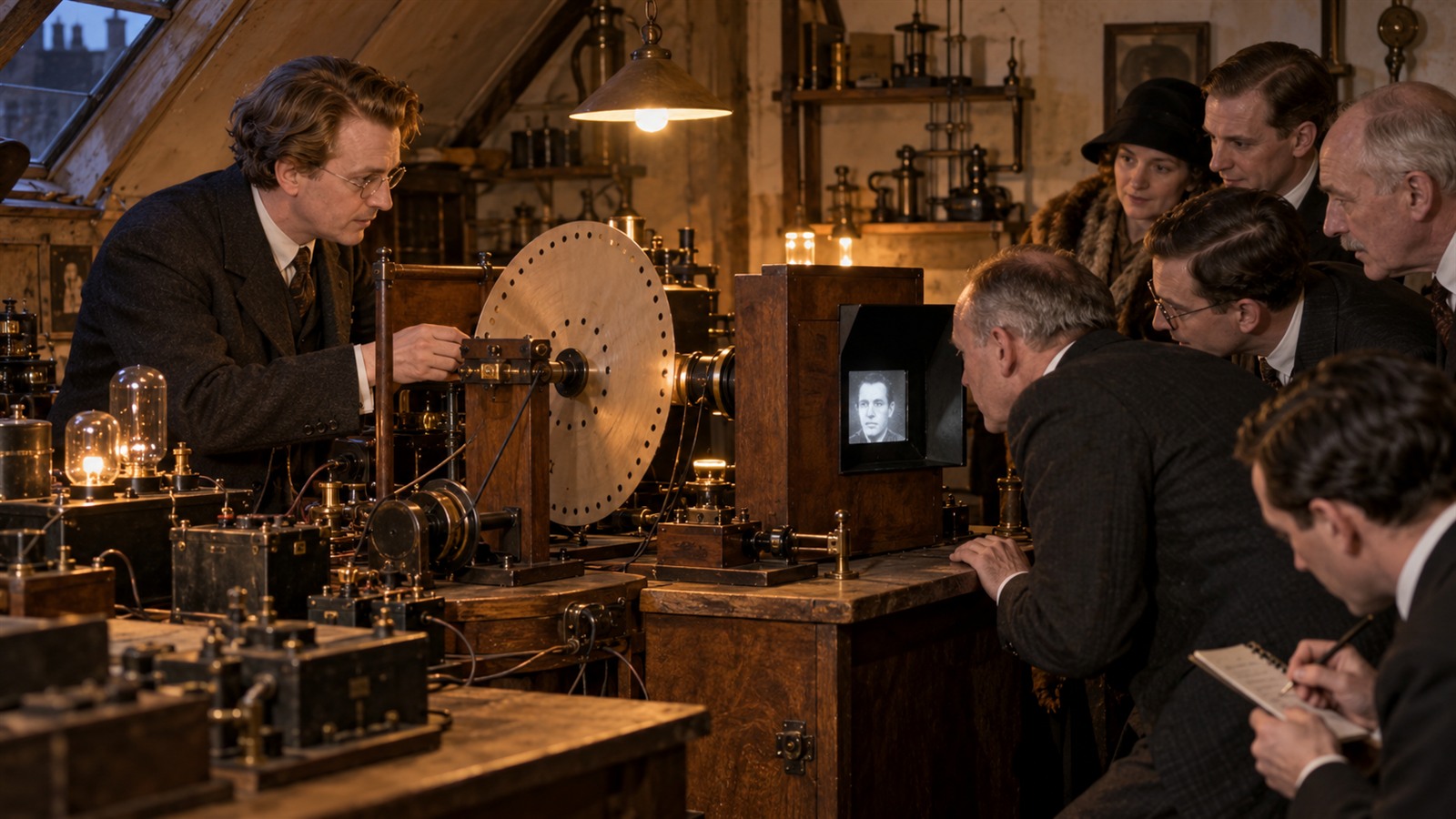
On January 26, 1926, Scottish inventor John Logie Baird demonstrated what is widely recognized as the first public presentation of true television. In two attic rooms at 22 Frith Street in London's Soho district, members of the Royal Institution and a reporter from The Times watched the faint image of a moving human face appear on a receiving apparatus. Baird had previously transmitted outlines and a ventriloquist's dummy, but the 1926 demonstration showed live tonal detail and motion clearly enough for independent observers to recognize a person. The event transformed a solitary experiment into a credible communications proposition at a moment when radio broadcasting was rapidly building a mass audience.
Baird's system was mechanical. A rapidly rotating Nipkow disc, pierced with holes arranged in a spiral, scanned the subject line by line. A photoelectric cell converted changing light into an electrical signal, and a synchronized disc at the receiver reconstructed the image using a rapidly varying lamp. The picture was tiny, flickering and low in resolution. Powerful illumination made sitting before the transmitter uncomfortable, and precise synchronization was difficult. Yet the apparatus demonstrated the entire commercial idea: capture a scene, transmit information electrically and reproduce motion somewhere else. The limitations were engineering problems rather than a failure of the concept.
Public proof helped Baird attract press attention, investors and institutional interest. He established the Baird Television Development Company and continued improving transmission, color experiments and long-distance demonstrations. In 1928 his organization sent a television image across the Atlantic. The BBC later experimented with Baird's 30-line system and began regular transmissions, giving owners of early receivers something to watch. Mechanical television nevertheless faced a technological rival. Electronic camera tubes and cathode-ray displays offered greater resolution and stability, and the BBC chose Marconi-EMI's all-electronic system for regular high-definition service after comparative trials in the 1930s.
Baird's machinery did not become the lasting technical standard, but his demonstration helped create the market category. It made television visible to scientists, journalists and eventually investors before the product was ready for ordinary homes. January 26 matters because new industries often begin with imperfect systems that prove demand and direct capital toward improvement. Baird showed that moving images could travel through an electrical communications network, then built a company around that possibility. His experience also illustrates a harder business truth: the pioneer who validates a market may not own the dominant architecture. Commercial success depends on timing, production quality, standards and the ability to scale—not only on being first to make an astonishing idea work.
Baird experimented in cramped rooms at 22 Frith Street, using intense light, photoelectric cells and rotating perforated discs to scan moving subjects.
Earlier tests produced outlines and dummy heads, but observers needed recognizable tonal detail and live motion before the system could claim true television.
On January 26, 1926, Royal Institution members and a Times reporter watched a moving human face appear on Baird's receiving apparatus.
The tiny 30-line image flickered, yet it proved the complete chain from optical capture through electrical transmission to remote visual reconstruction.
Public demonstrations supported the Baird Television Development Company, transatlantic experiments and early BBC broadcasts to mechanical receivers.
Electronic systems ultimately displaced Baird's mechanism, showing how a pioneering product can validate an industry without becoming its lasting standard.
Explore more of "On This Day ..."
Discover more events from the same date across news, politics, technology, sports, and other fields. Each link highlights significant moments that shaped history on different fronts.