

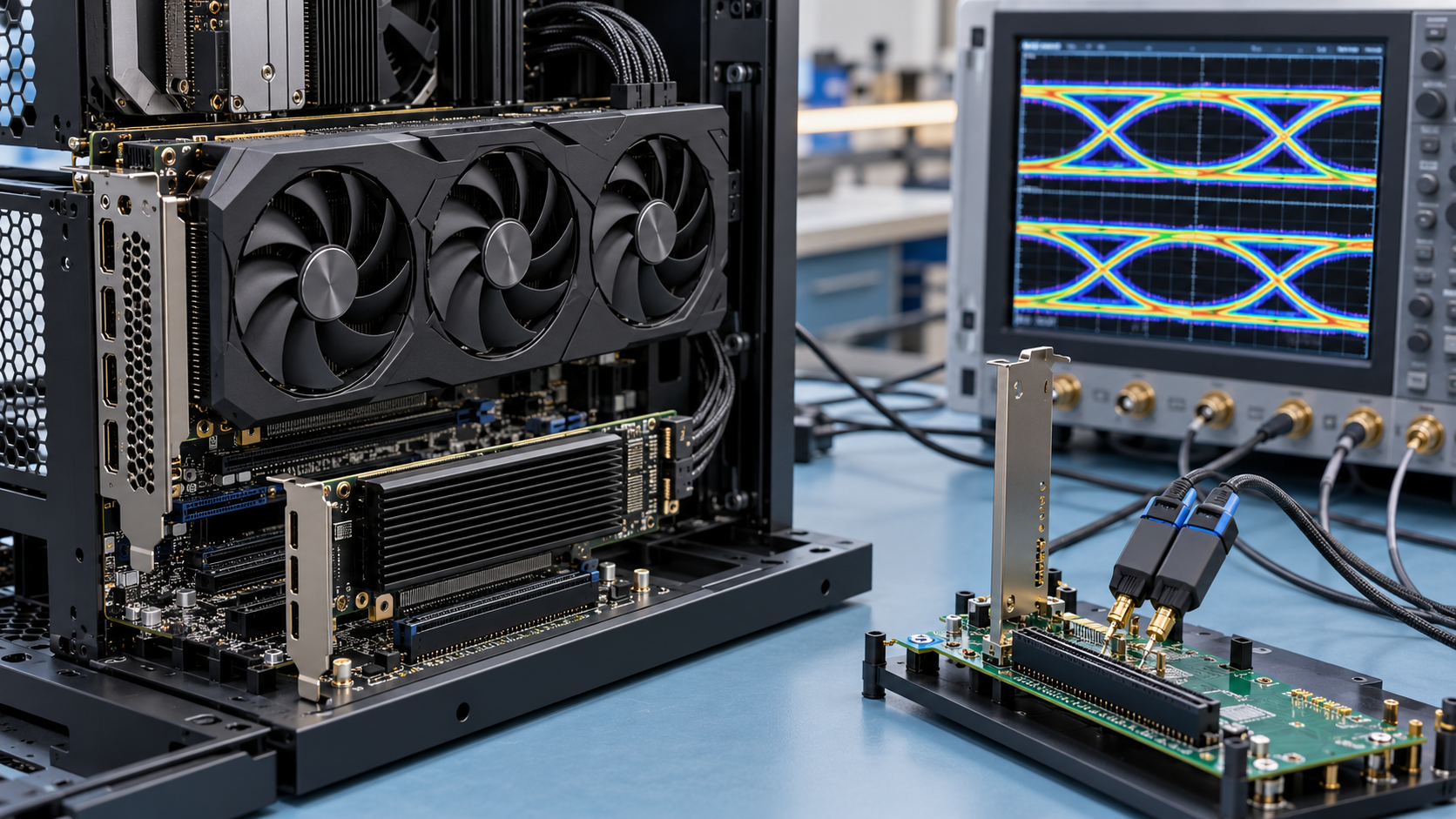
PCI Express Data Transfer Explainer
PCI Express, or PCIe, connects processors with graphics cards, storage devices, network adapters, and other high-speed components. Unlike an older shared parallel bus, each PCIe link is a point-to-point serial connection. One lane contains a differential pair for transmitting and another for receiving, so traffic can move in both directions at once. Links combine one, four, eight, sixteen, or another supported number of lanes. A wider link sends more bits in parallel while preserving the same packet rules.
At startup, physical-layer state machines detect each other and train the link. They establish lane polarity and ordering, negotiate a common lane count and generation, equalize high-speed signals, and enter an operational state. A card installed in a mechanically wide slot may run with fewer electrical lanes, and a link can fall back to a lower speed when signal quality or platform capability requires it. Newer generations raise the transfer rate and may use different encoding, which increases the importance of board layout, connectors, retimers, and trace length.
The transaction layer turns memory reads, writes, configuration accesses, and messages into packets. A request includes routing and addressing information; a device may return one or more completion packets with data or status. Posted writes do not require an immediate completion, allowing efficient streaming, while reads must wait for a response. Sequence numbers, checks, acknowledgments, and replay at lower layers protect delivery across the link. End-to-end checks may add another integrity mechanism for certain traffic.
Credit-based flow control prevents a sender from overflowing the receiver. Each side advertises buffer space for different packet classes. The transmitter spends credits as it sends and receives updates when capacity becomes available again. Traffic classes and virtual channels can separate priorities where supported. The protocol is ordered carefully so devices observe transactions consistently, while relaxed-ordering attributes permit more reordering when software and hardware can tolerate it.
PCIe forms a hierarchy. A root complex connects the processor and memory system to endpoints, and switches add downstream ports for more devices. Bridges preserve compatibility with other bus types. Enumeration software assigns address ranges, interrupts, and resources by reading configuration space. Devices can expose multiple functions, and virtualization features can divide one physical device into isolated virtual functions. Power-management states reduce link or device energy when full performance is unnecessary.
Direct memory access commonly carries the useful payload. A storage or network device uses PCIe transactions to read descriptors and move data to host memory, while an IOMMU controls permitted addresses. Message-signaled interrupts are delivered as writes rather than separate physical interrupt wires. High bandwidth does not remove software overhead, queue design, memory latency, or contention at the root complex. Real application performance depends on the complete path and workload.
PCI Express therefore moves structured packets across trained, full-duplex serial lanes. The physical layer maintains electrical reliability, the data-link layer protects hop delivery, and the transaction layer expresses reads, writes, and messages. Negotiated width and speed define raw capacity; flow control and ordering keep receivers safe; the system hierarchy routes packets to the correct function. The familiar expansion slot is only the mechanical doorway to that layered network inside a computer.
Explore more "Explainers"
Discover additional explainers across politics, science, business, technology, and other fields. Each explainer breaks down a complex idea into clear, everyday language—helping you better understand how major concepts, systems, and debates shape the world around us.