

On This Day in Health: August 8, 1901
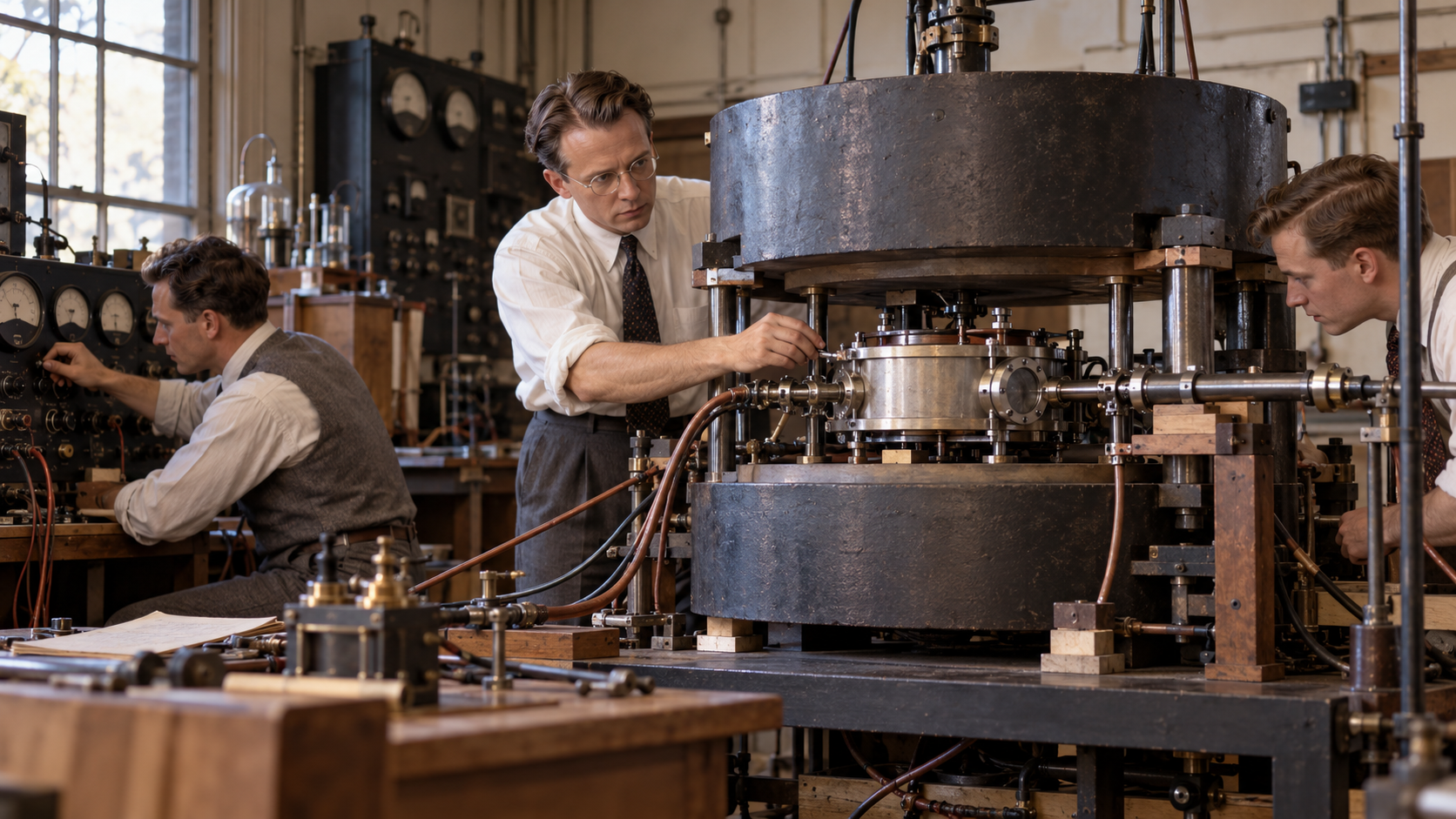
Ernest Orlando Lawrence was born in Canton, South Dakota, on August 8, 1901. He studied physics at the University of South Dakota, Minnesota, Chicago, and Yale before joining the University of California, Berkeley. In 1929, inspired by a published diagram of a linear accelerator, he conceived a more compact way to accelerate charged particles. A magnetic field could bend the particles into a spiral while an alternating electric field gave them repeated boosts. The resulting device, called the cyclotron, could generate particle energies that previously required much larger equipment. Lawrence and his students built working versions and rapidly increased their size and power.
The cyclotron transformed experimental physics by allowing researchers to bombard atomic nuclei and produce new isotopes. Lawrence received the 1939 Nobel Prize in Physics for the invention and development of the machine and for results obtained with artificial radioactive elements. Just as significant was the research culture around it. He assembled physicists, chemists, engineers, technicians, biologists, and physicians to solve problems together, an approach that helped establish the era of large interdisciplinary laboratories. Berkeley’s Radiation Laboratory grew around this model and became the institution now known as Lawrence Berkeley National Laboratory.
Lawrence recognized that accelerators could serve medicine as well as physics. He encouraged his brother, physician John Lawrence, to join the Berkeley program, where teams investigated how radiation and radioisotopes behaved in living systems. Cyclotrons produced useful radioactive isotopes for tracing biological processes, diagnosing disease, and testing treatments. Early Berkeley work helped establish nuclear medicine, including the therapeutic study of phosphorus-32 for blood disorders and the use of particle beams in radiation research. Modern practice uses far more precise equipment, dosimetry, safety standards, and evidence, but medical imaging and targeted radiotherapy still depend on the ability to create and control radioactive materials.
The same accelerator principle also contributed to later forms of particle therapy. Cyclotrons and related machines now produce beams and isotopes used in cancer diagnosis and treatment, including materials for positron emission tomography and certain targeted therapies. Lawrence’s legacy is complicated by the broader military history of nuclear science, but the health applications show how a general research tool can acquire many purposes. His birthday marks the meeting of physics, engineering, and medicine. By turning repeated small pushes into a powerful beam, the cyclotron opened atomic nuclei to study and gave health researchers new ways to see processes inside the body and direct radiation toward disease.
Lawrence was born in Canton, South Dakota, on August 8, 1901, trained as a physicist, and joined the University of California, Berkeley, in 1928.
He devised the cyclotron by using a magnetic field to curve charged particles and an alternating electric field to accelerate them repeatedly in a compact space.
Working cyclotrons enabled researchers to probe nuclei and make artificial radioactive isotopes, earning Lawrence the 1939 Nobel Prize in Physics.
His Berkeley laboratory organized physicists, engineers, chemists, biologists, and physicians into teams, helping establish a model for interdisciplinary large-scale science.
The program produced radioisotopes for biological research, diagnosis, and experimental treatment and helped create the emerging field of nuclear medicine.
Today, accelerator technology supports medical-isotope production, PET imaging, radiation research, and forms of particle therapy used against cancer.
Explore more of "On This Day ..."
Discover more events from the same date across news, politics, technology, sports, and other fields. Each link highlights significant moments that shaped history on different fronts.