

On This Day in Health: August 9, 1896
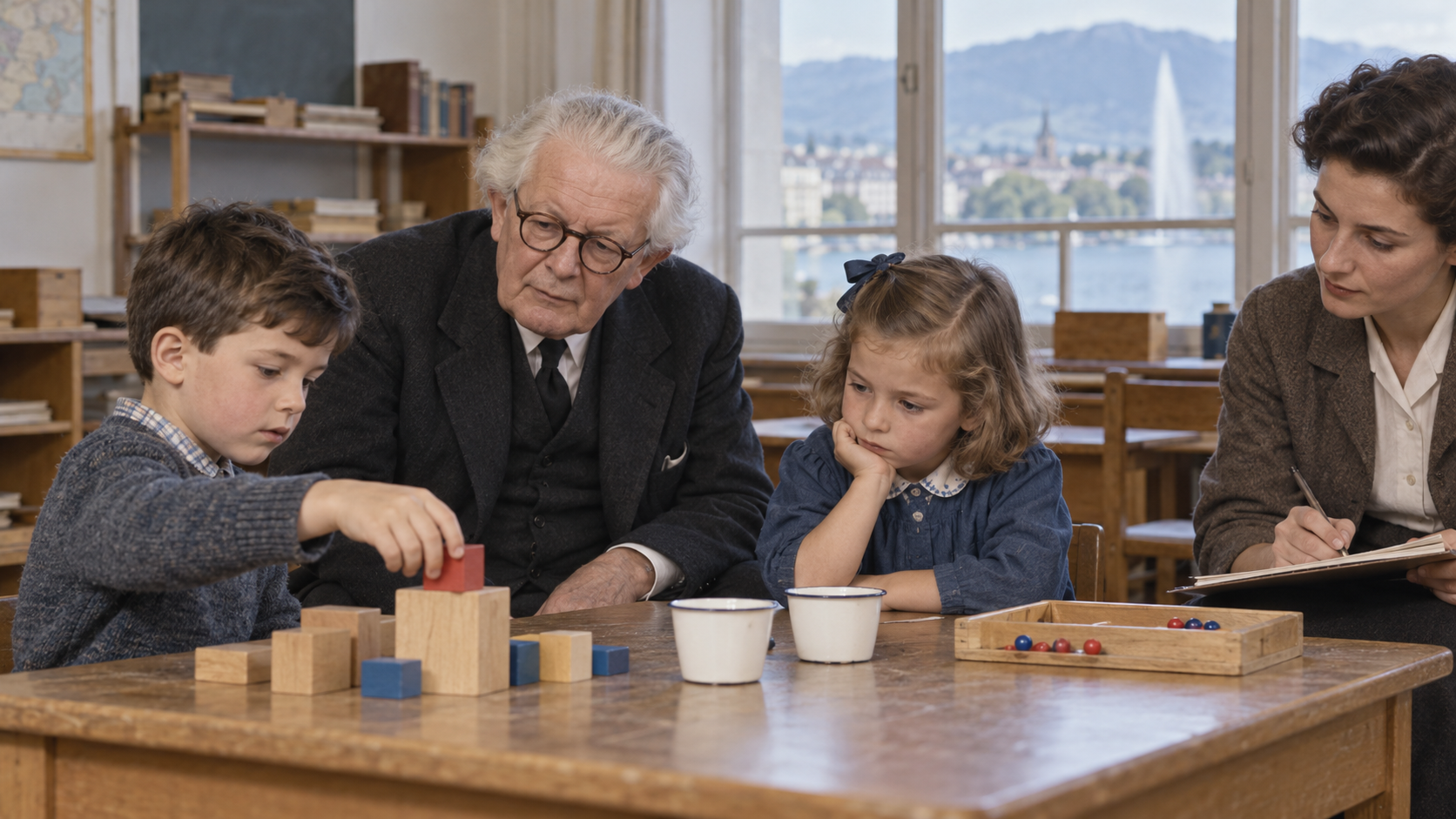
Jean Piaget was born in Neuchâtel, Switzerland, on August 9, 1896. He began publishing observations of nature as a child and trained in biology before turning toward philosophy and psychology. Work with intelligence tests in Paris drew his attention to something that standard scoring often ignored: children of similar ages made similar kinds of mistakes. Piaget became interested in the reasoning behind their answers rather than simply whether an answer was correct. At the Jean-Jacques Rousseau Institute in Geneva, he used conversations, observation, and hands-on tasks to study how children build explanations of objects, number, space, cause, and rules.
Piaget argued that children actively construct knowledge through interaction with the world. He described assimilation, in which new experience is fitted into an existing mental framework, and accommodation, in which the framework changes to handle new information. His widely known account organized cognitive development into sensorimotor, preoperational, concrete operational, and formal operational stages. The model proposed qualitative changes in thinking from infancy through adolescence. It challenged the idea that children were merely less informed adults and encouraged researchers, teachers, and clinicians to consider what a child could understand at a particular point in development.
That perspective influenced health care as well as education. Pediatric professionals use developmentally appropriate language, play, pictures, demonstrations, and opportunities for participation when explaining illness or treatment. A young child may understand a procedure through concrete actions, while an older child or adolescent may reason about causes, future consequences, and alternatives. Research on children’s concepts of health and illness has often used or tested Piagetian ideas, and nursing guidance still connects explanations with cognitive development. The practical goal is not to assign every child rigidly to a stage, but to communicate in a way that matches the individual’s abilities, experience, emotions, and questions.
Later research also revised important parts of Piaget’s account. Children sometimes show abilities earlier than his tasks suggested, development can be uneven across domains, and culture, language, teaching, and social relationships shape performance. Contemporary developmental science therefore treats the classic stages as influential theory rather than a fixed timetable. Piaget’s lasting contribution was methodological and ethical as much as conceptual: listen to children’s reasoning, observe how they solve problems, and recognize them as active participants in learning. In health settings, that legacy supports clearer consent discussions, less frightening preparation, better health education, and respect for the developing person behind the patient. His birthday marks a change in how adults learned to see children’s minds.
Piaget was born in Neuchâtel on August 9, 1896, trained in biology, and shifted toward psychology after studying patterns in children’s answers to intelligence tests.
His clinical interviews and hands-on tasks focused on how children reasoned about number, objects, space, causes, rules, and other features of experience.
He described children as active builders of knowledge who assimilate new experiences into existing schemes and accommodate those schemes when experience does not fit.
The four-stage model made cognitive development central to education, psychology, and communication with children in medical and public-health settings.
Developmentally appropriate care uses concrete explanations, play, pictures, questions, and growing participation to match each child’s understanding and emotional needs.
Research has challenged rigid stage boundaries and highlighted culture and context, but Piaget’s insistence on studying children’s reasoning remains deeply influential.
Explore more of "On This Day ..."
Discover more events from the same date across news, politics, technology, sports, and other fields. Each link highlights significant moments that shaped history on different fronts.