

On This Day in Business: February 14, 1876
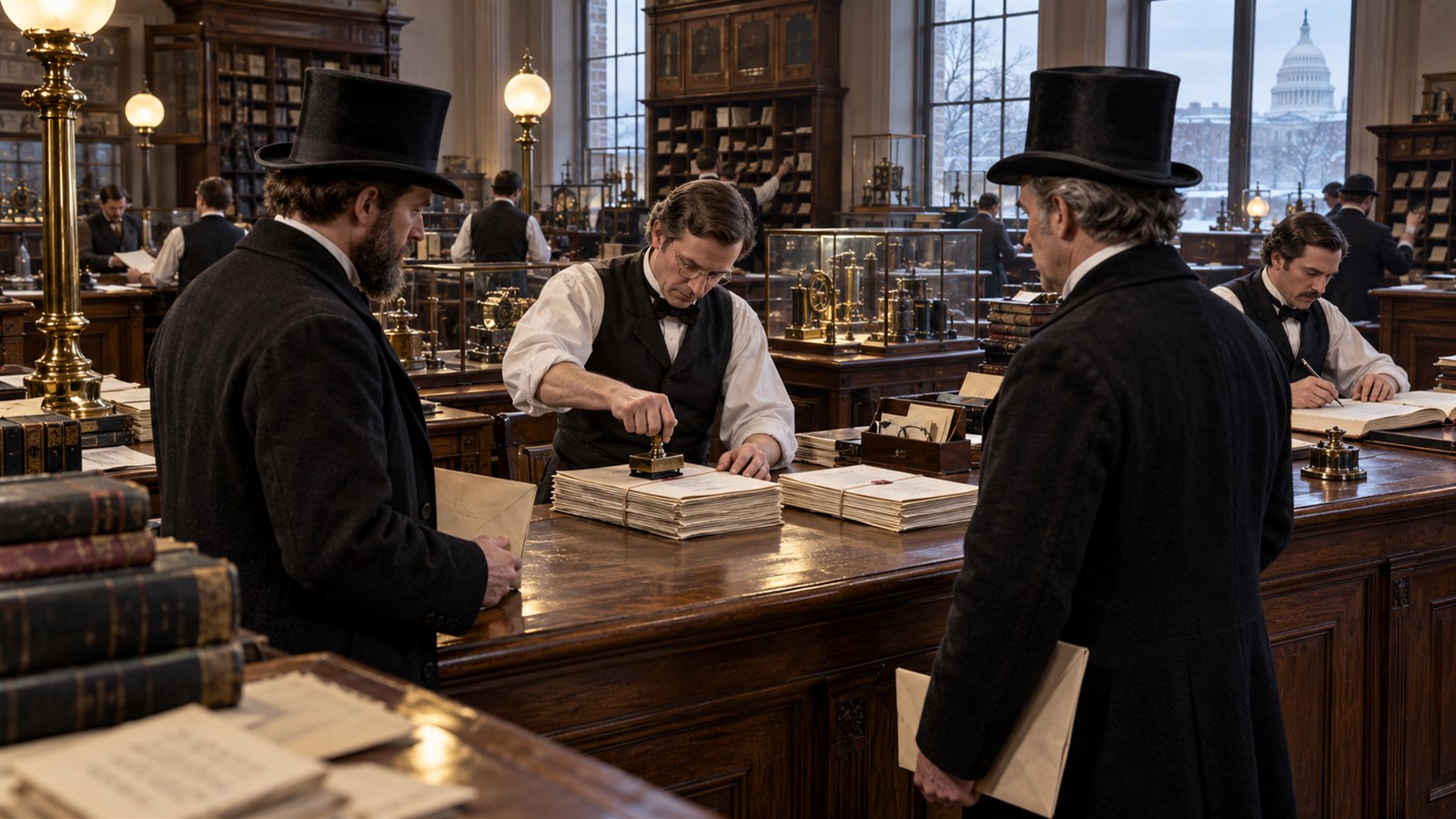
On February 14, 1876, Alexander Graham Bell's lawyer filed a patent application at the United States Patent Office for a method of transmitting vocal and other sounds by electrical undulations. That same day, an attorney for Elisha Gray filed a caveat describing a related liquid-transmitter concept. The close timing later fed decades of dispute, but Bell's application proceeded. U.S. Patent No. 174,465 was issued on March 7, and three days later Bell recorded the famous successful call to his assistant Thomas Watson.
The filing was one step in a crowded field of telegraph research. Bell had been working on ways to send multiple tones over a wire and was deeply interested in speech because of his family's work in elocution and deaf education. Financial partners Gardiner Greene Hubbard and Thomas Sanders supported the experiments and pushed the legal and commercial process forward. Patent strategy mattered because a working device alone would not create a defensible enterprise. The claims had to be broad enough to protect the principle and specific enough to survive examination and later litigation.
Bell and his backers formed the Bell Telephone Company in 1877 and licensed local operating companies to build exchanges. The early business sold access to a network, not simply ownership of an instrument. Each additional subscriber increased the number of reachable connections, while central switchboards and long-distance lines required continuing capital. Rival inventions and Western Union's resources threatened the young company, producing major patent battles and an 1879 settlement. Control of foundational patents gave Bell's organization time to establish standards, equipment relationships and a rapidly expanding installed base.
The February filing became one of the most consequential pieces of business intellectual property in American history. It did not make the telephone inevitable or erase contributions from Gray, Antonio Meucci and other experimenters. It did show how invention, financing, legal claims and network construction must reinforce one another. A patent can provide leverage, but the value arrives only when a company turns the protected idea into reliable service and persuades customers to join. Bell's future enterprise succeeded because it paired courtroom defensibility with exchanges, operators, wires and a pricing model for connection. The result established a template used by later communication platforms: secure a technical position, build shared infrastructure and let the network become more useful as participation grows. The controversy surrounding priority is a reminder that invention rarely occurs in isolation. Several researchers approached similar problems because telegraph technology, scientific knowledge and market demand had reached a point where voice transmission was becoming both imaginable and valuable.
Bell's work on harmonic telegraphy and speech transmission developed within a competitive field of inventors seeking to send more information over wires.
Financial partners and patent attorneys helped convert laboratory experiments into formal claims and a plan for a commercial communications system.
On February 14, 1876, Bell's patent application was filed at the U.S. Patent Office, while Elisha Gray's attorney submitted a related caveat hours later.
Patent No. 174,465 issued on March 7, and Bell achieved an intelligible telephone call with Thomas Watson three days afterward.
The Bell Telephone Company used licensing, exchanges and litigation to expand service and protect its position against better-funded rivals.
The business ultimately derived value from a network of subscribers and infrastructure, showing that protected invention and execution must grow together.
Explore more of "On This Day ..."
Discover more events from the same date across news, politics, technology, sports, and other fields. Each link highlights significant moments that shaped history on different fronts.