

On This Day in Health: August 14, 1881
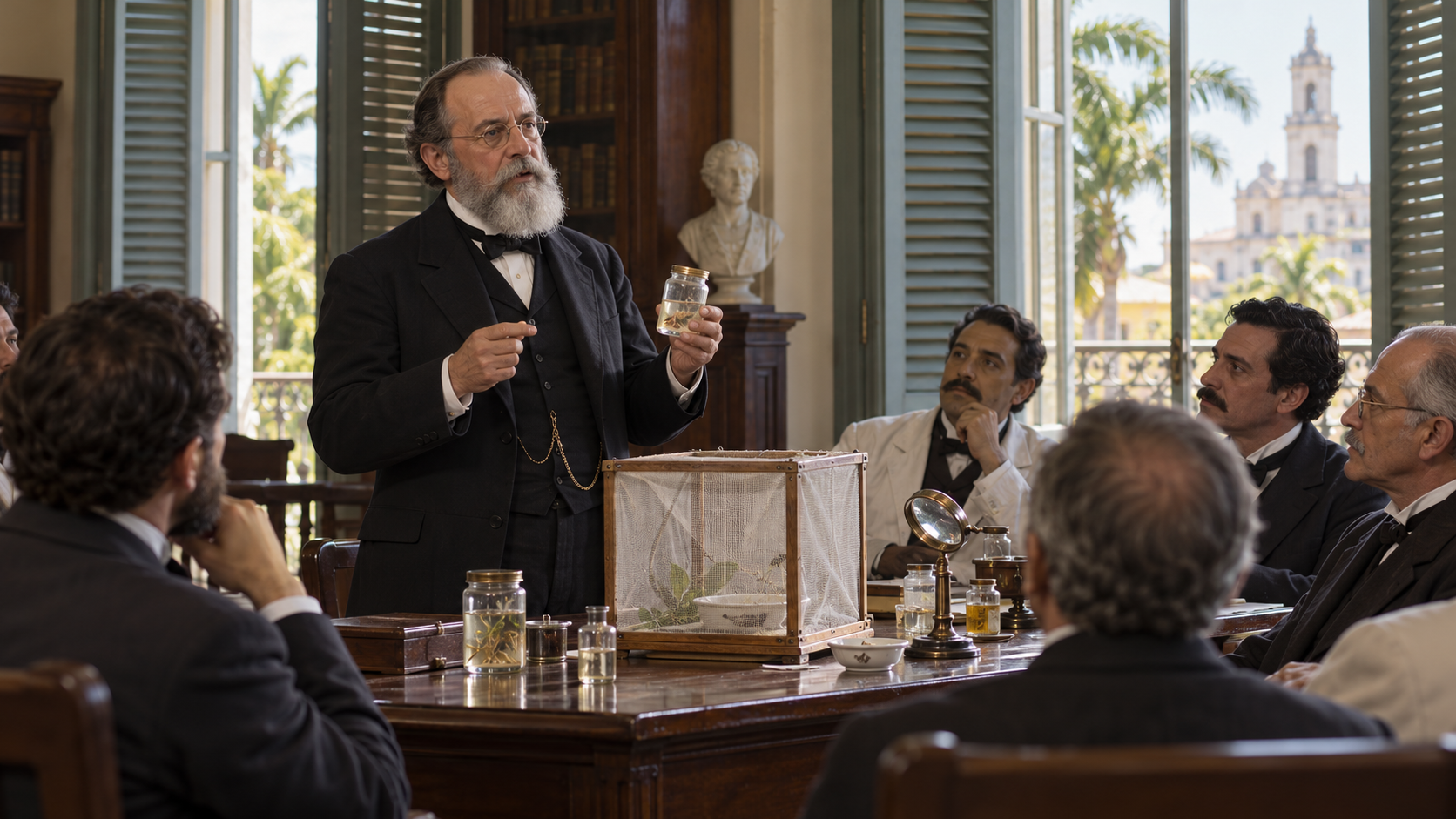
On August 14, 1881, Cuban physician Carlos Juan Finlay presented a paper to the Royal Academy of Medical, Physical and Natural Sciences of Havana proposing that a mosquito transmitted yellow fever. The disease repeatedly devastated Caribbean and American cities, but prevailing explanations emphasized contaminated objects, direct contagion, or unhealthy air. Finlay argued that transmission required a patient in the appropriate stage of illness, a susceptible person, and an independent living agent that could move infection between them. He identified the mosquito now called Aedes aegypti as the likely carrier.
Finlay’s proposal grew from observation of Havana’s outbreaks, mosquito behavior, and experimental efforts with his colleague Claudio Delgado. He described conditions under which a mosquito might bite an ill person, survive long enough, and later bite someone susceptible. His early human experiments were limited and did not prove the theory by modern standards. The academy’s response was largely indifferent, and many physicians remained unconvinced for years. Finlay continued collecting evidence and publishing, while the difficulty of isolating the yellow-fever agent and the complexity of the mosquito’s infectious period left important gaps.
In 1900, the U.S. Army Yellow Fever Commission led by Walter Reed tested mosquito transmission in Cuba. Its work, informed by Finlay’s ideas and mosquitoes, supported the vector theory and ruled against contaminated bedding as the main route. The experiments also raise lasting ethical questions because consent and risk standards differed sharply from those required today. Once mosquito transmission was accepted, William Gorgas and other public-health officials organized campaigns against Aedes breeding sites. Screening, drainage, water-container management, and mosquito control sharply reduced urban yellow fever in Havana and later supported work in Panama.
The anniversary marks the power of identifying a disease’s route of transmission. Yellow fever is caused by a virus, and vaccination is now the strongest preventive tool for people at risk, but vector surveillance and mosquito control remain important. Finlay’s theory did not arrive complete, and confirmation depended on later researchers, public-health workers, and community action. His August 14 presentation nevertheless redirected prevention from disinfecting possessions and fearing casual contact toward interrupting a biological cycle. The same reasoning underlies control programs for dengue, Zika, chikungunya, and other Aedes-borne infections. A careful hypothesis about an insect changed how cities could defend health. Finlay’s work further changed the meaning of sanitation. Instead of treating every unpleasant odor or object as equally dangerous, health departments could focus resources on the insect’s breeding and biting behavior. Effective control still requires community cooperation because household water storage, waste, construction, and climate influence where Aedes mosquitoes thrive.
Yellow fever repeatedly struck Havana and other port cities, while physicians debated whether contaminated objects, direct contact, or unhealthy air caused its spread.
Finlay proposed a three-part chain involving an infectious patient, a susceptible person, and an independent agent able to carry disease between them.
On August 14, 1881, he named a mosquito as the likely vector and presented experimental observations to Havana’s scientific academy.
His evidence was not yet conclusive, and acceptance came only after later testing by the Reed commission, whose methods also present ethical concerns.
Mosquito control in Havana and Panama showed that removing breeding sites and blocking bites could interrupt urban yellow-fever transmission.
Vaccination now anchors yellow-fever prevention, while Finlay’s vector framework continues to guide control of multiple mosquito-borne diseases.
Explore more of "On This Day ..."
Discover more events from the same date across news, politics, technology, sports, and other fields. Each link highlights significant moments that shaped history on different fronts.