

On This Day in Health: August 13, 1918
Frederick Sanger was born in Rendcomb, Gloucestershire, England, on August 13, 1918. He studied natural sciences and biochemistry at the University of Cambridge and remained there for most of his career. During the 1940s and early 1950s, Sanger set out to determine the exact order of amino acids in insulin. Proteins were known to contain amino acids, but some scientists still questioned whether each protein possessed a fixed, reproducible sequence. By labeling one end of peptide chains and patiently separating fragments, Sanger reconstructed insulin’s two chains and their connecting bonds.
The completed insulin structure showed that a protein has a defined chemical sequence. That result strengthened the idea that biological function depends on molecular order and helped connect genes with the proteins they encode. Sanger received the 1958 Nobel Prize in Chemistry for this work. He then moved from proteins to nucleic acids, joining the Medical Research Council Laboratory of Molecular Biology in Cambridge. Sequencing RNA provided experience, but DNA posed a larger technical challenge because of its length and chemical regularity. Sanger’s group tested several strategies for turning invisible molecular order into readable experimental patterns.
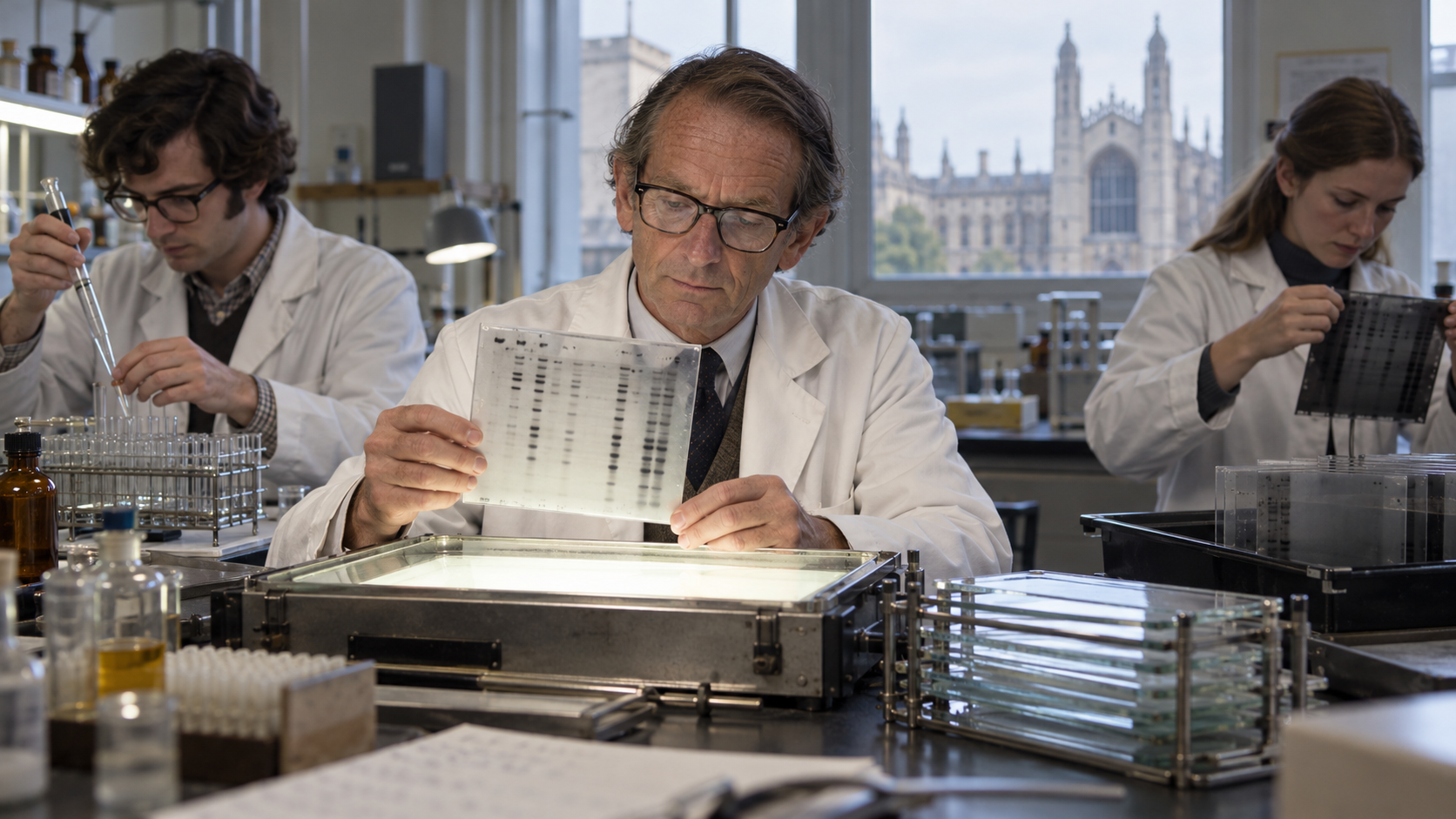
In 1977, his team published the chain-termination method now commonly called Sanger sequencing. During DNA copying, modified nucleotides stopped extension at particular bases. Separating fragments by size allowed researchers to infer the sequence from the resulting pattern. The method was improved with fluorescent labels, automation, and capillary instruments. It became central to laboratory genetics and supplied much of the data for the Human Genome Project. Sanger shared the 1980 Nobel Prize in Chemistry with Paul Berg and Walter Gilbert, becoming one of the few people to receive two Nobel Prizes in the same scientific category.
Sanger’s birthday marks a foundation of molecular medicine. Reading DNA made it possible to identify disease-causing variants, confirm diagnoses, track inherited conditions, study tumors, and detect microorganisms with increasing precision. Newer high-throughput technologies can sequence vastly more material at lower cost, but Sanger sequencing remains valuable when a laboratory needs a highly accurate read of a targeted region or confirmation of another result. His achievement also reflected team science and painstaking method development rather than a sudden flash of insight. By turning the sequence of biological molecules into measurable information, Sanger helped create the technical language used by genomics, biotechnology, and many forms of modern clinical testing. Sequencing also created responsibilities around privacy, interpretation, and uncertainty. A technically accurate DNA read does not automatically reveal whether a variant causes disease or what should be done about it. Modern clinical genetics therefore pairs laboratory methods with validated evidence, counseling, consent, and careful communication of results that may affect entire families.
Sanger was born on August 13, 1918, studied biochemistry at Cambridge, and began by asking whether proteins possess fixed chemical sequences.
His reconstruction of insulin’s amino-acid order demonstrated molecular specificity and earned the 1958 Nobel Prize in Chemistry.
After protein sequencing, Sanger’s group developed approaches for reading nucleic acids at the Medical Research Council Laboratory of Molecular Biology.
The 1977 chain-termination method converted DNA copying into ordered fragments that could be separated to reveal a base sequence.
Automation made Sanger sequencing a workhorse of genetics and a major contributor to the Human Genome Project and clinical molecular testing.
Newer platforms handle larger volumes, while targeted Sanger sequencing remains useful for accurate confirmation of specific genetic regions.
Explore more of "On This Day ..."
Discover more events from the same date across news, politics, technology, sports, and other fields. Each link highlights significant moments that shaped history on different fronts.