

On This Day in Politics: February 5, 1937
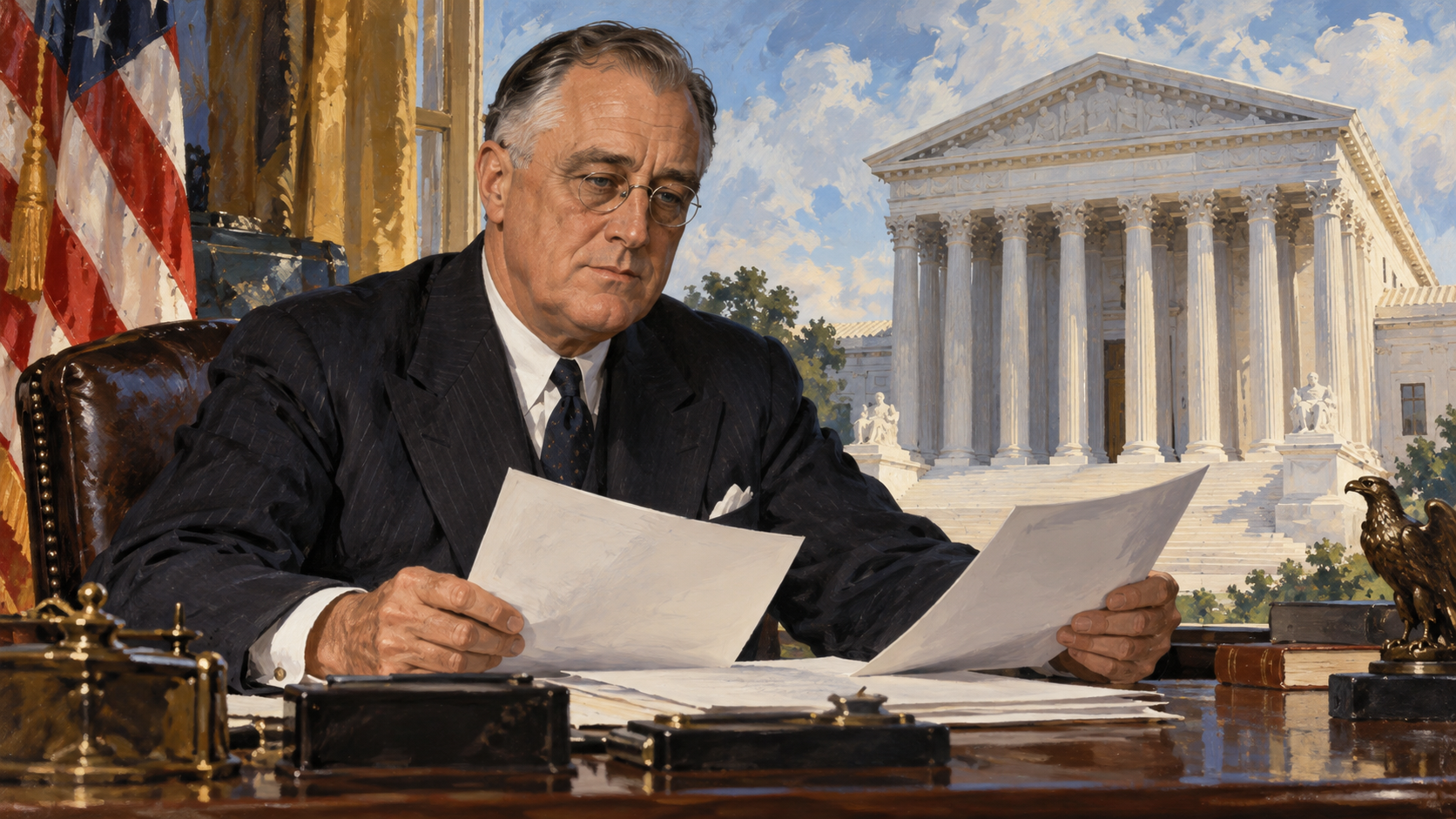
On February 5, 1937, President Franklin D. Roosevelt sent Congress a proposal in Washington to reorganize the federal judiciary. Its most controversial provision would allow additional Supreme Court appointments when older justices remained in office, potentially enlarging the Court from nine members to fifteen. The proposal followed Roosevelt’s decisive reelection and repeated judicial setbacks for his New Deal program. He presented it as a way to improve the administration of justice, while critics saw an attempt to change the Court’s ideological balance. The announcement opened a major confrontation over the relationship between elected branches and a judiciary empowered to judge the constitutionality of their actions.
Roosevelt’s message argued that crowded court calendars, slow appeals, and an aging bench were making justice costly and inaccessible. The accompanying draft bill supplied a specific mechanism: an additional judge could be appointed when an incumbent had reached seventy, had served for at least ten years, and had not retired or resigned within the prescribed six-month period. It limited the Supreme Court to fifteen members and placed separate limits on additions elsewhere in the federal system. The package also proposed administrative changes for lower courts and faster handling of constitutional questions. These details show that it was broader than a simple demand to dismiss sitting justices, whose existing positions would have remained intact.
The political setting made the Court expansion the center of the controversy. Supreme Court decisions had invalidated important New Deal measures, threatening Roosevelt’s effort to use federal power against the Depression. Additional appointments offered a route toward a more sympathetic majority, and opponents warned about judicial independence. Senate majority leader Joseph Robinson worked to advance the president’s plan despite the resistance it encountered. His death in July removed a crucial advocate at a difficult moment. Congress did not enact the proposed Supreme Court expansion, and the struggle cost Roosevelt political support. A large election victory had given the president substantial authority to pursue his program, but it did not guarantee acceptance of the institutional changes he proposed.
Meanwhile, Supreme Court decisions in 1937 began upholding regulations of kinds that had previously faced serious constitutional obstacles. The Court sustained the National Labor Relations Act in a major case involving Jones and Laughlin Steel. Those decisions encouraged the familiar explanation that political pressure had changed the Court, especially Justice Owen Roberts’s position. Legal scholars have challenged that account, so the proposal should not be presented as a proven cause of his votes. The episode’s importance lies in both its failed legislative objective and the larger constitutional argument it exposed. February 5 marks the opening of a struggle over how a government should respond when an elected reform program encounters judicial resistance, and over the limits of changing an institution to obtain different decisions.
Roosevelt's formal message emphasized delays, expense, and personnel across the federal courts. The proposed increase in Supreme Court membership attracted the greatest political attention.
The draft tied new appointments to age, service, and retirement conditions. It proposed additional seats rather than removing the justices who already held office.
The administration sought legislation from Congress. The message itself did not change the Court's membership or authorize appointments to new seats.
Joseph Robinson's support was important to the effort in the Senate. His death in July came while he was trying to rescue the contested proposal.
The proposed expansion failed, while the Court's approach to economic regulation was changing. Those overlapping developments should not be treated as proof of a single cause.
Debate over judicial independence continued beyond the immediate bill. The episode illustrates the tension between institutional safeguards and elected leaders' attempts to carry out their programs.
Explore more of "On This Day ..."
Discover more events from the same date across news, politics, technology, sports, and other fields. Each link highlights significant moments that shaped history on different fronts.