

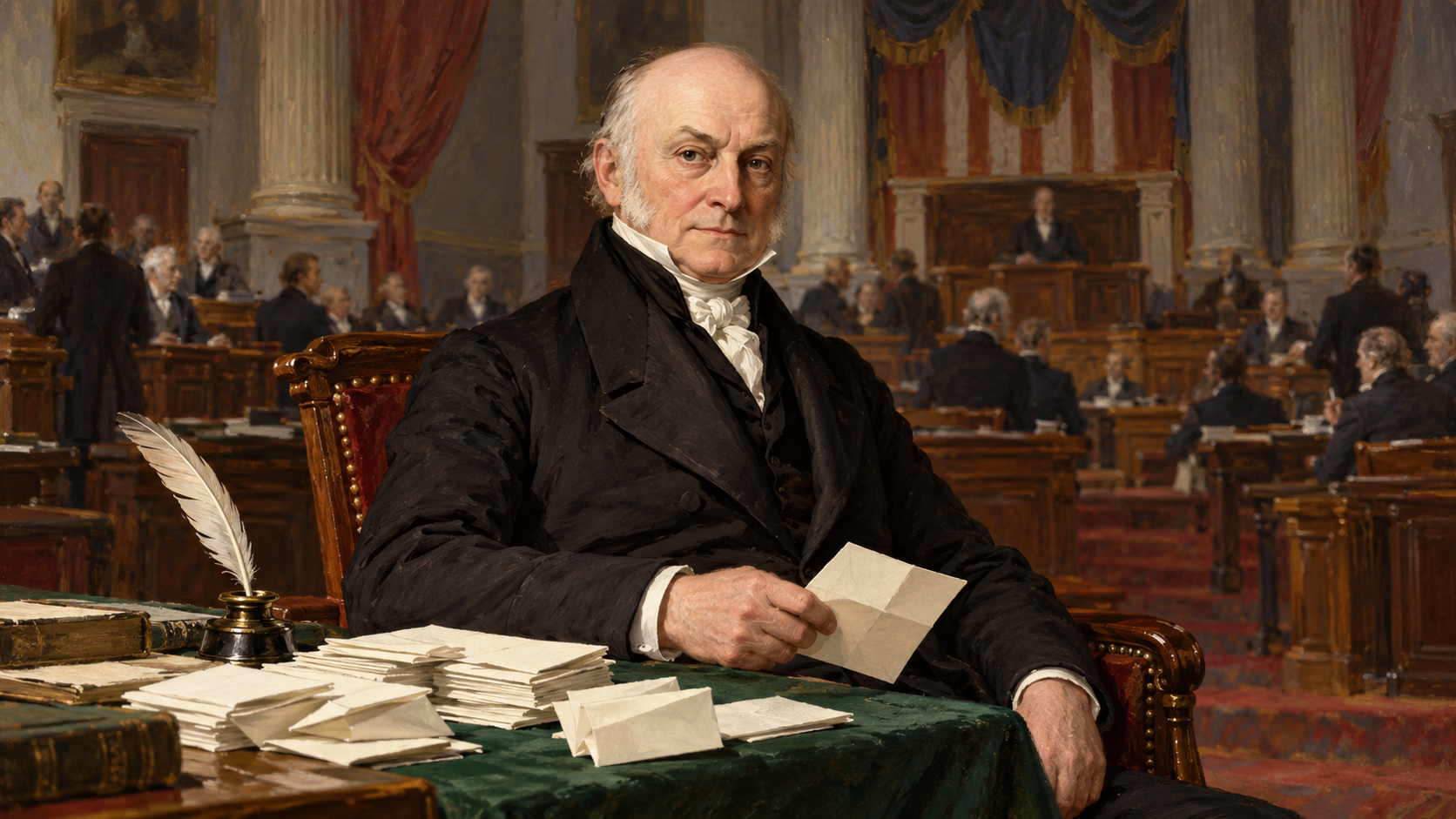
On This Day in Politics: February 9, 1825
On February 9, 1825, the United States House of Representatives elected John Quincy Adams president in Washington after the election of 1824 produced no Electoral College majority. Adams, then secretary of state, defeated Andrew Jackson and William H. Crawford in a contingent election conducted under the Twelfth Amendment. Representatives did not cast one national tally of individual House votes. Instead, each state’s delegation had one vote, and a majority of the states was required. Adams secured thirteen of the twenty-four states on the first ballot, enough to win. Jackson received seven state votes and Crawford four, bringing the formal presidential selection to a conclusion.
The unusual result emerged from competition within the dominant Democratic-Republican political tradition. Four major candidates divided the electoral vote: Jackson received ninety-nine, Adams eighty-four, Crawford forty-one, and House Speaker Henry Clay thirty-seven. Jackson led the field, but a plurality was not the constitutional majority required for election. The Twelfth Amendment directed the House to choose among the three leading presidential candidates when no one cleared that threshold. Clay therefore could not be selected in the House contest, although his position as speaker and his relationships with representatives gave his support considerable importance. The procedure shifted the decisive political arena from the states’ selection of electors to their delegations in Congress.
Clay backed Adams, whose supporters assembled the state majority needed for victory. The February vote was not a new popular election and did not give the House an unrestricted choice among potential presidents. Its eligible candidates and voting rules were set by the Constitution. That distinction explains how Adams could become president despite having fewer electoral votes than Jackson. It also helps separate the recorded outcome from the controversy surrounding it. After his election, Adams chose Clay as secretary of state. Jackson’s supporters treated that appointment as evidence of a corrupt bargain, an accusation that became central to opposition politics. The allegation should not be confused with an established finding that the two men had exchanged the office for votes.
Adams took office on March 4, 1825, several weeks after the House decision. The constitutional mechanism had produced a president, but it had not created political agreement about his mandate. The dispute intensified rivalries that helped reshape American party politics and presidential campaigning. The episode also illustrates the difference between leading an electoral contest and meeting the legal conditions for winning it. A fragmented field had activated a procedure designed for precisely that absence of a majority. February 9 remains a significant example of Congress exercising a narrowly defined role in presidential selection, while the lasting controversy shows how a procedurally valid outcome can still generate fierce disagreement over political legitimacy.
The Twelfth Amendment limited the House's choice to the top three presidential candidates in the electoral count. Fourth-place finisher Henry Clay was outside that group.
State delegations, rather than individual representatives counted together, determined the result. Thirteen states constituted a majority of the twenty-four then in the Union.
Adams won on the first House ballot. This distinguishes the 1825 decision from the prolonged House balloting that resolved the election of 1800.
Jackson's electoral lead was a plurality. With four candidates dividing the vote, that lead did not satisfy the majority requirement that would have avoided a contingent election.
The appointment of Clay as secretary of state gave opponents a powerful political charge. It does not by itself establish that an explicit bargain had been made.
The House election occurred in February; Adams's inauguration followed in March. Keeping those dates separate clarifies when he was chosen and when he began serving.
Explore more of "On This Day ..."
Discover more events from the same date across news, politics, technology, sports, and other fields. Each link highlights significant moments that shaped history on different fronts.