

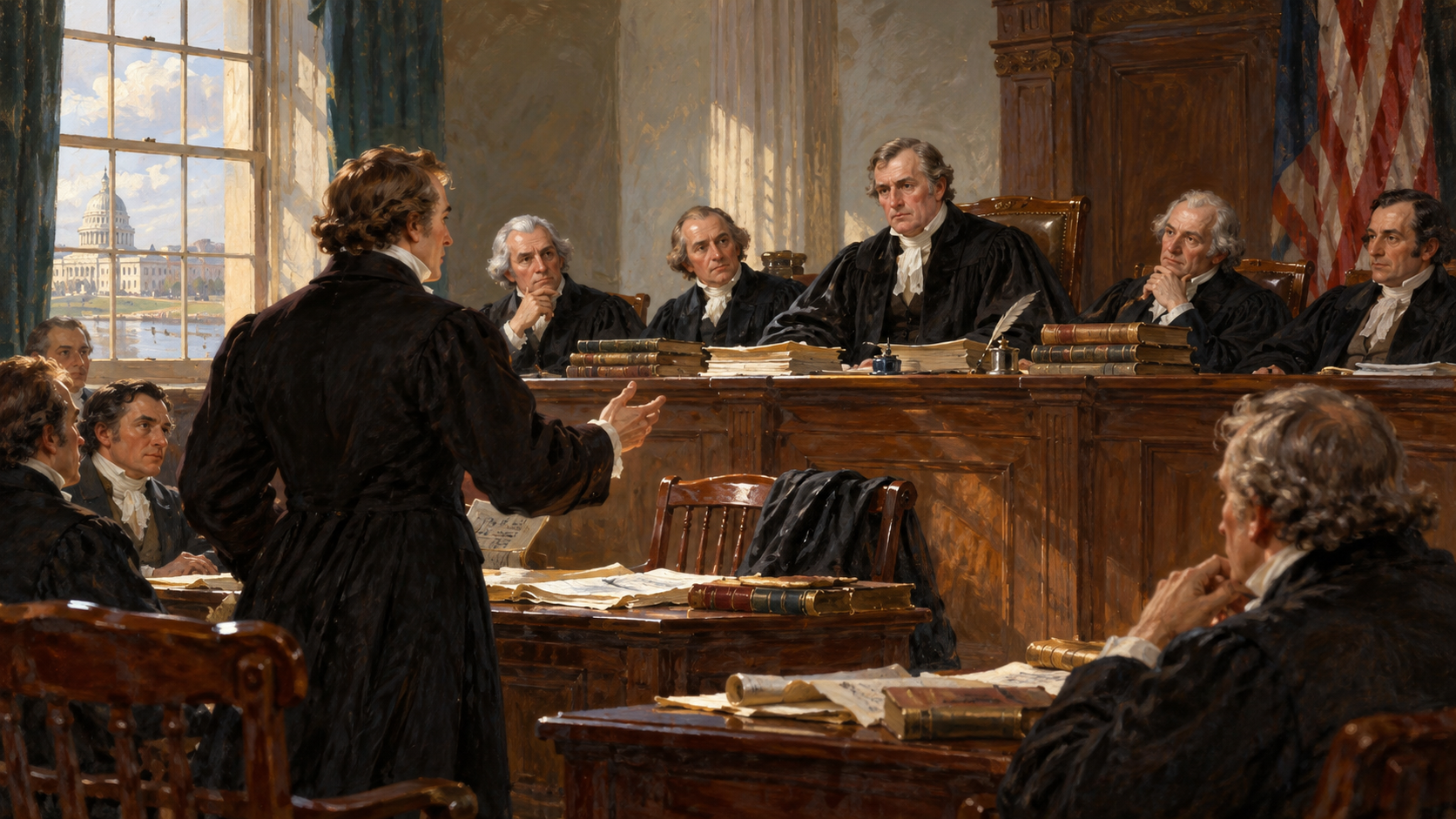
On This Day in Politics: February 24, 1803
On February 24, 1803, the United States Supreme Court decided Marbury v. Madison, a case that became a foundation of judicial review. Chief Justice John Marshall’s opinion held that the Court could not grant the order William Marbury sought because the statutory authority invoked conflicted with the Constitution. Marbury lost his immediate effort to obtain a judicial commission, yet the decision strengthened the judiciary’s ability to assess the constitutional limits of federal law. The case’s importance lies in that combination: a refusal to exercise power in one dispute helped define a far-reaching power to decide which legal rules courts could apply.
The controversy grew out of the transfer from John Adams’s presidency to Thomas Jefferson’s administration. Adams had appointed Marbury a justice of the peace for the District of Columbia, but the commission had not been delivered before the change in government. Jefferson’s secretary of state, James Madison, refused to deliver it. Marbury asked the Supreme Court for a writ of mandamus, an order directing an official to perform a duty. The disagreement was therefore tied to partisan rivalry and appointments, but it also raised questions about legal rights, official responsibility, and the jurisdiction of the Court itself.
Marshall’s reasoning separated those questions. A person might possess a legal right and still be unable to obtain a particular remedy from a particular court. The opinion examined whether the Supreme Court could hear this kind of request as an original proceeding. Marshall concluded that Congress could not expand the Court’s original jurisdiction beyond the categories established by the Constitution. To the extent that the Judiciary Act’s provision purported to authorize the requested writ in this setting, it could not govern the case. The Court thus treated the Constitution as controlling over an inconsistent act of Congress, rather than assuming that every enacted statute must be applied regardless of constitutional conflict.
The ruling did not invalidate the entire Judiciary Act or give the Court an unlimited license to decide political questions. Its lasting influence came from the argument that interpreting law requires judges to resolve conflicts between ordinary legislation and the higher authority of the Constitution. That principle became central to the American system of checks and balances, while generating continuing debate over the proper reach of judicial power. February 24 marks a decision whose institutional consequences were much larger than Marbury’s undelivered commission. The case remains a useful reminder that jurisdiction, remedies, and constitutional authority are distinct questions, and that a court’s explanation of why it cannot act may reshape the power it exercises in future disputes.
Marbury’s appointment arose during the change from Adams to Jefferson. The undelivered commission linked an individual claim to a partisan struggle over offices.
The requested writ of mandamus would have directed Madison to perform an official duty. The Court first had to determine whether it could issue it.
Marshall distinguished a legal right from the jurisdiction needed to enforce it in this proceeding.
The constitutional problem concerned the provision used to expand original jurisdiction. The decision did not strike down the entire Judiciary Act.
Judicial review made constitutional limits enforceable in cases before the courts and strengthened the judiciary’s place among the branches.
The ruling’s continuing importance lies in the relationship between higher law and ordinary statutes, alongside debate about who should interpret constitutional boundaries.
Explore more of "On This Day ..."
Discover more events from the same date across news, politics, technology, sports, and other fields. Each link highlights significant moments that shaped history on different fronts.