

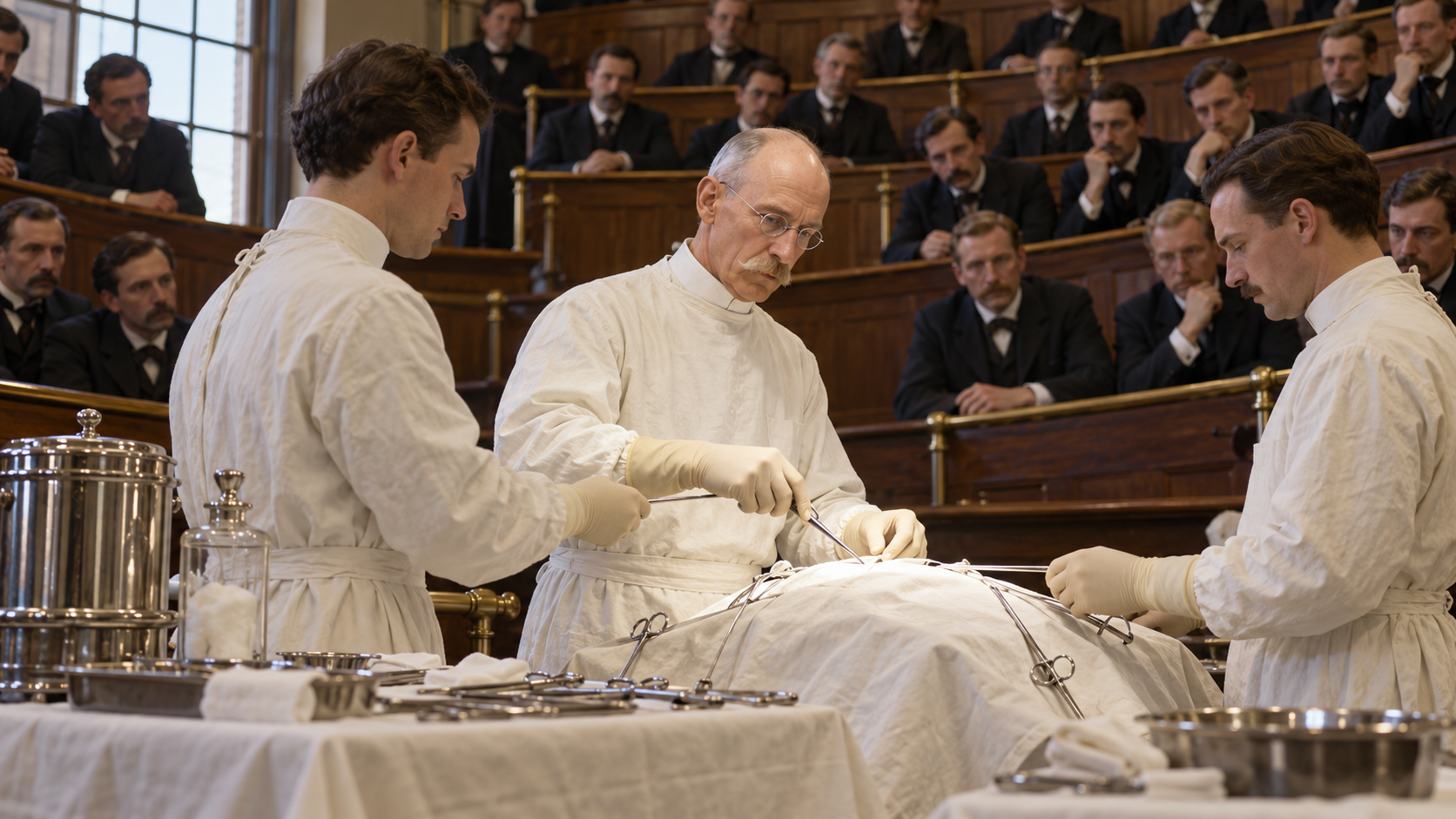
On This Day in Health: September 23, 1852
On September 23, 1852, William Stewart Halsted was born in New York City. He became the first professor of surgery at the Johns Hopkins School of Medicine and helped define a meticulous approach to tissue handling, bleeding control, sterile practice, and postgraduate surgical training. This date matters because it fixes a broad medical story to a specific moment, place, and group of people. It also shows how health history is shaped by institutions and practical choices as well as laboratory discoveries.
The background was already developing before that day. Surgery in the late nineteenth century was changing through anesthesia, germ theory, antisepsis, and new hospital laboratories. Halsted studied in Europe and returned to the United States determined to make operations more controlled. His career also became entangled with cocaine after self-experiments in local anesthesia led to dependence. Those conditions defined what participants could attempt and what patients or communities could reasonably expect. They also explain why later accounts sometimes compress years of preparation into a single anniversary. Looking at that preparation keeps credit broad and makes the turning point easier to understand without turning it into a miracle story.
What happened on the date was consequential but limited. At Johns Hopkins, Halsted emphasized gentle dissection, exact hemostasis, preservation of blood supply, and careful closure. He developed a graded residency system in which trainees assumed increasing responsibility and helped introduce thin rubber gloves after scrub nurse Caroline Hampton developed severe dermatitis from disinfectants. His influence carried serious costs. The residency model demanded extreme hours and rigid hierarchy, while his radical mastectomy removed extensive tissue and caused major disability before later trials supported less destructive surgery. His cocaine and morphine dependence was long concealed by colleagues. The distinction is important: the event did not instantly solve the underlying health problem, and later progress depended on follow-up research, training, policy, funding, and public trust. Contemporary evidence also helps separate what participants knew then from interpretations added after the result became famous.
Its longer legacy reaches beyond the original setting. Halsted's technical principles became foundations of modern surgery and his trainees spread the Hopkins model widely. At the same time, later medicine revised his operations and training culture, showing that disciplined practice must still be tested against outcomes and patient experience. His legacy is most useful when treated whole: precision and education changed surgery, while secrecy, over-treatment, and hierarchy offer equally important lessons about professional accountability. Seen in context, the anniversary is useful because it connects a concrete historical episode with continuing questions about evidence, access, safety, and responsibility in health care. That connection is stronger when the people affected, the limits of the achievement, and the work still unfinished remain part of the account.
At Johns Hopkins, Halsted emphasized gentle dissection, exact hemostasis, preservation of blood supply, and careful closure. He developed a graded residency system in which trainees assumed increasing responsibility and helped introduce thin rubber gloves after scrub nurse Caroline Hampton developed severe dermatitis from disinfectants.
His influence carried serious costs. The residency model demanded extreme hours and rigid hierarchy, while his radical mastectomy removed extensive tissue and caused major disability before later trials supported less destructive surgery. His cocaine and morphine dependence was long concealed by colleagues.
Halsted's technical principles became foundations of modern surgery and his trainees spread the Hopkins model widely. At the same time, later medicine revised his operations and training culture, showing that disciplined practice must still be tested against outcomes and patient experience.
Surgery in the late nineteenth century was changing through anesthesia, germ theory, antisepsis, and new hospital laboratories. Halsted studied in Europe and returned to the United States determined to make operations more controlled. His career also became entangled with cocaine after self-experiments in local anesthesia led to dependence.
William Stewart Halsted was born in New York City. He became the first professor of surgery at the Johns Hopkins School of Medicine and helped define a meticulous approach to tissue handling, bleeding control, sterile practice, and postgraduate surgical training.
His legacy is most useful when treated whole: precision and education changed surgery, while secrecy, over-treatment, and hierarchy offer equally important lessons about professional accountability.
Explore more of "On This Day ..."
Discover more events from the same date across news, politics, technology, sports, and other fields. Each link highlights significant moments that shaped history on different fronts.