

On This Day in Business: March 1, 1873
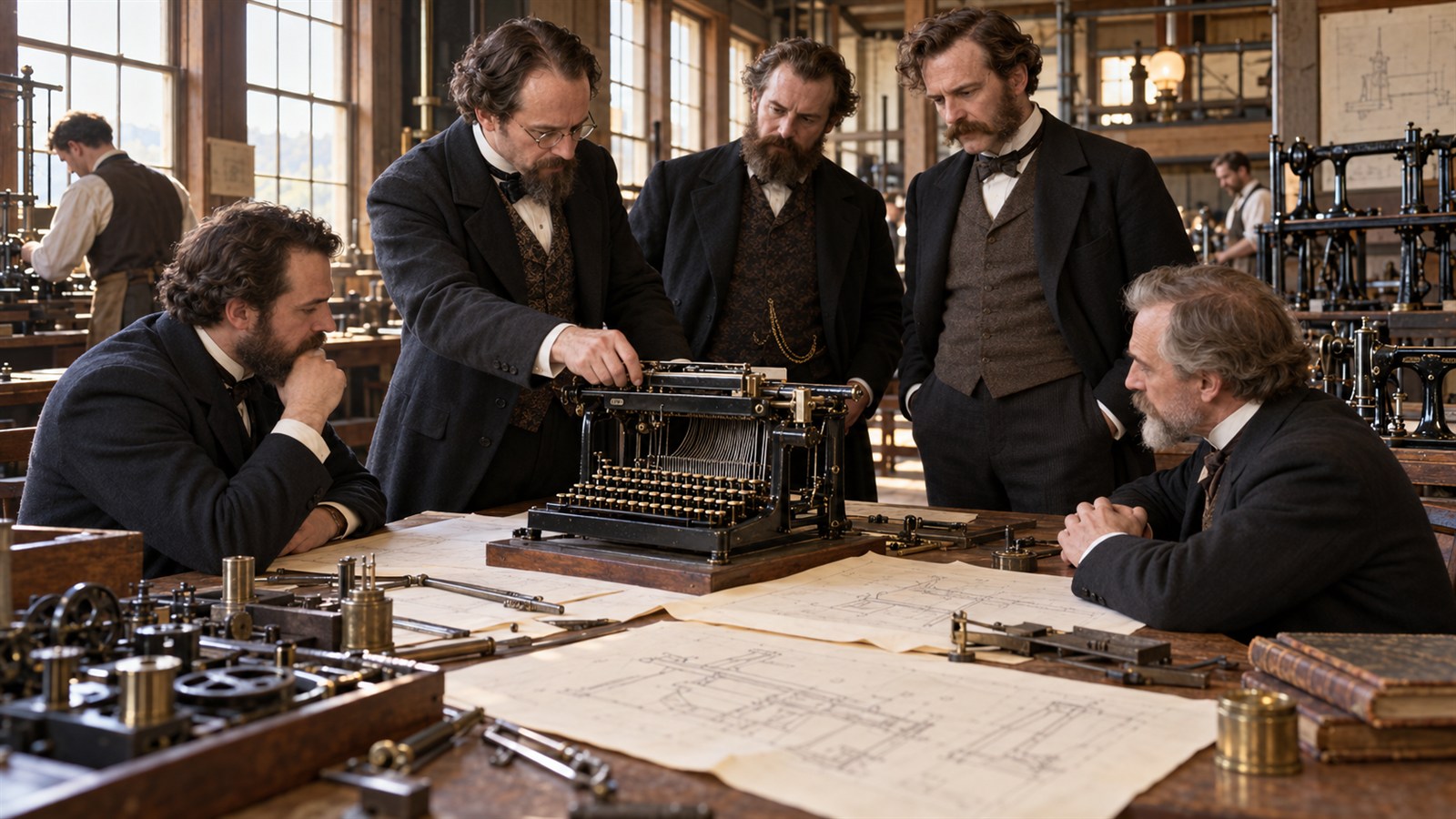
On March 1, 1873, E. Remington & Sons signed an agreement to manufacture the writing machine developed by Christopher Latham Sholes and his collaborators. The decision linked an experimental device to a company that already knew precision metalwork, interchangeable production, and national distribution. Sholes had spent years revising a machine that could place inked characters on paper through keys and type bars, but invention alone did not create a market. Remington supplied the industrial credibility and production discipline needed to move the typewriter from a workshop curiosity toward a product offices could buy, maintain, and use every day.
The arrangement was a calculated diversification for Remington. The Ilion, New York, manufacturer was known for firearms and sewing machines, businesses that required accurate machining and the assembly of many small parts. Those capabilities transferred naturally to the intricate keyboard mechanism. Remington engineers altered the design for manufacturing, gave the machine a sewing-machine-like stand, and prepared it for serial production. The first commercial units appeared the following year. Early machines were expensive, wrote only capital letters, and hid the typed line from the operator, so adoption was gradual rather than immediate.
The typewriter eventually reorganized office work. Documents became more legible and reproducible, correspondence could be produced faster, and employers began to treat typing as a specialized skill. The growing demand opened large numbers of clerical jobs to women, though wages and advancement remained unequal. It also fostered training schools, repair services, ribbon and paper suppliers, and new standards for business communication. The familiar QWERTY arrangement, rooted in Sholes's experiments and Remington's commercial machine, spread as typists and employers invested in compatible skills and equipment.
For business history, the contract shows why complementary assets matter. A talented inventor may solve a technical problem but still lack tooling, capital, quality control, sales channels, and service. An established manufacturer can provide those missing pieces while gaining entry to a new market. Remington did not merely copy a prototype; it translated an unsettled mechanism into something that could be produced repeatedly and supported after sale. The agreement therefore marks a handoff between invention and commercialization, the point at which a new way of writing began to acquire an industry around it. The timing also mattered. Offices, railroads, insurance firms, and government departments were producing more records as organizations grew in size. A machine that made writing faster and more uniform met that administrative expansion. Once firms hired trained operators, switching to an incompatible system became costly, so early keyboard and service choices influenced later competition. The typewriter was therefore not only a labor-saving device; it became part of the information infrastructure of the modern corporation.
Sholes and his partners had built successive writing-machine prototypes in Milwaukee, but making one device work was different from manufacturing hundreds of reliable machines.
Remington brought precision tooling, factory labor, capital, and a dealer network developed through firearms and sewing machines.
The March 1 agreement led to production of the Sholes and Glidden machine, later marketed as the Remington No. 1, beginning in 1874.
The product was costly and mechanically unfamiliar, and its up-strike design prevented operators from seeing a line while they typed it.
As improved models spread, typing created a new office occupation and supported schools, service shops, supply makers, and standardized document practices.
The episode became a durable example of an inventor partnering with an established manufacturer to cross the difficult gap from prototype to market.
Explore more of "On This Day ..."
Discover more events from the same date across news, politics, technology, sports, and other fields. Each link highlights significant moments that shaped history on different fronts.