

On This Day in Business: March 20, 1602
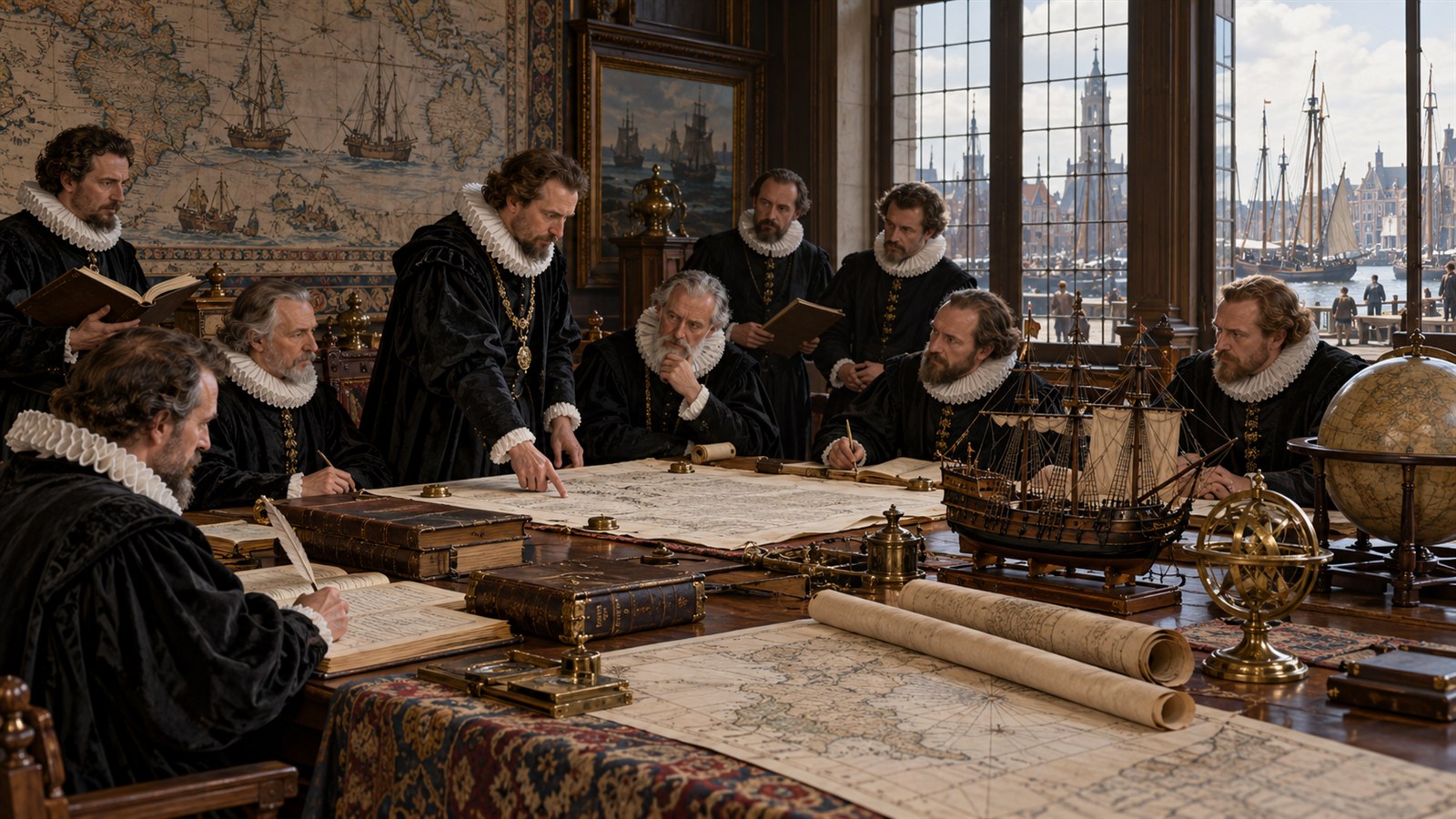
On March 20, 1602, the States General of the Netherlands granted a charter to the United East India Company, commonly known by its Dutch initials, VOC. The new organization combined competing Dutch trading ventures into one enterprise with exclusive national rights to trade east of the Cape of Good Hope and west of the Strait of Magellan. The charter was intended to reduce damaging rivalry, pool capital for expensive voyages, and strengthen the Dutch position against established Portuguese and Spanish power in Asian trade.
Long-distance commerce required ships, crews, weapons, provisions, information, and years of patience before a return. The VOC raised money from investors and gave the company a continuing capital base rather than liquidating after each voyage. Tradable shares allowed ownership to change without dismantling the enterprise. A board representing regional chambers coordinated policy, while managers and agents acted across great distances. Those arrangements helped make the company an important precedent in corporate finance, although governance and information problems remained severe.
The charter also granted powers far beyond those of an ordinary merchant. The VOC could build forts, make treaties, wage war, and administer territory in the name of the Dutch state. It used coercion and violence to control production and trade, contributing to exploitation, dispossession, and death across its sphere of operations. Profits and financial innovation cannot be separated from those human costs. The same delegated authority that enabled decisive action abroad reduced accountability to the people whose land, labor, and commerce the company controlled.
The VOC's creation influenced the development of permanent joint-stock enterprise, securities trading, and multinational administration. By pooling risk and allowing capital to persist across voyages, it could invest on a scale unavailable to most individual merchants. Yet its history also exposes the danger of combining commercial incentives with state-backed force and weak oversight. March 20, 1602, therefore marks both an institutional innovation and a warning. Corporate structures can mobilize capital and coordinate complex operations, but their efficiency does not determine whether their conduct is legitimate or their gains are justly obtained. The VOC also exposed the principal-agent problem at global scale. Investors in the Netherlands depended on directors, who in turn relied on officials thousands of miles away with slow communications and broad discretion. Information could take months to arrive, making oversight weak and self-dealing difficult to detect. Accounting and governance practices developed partly to manage that distance, but formal systems never neutralized the incentives created by monopoly power and coercion. Financial sophistication and ethical conduct advanced on separate tracks.
Several Dutch companies competed for Asian trade, raising costs and weakening their position against larger Iberian maritime empires.
Government and merchants sought a single organization that could pool capital, coordinate voyages, and pursue a national trading strategy.
The March 20 charter created the VOC with exclusive trading rights and a durable joint-stock structure supported by regional chambers.
Its extraordinary authority included diplomacy, forts, armed force, and territorial administration, producing profound violence and exploitation.
The company helped develop permanent capital, transferable shares, securities markets, and management across widely separated operations.
Its legacy joins major financial innovation with a lasting warning about monopoly, colonial coercion, delegated power, and inadequate accountability.
Explore more of "On This Day ..."
Discover more events from the same date across news, politics, technology, sports, and other fields. Each link highlights significant moments that shaped history on different fronts.