

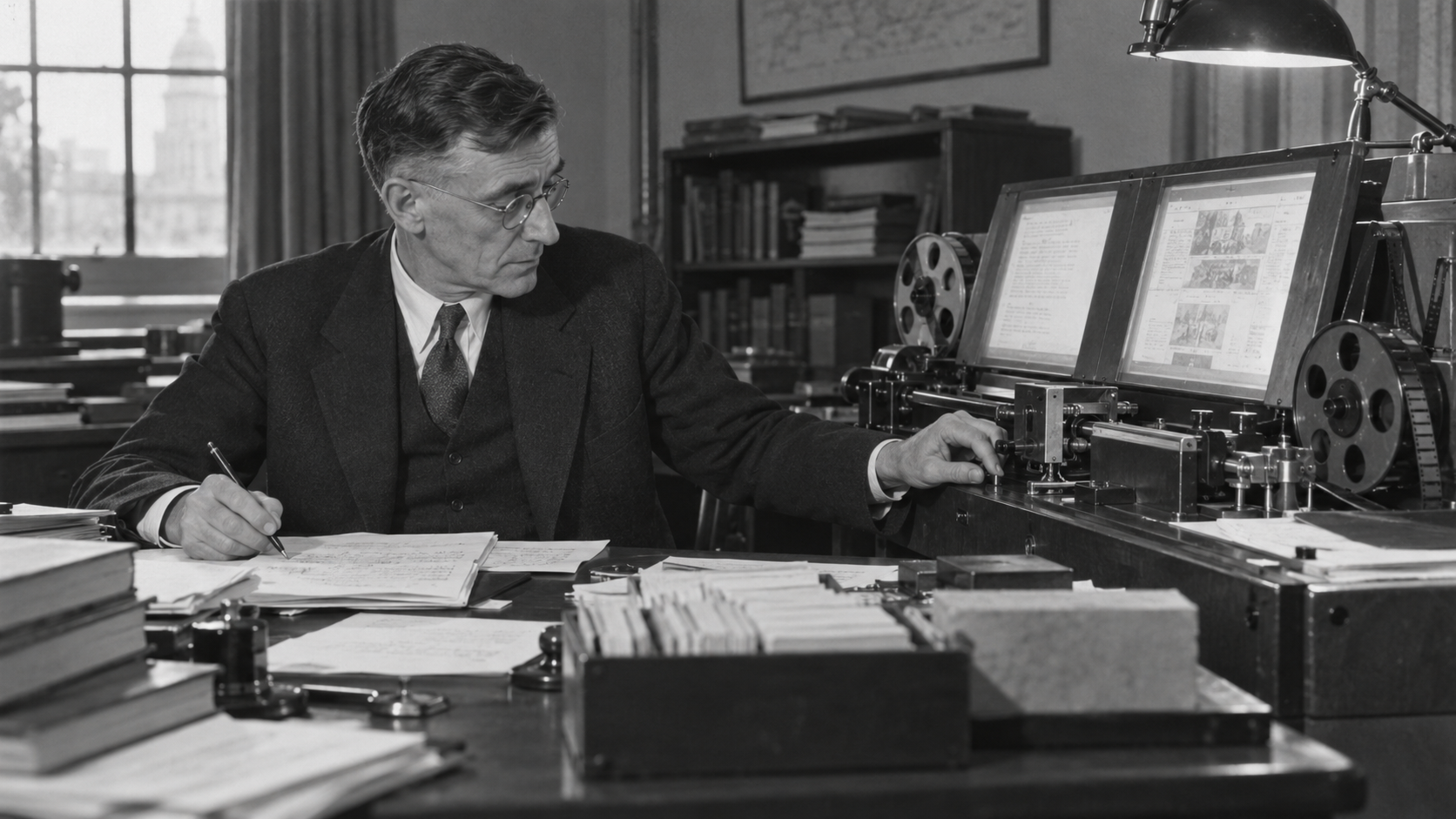
“Consider a future device for individual use, which is a sort of mechanized private file and library.”
Vannevar Bush introduced this device—the “memex”—in his 1945 Atlantic essay “As We May Think.” As the Second World War ended, Bush asked how scientists might redirect their methods toward organizing the rapidly expanding record of human knowledge. Books, journals, photographs, and notes were accumulating faster than any one person could consult them. His proposed answer was a desk-like machine that would store large collections and help an individual retrieve and connect them.
The memex was imagined with the technology of its time: microfilm, screens, levers, and photographic mechanisms rather than digital computers and networks. Its most influential feature was not compact storage alone. Bush emphasized “associative trails,” paths linking one item to another in the way a person might move among related ideas. A reader could build a trail, annotate it, return to it, and share a copy. That concept later resonated with pioneers of hypertext and personal computing.
It is tempting to treat the essay as a precise prediction of the modern web. That overstates the case. The memex was private and centered on an individual’s collection; it did not describe the Internet’s packet-switched infrastructure, search engines, or vast public platforms. Bush’s achievement was conceptual. He identified a problem of information abundance and proposed tools that would augment human memory by preserving relationships among sources. The distinction keeps the history honest while making the idea more useful.
Today’s browsers, note-taking systems, digital libraries, recommendation tools, and knowledge graphs all address pieces of the challenge Bush described. They also reveal complications his mechanical sketch did not fully resolve. Links decay, search rankings shape attention, recommendation systems can narrow perspectives, and personal archives depend on formats and services that may disappear. The memex remains a productive standard because it asks whether technology helps people understand knowledge, not merely accumulate it. Good tools should make sources traceable, connections editable, and context recoverable. They should support deliberate inquiry rather than replace it with an endless stream. Bush’s quote is therefore less a prophecy than an invitation to design. As information grows, people need systems that extend memory while preserving judgment, authorship, and the paths by which an idea was reached.
Bush published “As We May Think” in 1945, reflecting on how scientific tools might help manage a rapidly growing body of recorded knowledge.
He described the memex as a personal desk-like system using microfilm and mechanical controls, not as a digital network.
The central innovation was associative linking. Users could connect items into trails, annotate those paths, revisit them, and share copies.
Calling the memex a direct prediction of the web misses important differences. Its lasting power lies in the design concept, not exact technical foresight.
Modern search, hypertext, personal notes, and digital libraries pursue parts of Bush’s goal while introducing new problems of trust and attention.
The quote challenges designers to make knowledge systems navigable and accountable, preserving sources and context rather than maximizing accumulation alone.
Explore more "Quotes of The Day"
Discover more notable quotes from influential voices across politics, science, business, technology, sports, and culture. Each quote offers insight into how ideas, beliefs, and decisions shape the world around us.