

On This Day in Lifestyles: March 14, 1988
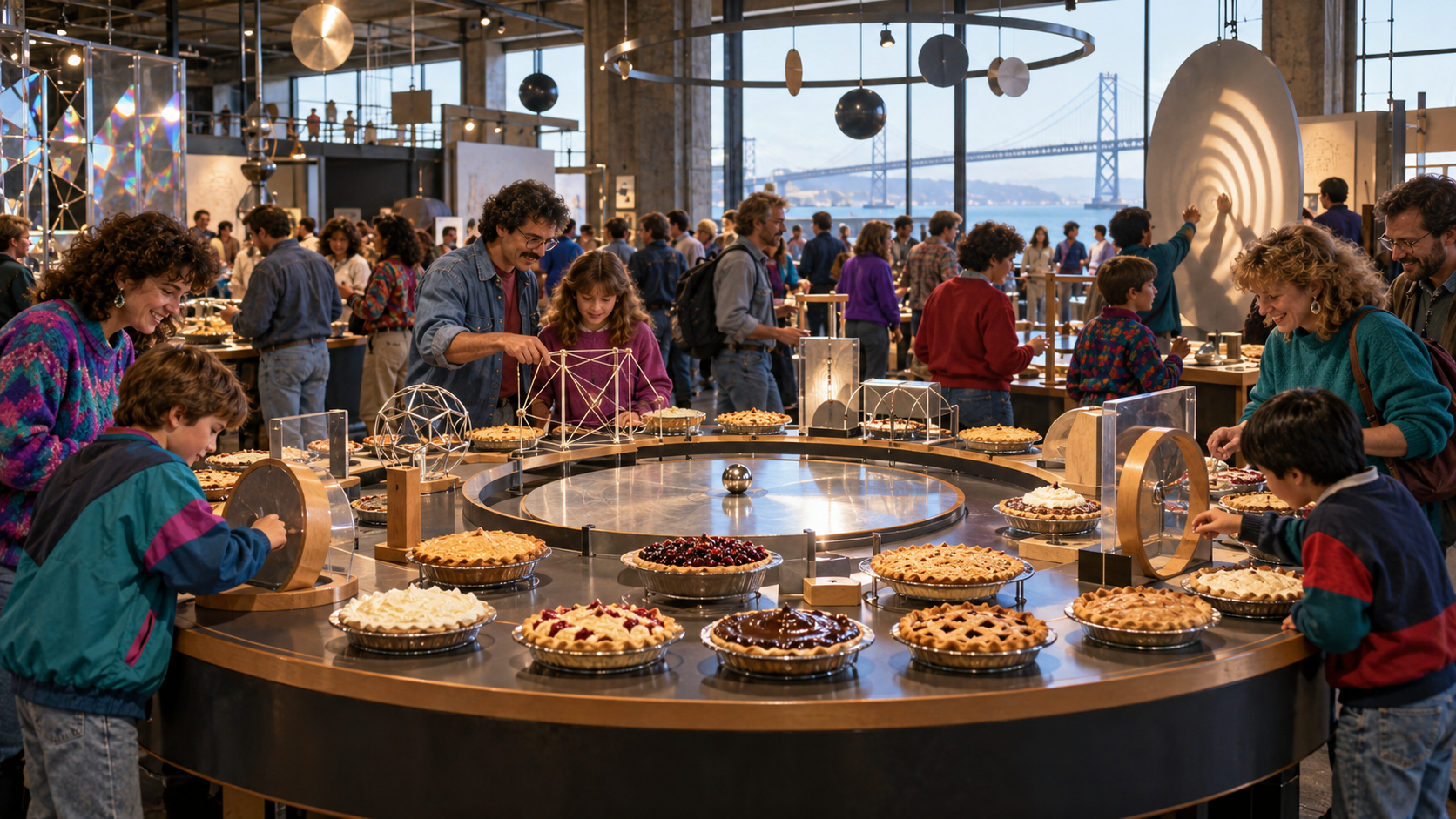
On March 14, 1988, Physicist Larry Shaw organized the first known Pi Day celebration at San Francisco’s Exploratorium. Staff and visitors marked 3/14 by walking around a circular space and sharing pie, turning the digits associated with the ratio of a circle’s circumference to its diameter into an approachable museum ritual. The date matters in lifestyle history because an abstract constant became the center of a friendly public ritual. Rather than remaining an isolated announcement or demonstration, the moment gave people a new way to think about measuring circles, solving puzzles, sharing pie, making art, and celebrating mathematical curiosity. Its importance became visible through familiar places, objects, and routines, where a broad historical change could be felt at human scale.
The date worked as a playful memory aid in the month-day format used in the United States. The Exploratorium’s hands-on culture made an ideal setting: abstract mathematics could be explored through movement, food, shapes, measurement, and conversation rather than a worksheet alone. The setting shaped how contemporaries understood the event. museum staff, teachers, students, families, mathematicians, bakers, and science enthusiasts encountered it through museum demonstrations, classrooms, libraries, public events, social media, contests, and community baking. Those details show that social change usually travels through ordinary systems such as workplaces, schools, shops, homes, streets, or public institutions. What seems inevitable in hindsight depended on people testing, organizing, purchasing, teaching, maintaining, or protecting the idea in real time.
Pi Day spread through schools, universities, libraries, bakeries, science museums, and online communities. Competitions to recite digits coexist with geometry demonstrations, art projects, jokes, and literal pies, giving teachers many entry points for learners who might otherwise find mathematics intimidating. In daily life, people used humor, food, and hands-on experiments to approach a concept that can seem remote on the page. The episode also exposed questions about playful outreach versus superficial gimmick and memorization versus deeper mathematical understanding. Access and influence were never perfectly even, and later generations adapted the original development to different communities, values, and technologies. Still, the event changed expectations by making a welcoming doorway into mathematics easier to imagine, recognize, or demand.
Congress later recognized March 14 as a day supporting mathematics education, and the date also became associated with Albert Einstein’s birthday. The celebration endures because it treats curiosity as social and enjoyable without reducing mathematics to trivia. Today, echoes remain in school projects, museum programs, pie sales, digit-recitation contests, geometry activities, and public enthusiasm for science. Looking back helps separate the documented milestone from the myths that often accumulate around famous anniversaries. It also reminds us that lifestyle history is built from choices about design, health, work, leisure, communication, memory, and public space. On this day, the Exploratorium gathering proved that serious ideas can travel through delight.
Physicist Larry Shaw organized the first known Pi Day celebration at San Francisco’s Exploratorium. Staff and visitors marked 3/14 by walking around a circular space and sharing pie, turning the digits associated with the ratio of a circle’s circumference to its diameter into an approachable museum ritual.
The date worked as a playful memory aid in the month-day format used in the United States. The Exploratorium’s hands-on culture made an ideal setting: abstract mathematics could be explored through movement, food, shapes, measurement, and conversation rather than a worksheet alone.
Pi Day spread through schools, universities, libraries, bakeries, science museums, and online communities. Competitions to recite digits coexist with geometry demonstrations, art projects, jokes, and literal pies, giving teachers many entry points for learners who might otherwise find mathematics intimidating.
The larger theme was that an abstract constant became the center of a friendly public ritual.
Congress later recognized March 14 as a day supporting mathematics education, and the date also became associated with Albert Einstein’s birthday. The celebration endures because it treats curiosity as social and enjoyable without reducing mathematics to trivia.
Today the story remains visible in school projects, museum programs, pie sales, digit-recitation contests, geometry activities, and public enthusiasm for science.
Explore more of “This Day in Lifestyles”
Discover more moments in everyday life, design, education, travel, food, fashion, and culture. Each story connects a calendar date with an event that changed how people lived.