

Mayonnaise Emulsion Explainer
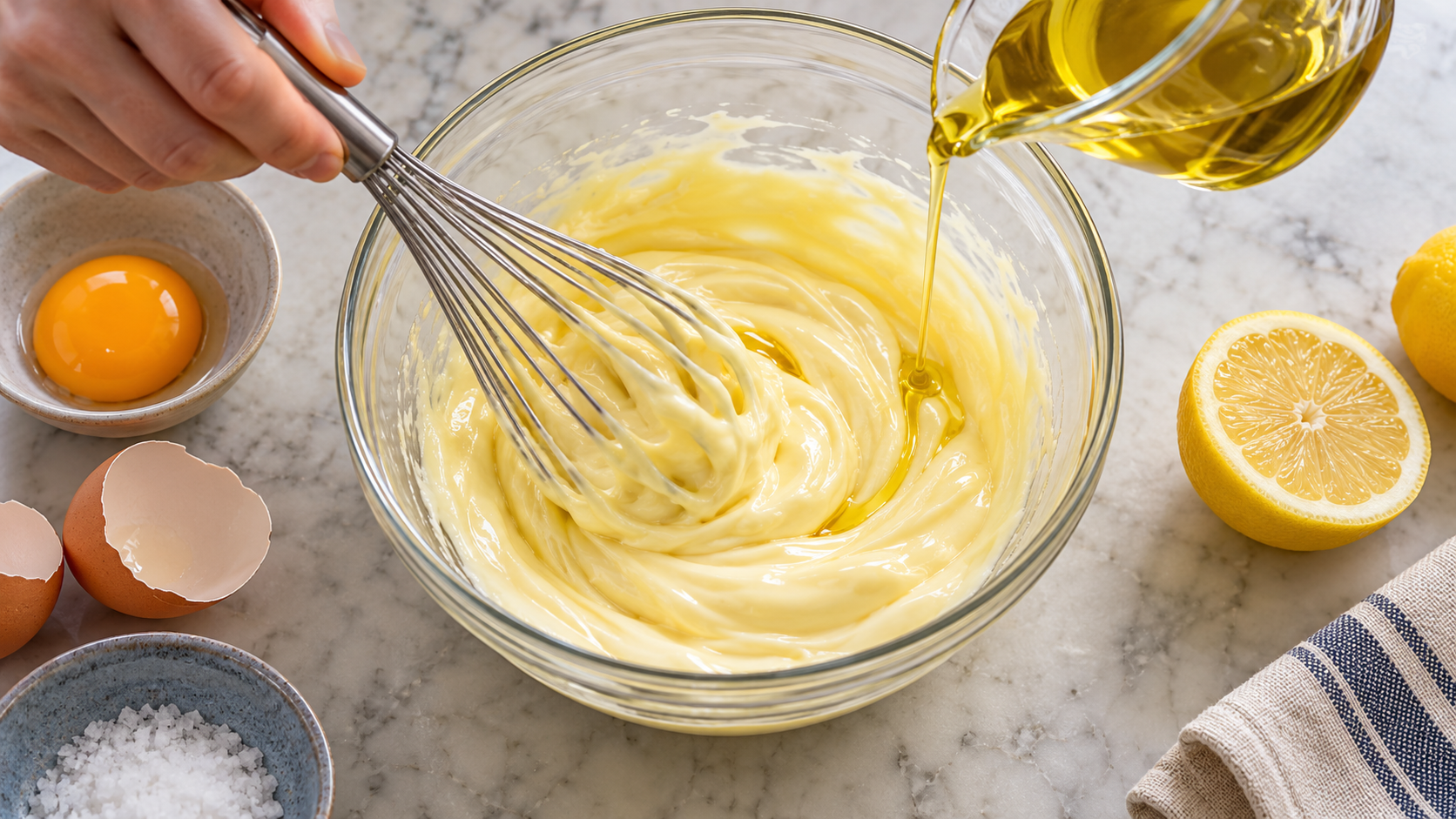
Mayonnaise combines a large amount of oil with a smaller water phase supplied by egg yolk, lemon juice, vinegar, or other ingredients. Oil and water normally separate because their molecules interact differently. Whisking breaks the oil into tiny droplets dispersed through the watery phase. Molecules in egg yolk, especially phospholipids such as lecithin, gather at each oil-water boundary. One part of each molecule interacts with water and another with oil, forming a coating that discourages neighboring droplets from merging.
The mixture is called an oil-in-water emulsion because oil is the dispersed phase and water is the continuous phase. As more oil is divided into smaller droplets, the total interfacial area grows enormously and the sauce thickens. The droplets crowd one another and cannot move freely, creating the familiar spoonable texture even though neither the oil nor the watery ingredients are thick alone. Whisking, blending, or processing supplies the mechanical energy needed to create and repeatedly subdivide those droplets.
Oil is usually added slowly at the beginning because the initial amount of yolk and water can stabilize only a limited new surface at once. If too much oil arrives before it is divided and coated, droplets collide and coalesce into a separate slick. Once a stable emulsion has formed, oil can be incorporated faster, though the equipment and quantity still matter. Mustard contributes flavor and additional emulsifying particles, while acid changes taste and pH and may influence protein behavior and microbial safety.
Temperature affects viscosity and how readily ingredients combine. Extremely cold oil moves slowly, while very warm ingredients can alter yolk proteins; using ingredients near the recipe’s recommended temperature makes behavior more predictable. A broken mayonnaise can sometimes be rescued by starting a fresh small water-and-yolk base and gradually whisking the separated mixture into it. The goal is not to stir the visible oil harder in place, but to create new stable interfaces and feed the failed emulsion into them slowly.
Homemade mayonnaise made with raw shell eggs can carry food-safety risk. Pasteurized egg products are the safer choice for preparations that will not be cooked, especially for vulnerable people. Clean utensils, refrigeration, fresh ingredients, and short storage are important. Commercial mayonnaise uses controlled formulations, pasteurized ingredients, acidity, and manufacturing practices that home recipes do not necessarily reproduce. Visual stability alone does not prove a sauce is microbiologically safe.
The apparent contradiction of mayonnaise—mostly oil yet not oily in texture—comes from scale. Oil is divided into millions of droplets, each wrapped at an interface and packed into a continuous watery network. If those protective films weaken or droplets grow by merging, the sauce thins and separates. A successful mayonnaise is therefore a balance of chemistry and process: enough emulsifier, enough water, controlled oil addition, and mechanical work that makes many small droplets instead of a few large ones.
Whisking breaks oil into tiny droplets, and egg-yolk emulsifiers coat each oil-water boundary so droplets resist merging. Key terms include emulsion, dispersed phase, continuous phase, lecithin, interface, droplet, coalescence, and viscosity.
The small starting water phase and emulsifier can coat only so much new droplet surface. A large early addition merges faster than it can be stabilized.
Finely divided oil droplets become densely packed in the continuous water phase. Their crowding resists flow, producing a thick sauce from otherwise fluid ingredients.
Explore more "Explainers"
Discover additional explainers across politics, science, business, technology, and other fields. Each explainer breaks down a complex idea into clear, everyday language—helping you better understand how major concepts, systems, and debates shape the world around us.