

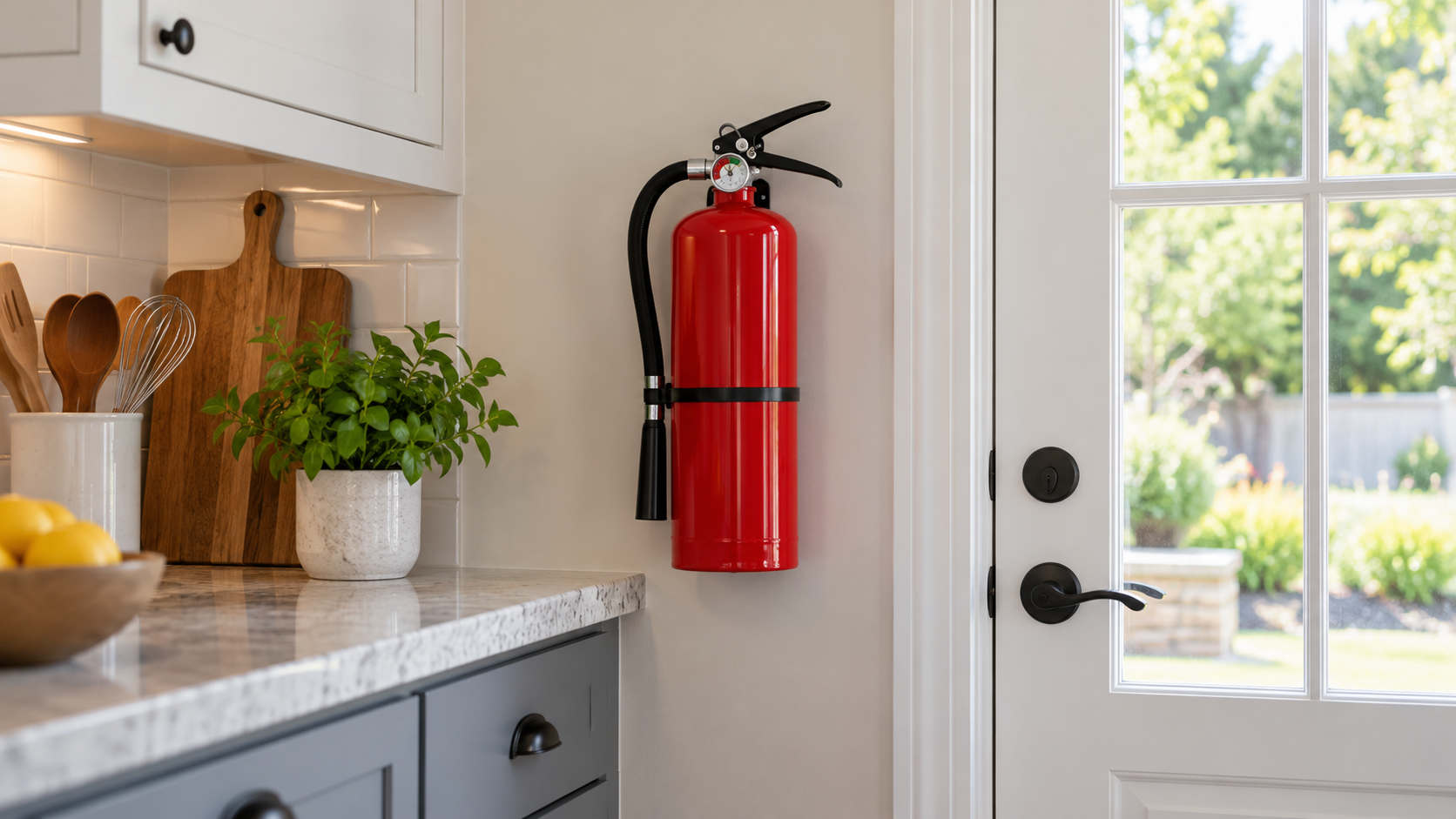
Portable Fire Extinguisher Explainer
A portable fire extinguisher stops a small fire by delivering an extinguishing agent that removes at least one requirement of combustion. Water absorbs heat, carbon dioxide displaces oxygen near the flame, foam can separate fuel from air, and dry chemical can interrupt the chain reactions that sustain burning. The metal cylinder stores the agent and, in most common models, compressed gas provides the force to expel it. Pulling the safety pin allows the operating lever to open a valve connected to the hose or nozzle.
Squeezing the handles pushes a valve stem against its seal. Pressurized gas then drives liquid or powder through an internal siphon tube and out of the discharge hose. The nozzle shapes the flow so the user can direct it at the base of the fire, where fuel is burning, rather than at the tops of the flames. Releasing the handle lets the spring close the valve on rechargeable designs, although remaining pressure and the condition of the seal determine whether the unit can hold its charge afterward.
Fire classes identify fuels and the agents that can be used safely. Class A covers ordinary combustibles such as wood, paper, and cloth. Class B covers flammable liquids, Class C involves energized electrical equipment, Class D covers combustible metals, and Class K addresses cooking oils and fats. A multipurpose dry-chemical extinguisher may carry several ratings, but one product is not right for every fire. Applying water to burning oil, energized equipment, or reactive metal can spread danger rather than reduce it.
The familiar PASS sequence means pull the pin, aim low, squeeze the lever, and sweep from side to side. That technique matters only after a person has alerted others, has a clear exit behind them, knows the extinguisher matches the fuel, and faces a small contained fire. Smoke, rapid growth, ceiling involvement, an uncertain fuel, or loss of an escape route are reasons to leave immediately, close doors if possible, and call emergency services from outside.
A pressure gauge, when fitted, shows whether stored pressure is in the usable range; it does not prove that powder is free-flowing or that every part will operate. The cylinder, hose, nozzle, handle, pin, tamper seal, and mounting location need regular checks. Corrosion, dents, leakage, blocked access, or an expired inspection interval require service. Some units can be recharged after use, while disposable types must be replaced. Even a short discharge usually means the extinguisher should be serviced.
An extinguisher is a limited first-aid tool for fire, not a substitute for alarms, sprinklers, escape planning, and the fire department. Its small cylinder empties quickly, and smoke can become disabling before flames appear large. The mechanism is straightforward—open a valve and use stored pressure to place the correct agent on the fuel—but the decision to use it carries the greater safety burden. Training lets a person recognize when a controlled attempt is reasonable and when immediate evacuation is the only sound response.
Opening the handle valve lets stored pressure drive an extinguishing agent through a tube and nozzle. The agent cools, smothers, or interrupts combustion. Key terms include fire class, agent, propellant, siphon tube, valve, nozzle, PASS, and pressure gauge.
The base is where fuel is burning. Directing the suitable agent there interrupts combustion more effectively than spraying through the visible tops of the flames.
Leave when the fire is growing, smoke is heavy, the fuel is uncertain, the extinguisher is wrong, or the exit is not clear. Call emergency services from outside.
Explore more "Explainers"
Discover additional explainers across politics, science, business, technology, and other fields. Each explainer breaks down a complex idea into clear, everyday language—helping you better understand how major concepts, systems, and debates shape the world around us.