

Coffee Brewing Extraction Explainer
Brewing coffee is a controlled extraction. Roasting creates and transforms thousands of compounds inside porous coffee beans. Grinding exposes more surface and opens paths into each particle. When water contacts the grounds, soluble material dissolves and diffuses into the surrounding liquid. The moving brew then carries those compounds through a filter or away from the bed. Acids, aroma molecules, sugars, melanoidins, caffeine, and bitter compounds do not all dissolve at the same rate, so the process changes flavor as it proceeds.
Grind size controls both surface area and water movement. Fine particles expose more area and provide short diffusion distances, accelerating extraction, but they also create greater resistance in a filter bed. Coarse particles extract more slowly and allow faster flow. A grind that is too coarse for the contact time can leave the cup weak or sharply sour; one too fine can slow the brew and emphasize bitterness or astringency. These descriptions are tendencies, not fixed rules, because roast, water, ratio, and method interact.
Hotter water generally extracts soluble compounds faster and melts some oils more readily. Very low temperature can still brew coffee, but it requires much more contact time. Water chemistry matters because dissolved minerals buffer acids and interact with flavor compounds. Water that is extremely hard, soft, alkaline, or strongly chlorinated can mute or distort the result. Because brewed coffee is mostly water, the brewing supply must be safe, fresh, and suitable before precise equipment adjustments can make much difference.
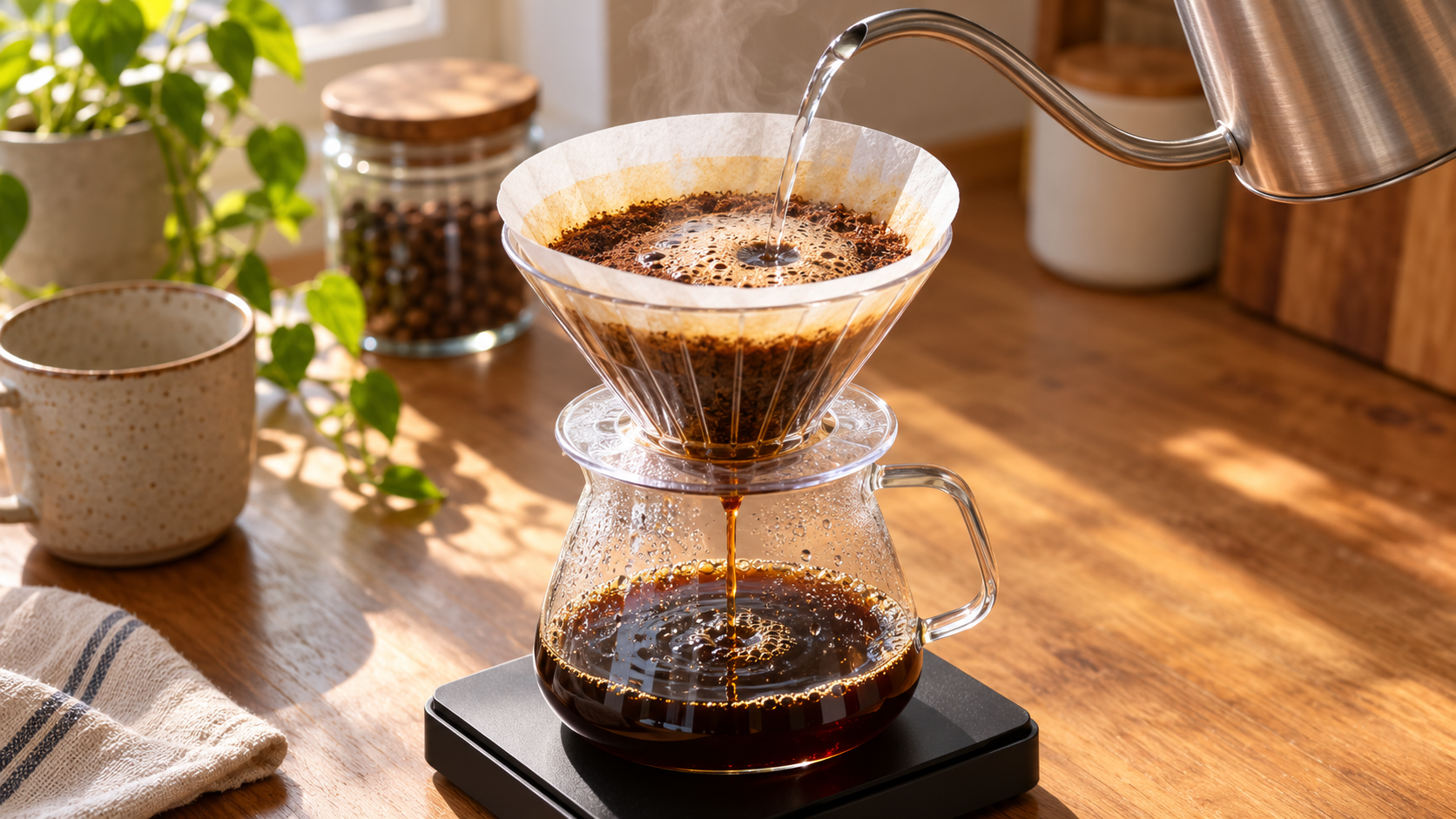
Even wetting is as important as average time. Dry pockets remain underextracted while channels let water bypass much of the bed. Pour-over brewers use controlled pouring and sometimes gentle agitation to distribute water. Fresh roasted coffee releases carbon dioxide, causing the bloom that lifts and separates grounds; an initial wetting period helps gas escape before the main pour. Automatic brewers are evaluated for contact, temperature, and how uniformly water reaches the basket, not merely for how hot the carafe becomes.
Brewers describe strength as the concentration of dissolved coffee in the beverage and extraction yield as the fraction of dry coffee mass removed. A strong cup can be underextracted if a large dose produces high concentration but water removes only a small fraction from each particle. Conversely, a weaker drink can be highly extracted after dilution. Ratio, grind, and brew time should therefore be adjusted with taste and method together. Maximizing extraction is not the goal; balanced extraction is.
After brewing, volatile aromas escape and heat drives continuing chemical change, so long holding on a hot plate can flatten flavor. Clean equipment matters because old coffee oils oxidize and add rancid notes. The useful mental model is water traveling into particles, dissolving accessible material, and carrying it out. Every variable changes one of those steps. A repeatable ratio and grind provide a baseline, and small changes then reveal whether the cup needs more or less extraction rather than random changes to everything at once.
Water moves into roasted coffee particles, dissolves soluble compounds, and carries them into the beverage. Key terms include extraction, solubles, diffusion, grind size, contact time, agitation, brew ratio, strength, and extraction yield.
It exposes more surface area and shortens the distance compounds travel to reach water. In filtered methods it also slows flow, extending contact.
No. Strength is concentration in the cup. Extraction yield is the fraction removed from the grounds, so dose and dilution can change one without matching the other.
Explore more "Explainers"
Discover additional explainers across politics, science, business, technology, and other fields. Each explainer breaks down a complex idea into clear, everyday language—helping you better understand how major concepts, systems, and debates shape the world around us.