

Meringue Foam Structure Explainer
Egg white is mostly water with a mixture of proteins folded into compact shapes. Whisking drags air into the liquid and subjects those proteins to mechanical stress. Some unfold, or denature, exposing regions that prefer water and regions that avoid it. At the air-water boundary, the water-repelling parts orient toward the bubble while water-attracted parts remain in the liquid. The proteins also link with one another, creating a flexible film around millions of bubbles and turning transparent egg white into an opaque foam.
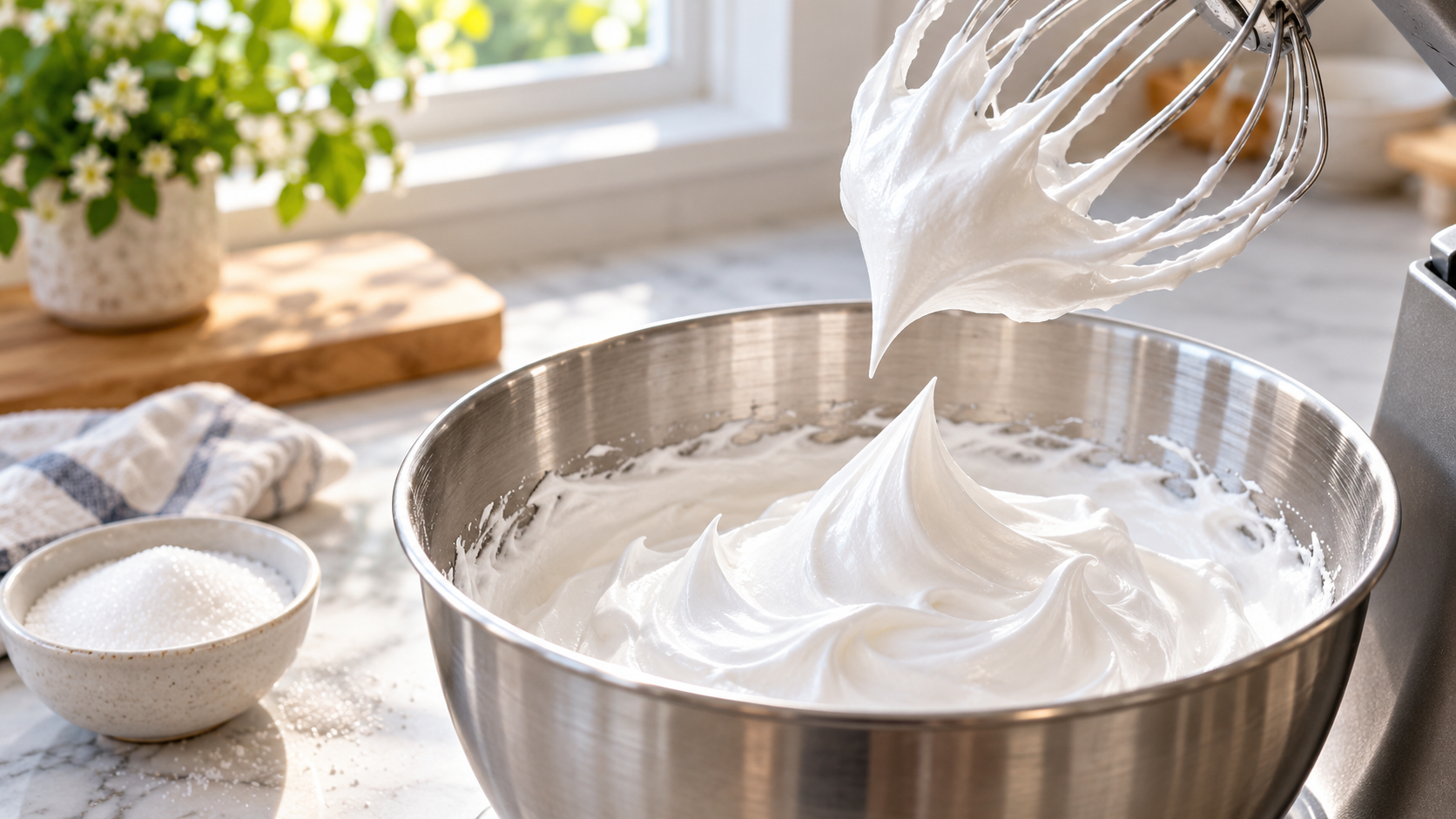
At first, bubbles are large and unstable. Continued whipping divides them, spreads protein over more interface, and thickens the network. Soft peaks indicate a foam that holds shape but remains elastic. Stiff peaks contain more incorporated air and a stronger network. Overbeating drives proteins into excessively tight clumps, squeezes out water, and leaves a grainy, dry foam that can collapse. The right endpoint depends on whether the meringue will be folded into batter, piped, poached, or baked.
Sugar dissolves in the water phase and slows drainage between bubbles. It also raises viscosity and helps the finished structure retain moisture, producing a finer, more stable foam. Added too early or too quickly, sugar weighs down the liquid and delays expansion; added gradually after a preliminary foam forms, it can dissolve while the network develops. Undissolved crystals can encourage weeping or a rough surface. The recipe’s sugar amount also determines whether the result is tender, marshmallow-like, or crisp.
A small amount of acid, such as cream of tartar or lemon juice, lowers pH and can help proteins form a stable network without bonding too aggressively. Salt may improve flavor but can reduce foam stability when added early. Fat is especially disruptive because it competes at the air-water interface and interferes with protein films. A trace of yolk, oily residue, or grease on the bowl can sharply reduce volume, so clean glass or metal equipment and careful egg separation matter.
Heating completes many meringues by further denaturing and cross-linking proteins around the bubbles. In a baked shell, water evaporates and sugar helps create a rigid porous structure. In cooked styles, hot syrup or gentle heating thickens and stabilizes the foam before final use. Food safety depends on reaching a validated time and temperature or using pasteurized egg products. A browned exterior or firm peak alone does not confirm that a raw-egg preparation received adequate heat.
A stable meringue is neither simply beaten air nor solid egg. It is a wet protein network engineered at countless microscopic boundaries. Whipping creates surface, proteins wrap that surface, sugar manages the liquid films, and heat may lock the architecture in place. The same explanation clarifies common failures: fat prevents films, coarse bubbles collapse, overbeating makes the network brittle, and humidity lets sugar attract water. Technique works because each step protects the thin walls between bubbles.
Whipping unfolds egg-white proteins, which arrange around air bubbles and bond into a network. Sugar slows drainage and heat can set the films. Key terms include foam, denaturation, interface, protein film, soft peak, stiff peak, drainage, and coagulation.
Yolk contains fat, which competes at the air-water interface and disrupts the protein films needed to surround and stabilize bubbles.
Yes. Proteins can bond too tightly, squeeze out water, and create a dry grainy foam that has lost the elasticity needed to expand or hold together.
Explore more "Explainers"
Discover additional explainers across politics, science, business, technology, and other fields. Each explainer breaks down a complex idea into clear, everyday language—helping you better understand how major concepts, systems, and debates shape the world around us.